
World Order by Henry Kissinger

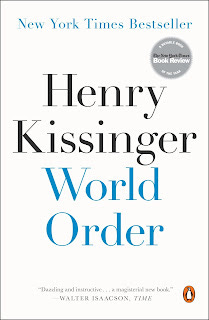
World Order by Henry Kissinger is a primer to the various concepts of foreign policy and nationalism across the world, with notes and questions for how it all my tie in to a modern world order. Kissinger bases the book on two notions of order which form statesmanship -- legitimacy and power. The chapters are organized geopolitically and the content is set across broad lengths of time (depending on the region in discussion).
Summary:
--
The main geopolitical areas I learned about were: Europe, Middle East, Asia, and the US.
World Order starts off with an explanation of Westphalian philosophy of international order, from which the concept of a balance of powers is drawn, and it's historical and contemporary importance.
An explanation of the Holy Roman Empire explains the power separation between Church and State. The power dynamics between a historically aggressive France and de-coupled, but powerful Germany as they deal with Britain (an arbiter of balance from across the channel) and other contending states like Russia and Austria. (This might be going to deep for my summary).
Kissinger spends considerable time covering Islamism and the Middle East's complex relation to modern powers. After a brief cultural explanation of Islam, we learn about the Ottoman's and their relation to Europe, and then the post WW2 interpretations of Islamism in the Arab Spring and how it relates to the balance of power with nations like Saudi Arabia, Israel, Egypt, and Iran. The Middle East and later in the book an explanation of Afghanistan and Iraq, areas with an influx in idealistic islamic non-state organizations (groups like Al Qaeda, Hazbollah, etc) proves a great example of groups with considerable regional power and influence, but without legitimacy. Ultimately, Kissinger's view on Islamism is that it is a version and motivations for world order in direct contrast to Westphalian and American views, and that it's thin-line a situation that must be dealt with through subtlety, not brashness.
The two chapters in Asia are among my favorite. My recent travels to India and Nepal have exposed me to a lot of the balance of power issues in Southeast Asia, so Chapter 5 was a particularly insightful read. Based on my understanding of India and the history of Southeast Asia, I feel like Kissinger quite accurately depicted the major events and political thoughts during every time period. Japan and China were great read, and I've added Kissinger's book On China on my reading list.
Kissinger spends more 1/3 of the book focusing on America and given our extent and influence during the past 100 years, for good reason. Theodore Roosevelt and Woodrow Wilson are explained as the great policy presidents of their time, paving the way for how the US would present itself on the world stage for topics ranging an imperial country to being a sole superpower. Chapter 8 was unique in that Kissinger drew from personal experiences in his lifetime, though sometimes it felt as if he was kissing up to the policy choices of his time instead of taking as much of a historical view, which is natural since he either made them or had considerable influence.
The final two chapters focuses on questioning the influence of technology, the changing consciousness of human minds, and the evolution of international order in our time. In my opinion, these considerations are a must read for every Gen Z.
Kissinger covers each section between 60-100 pages, making apparent the general trends of geopolitical area, their historical thought process in regards to Westphalian order, and leaves off at a brief summary of their motivations in a modern era.
--
After reading World Order, I'm convinced that understanding history is even more critical to being a leader, especially in technology. Presented with a primer on the history of many foreign countries, I've had to change my thoughts on many notions I've had about America's involvement in the world. After traveling to various parts of the world in the last few years, this book also reaffirms some thoughts I've had about America's moral principles and place in our society. I have friends with convincing arguments on all sides of the question: What level of involvement should America have in the world-stage? I'm now more confused than before, but Kissinger has equipped me with a few tools to better understand the foundations of our time and our international order.