
Working by Robert A. Caro

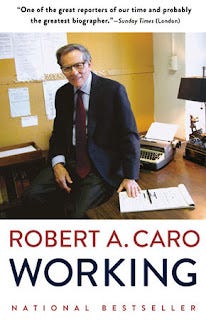
After finishing The Path to Power, I had to know more about the author behind such a beautiful piece of work. Working is part transcripts from interviews of Robert Caro combined with some of his own memories from his decades as a biographer. He tells us about his early life working in a newspaper in New Brunswick, the helpfulness of his wife and first & only research assistant, Ina, and his many many interviews. I'm incredibly impressed by the obsessive level of grit and dedication it takes to research so heavily into any one topic, and then the joint ability to create a seamless narrative.
A recurring theme, is Caro's wife, Ina. Throughout thick and thin, she stayed with Robert Caro to realize his (their) life's work. They moved from NYC to Hill County, Texas for 3 years. She even sold their house during the seven years when Caro was writing The Path to Power. She really must have believed in him. I'd love to read her book on France one day and hear her perspective of what it was like to accompany Caro on his life as biographer. They must have been true partners in crime/thought. I cross my fingers that the 5th volume of the LBJ series makes it out sooner rather than later and that Caro has ample time to write his own memoir.
Selected quotes and thoughts:
“that if (and this was a big "if" with me) I could just write it well enough, tell the story of his life the way it should be told, that story would cast light on the realities of urban political power, power in cities, power not just in New York but in all the cities of America in the middle of the twentieth century. And when I finished that book, I knew the one I would like to do next: a book about national political power. And I felt that I had learned that if you chose the right man, you could show quite a bit about power through the life of that man. But you have to choose the right man. How do you do that?” (Pg 81)
“I do most of the research for a book before I start writing, but this volume has been different because on Vietnam the LB Library is opening up new files all the time. People are always ask ing me what my daily schedule is. Its not fixed. I write each day as long as I can. As I've said, I write my first drafts in longhand - pen or pencil--on white legal pads, narrow-lined. I seldom have only one draft in longhand -I'd say I probably have three or four, Then I do the same pages over on a typewriter. I used to type on what they called "second sheets," brownish sheets, cheap paper like the paper used in the Newsday city room when I was a reporter. But those sheets are letter size. When I started writing books, I switched to white legal-size typing paper. You can get more words on a page that way. I triple-space the lines the way I did as a newspaperman, so there will be plenty of room to rewrite in pencil. I rewrite a lot. Sometimes I look at a page I typed but have reworked in pencil, and there's hardly a word in type left on it. Or no words in type left at all every one has been crossed out. And often there's been so much writing and rewriting and erasing that the page has to be tossed out completely. At the end of the day there will be a great many crumpled-up sheets of paper in the wastepaper basket or on the floor around it. I used to work late in the day or even into the evening, but as I've gotten older I've had to accept the fact that I'm just not able to work the same way. I always start each day by reading what I wrote the previous day, and more and more frequently when I reread the stuff I wrote in the late afternoon the day before, it was no good and I had to throw it out. So there was no sense in working late; I stop earlier now. I get too wound up when I'm working. Concentrating too hard or something. Any interruption is a shock, a real jolt.” (Page 162)
“It takes time to write all this. The books take time. Truth takes time. Just the research alone, if you add up the time, two months this year, six months the year before, and so on and so forth- Ina and I have spent years of our lives looking through papers at the Johnson Library. But it's been fascinating trying to figure out how all this happened in America, how political power works, to show the effect of political power on everyone's lives. Whether I knew it or not at the time, I can see now that that's really what I set out to do from the beginning, in my columns at the Princeton paper, my reporting at Newsday, and later in my books to explain how things really work.” (Page 184)
The Paris Review Interview with Robert Caro
“I thought I could have a rhythm that builds, and then change it abruptly in the last sentence. Rhythm matters. Mood mat-ters. Sense of place matters. All these things we talk about with novels, yet I feel that for history and biography to accomplish what they should accomplish, they have.” (Page 193)
“I can't start writing a book until I've thought it through and can see it whole in my mind. So before I start writing, I boil the book down to three paragraphs, or two, or one that's when it comes into view. That process might take weeks. And then I turn those paragraphs into an outline of the whole book. That's what you see up here on my wall now-twenty-seven typewritten pages. That's the fifth volume. Then, with the whole book in mind, I go chapter by chapter. I sit down at the typewriter and type an outline of that chapter, let's say if it's a long chapter, seven pages it's really the chapter in brief, without any of the supporting evidence. Then, each chapter gets a notebook, which I fill with all the materials I want to use quotations and facts pulled from all of the research I've done.” (Page 197)
The boiled down paragraph helps the author ask the most important question: is what I wrote (good or bad) fitting in. You have to throw it away or make it fit in. “Getting that boiled-down paragraph or two is terribly hard, but I have to tell you that my experience is that if you get it, the whole next seven years is easier.” (Page 199-200)
“But the books are also supposed to be a picture of America during the years of Lyndon Johnson. That's why they re called The Years of Lyndon Johnson. I mean, when I was starting The Power Broker and when I was starting the first Johnson volume, I said, You don't really have to show what the Depression is like in New York City or what it's like in Texas. That's been done. But I quickly realized that if I was going to do in these books what I wanted to do, I had to do the whole picture of what America was like.” (Page 203)
“When Moses has this great dream of the parkways, how do I show the greatness of the dream? How do I show the magnitude of the fight? I have to show the immense power of the men he defeated. That means showing the whole background of the robber barons. You've got to make people see the robber barons, with these magnificent estates in the path of the parkways he wanted to build so poor families from the city could get to the Long Island beaches. You can't just say, The robber barons were opposed to him.” (Page 204)
“You have to write not only about the man who wields the sword, but also the people on whom it is wielded.” (Page 206)