
The Stranger by Albert Camus

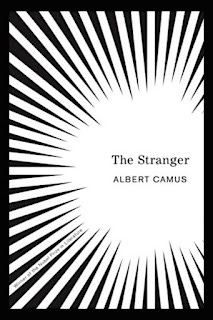
What a strange book, The Stranger. I really enjoyed the way it was written: to the point, objective, with enough description to make sense of what the main character sees through but not so much that you're lost in the details. It takes a strange man for sure to write so sociopathically.
I think the contents of the book are best summarized by a quote from Galapagos by Kurt Vonnegut (post coming up):
"Like so many other pathological personalities in positions of power a million years ago, he might do almost anything on impulse, feeling nothing much. The logical explanations for his actions, invented at leisure, always came afterwards"
Meursault is a not very emotional man. When he faces peoples emotions, he likes to satisfy them by agreeing with them. He gets through a lot of his life like this. I got the gist that he doesn't really know what love or other peoples emotions may really feel like, but he does understand his own innate desires and can label his own emotions quite well. He's a rational figure, really. Towards the end of the book, Camus used the word "indifference" and I thought that was a fantastic way to describe Meursault. When Marie asked to marry him, he said "sure." When asked if he loves her, he says it doesn't really matter but that he probably doesn't. Marie says this is weird and that she loves that about him. Meursault is so detached and says yes to marriage because he thinks Marie will be happy; nothing less nothing more. Case closed.
Camus writes about all these emotional events. A mother dying. A dog getting beaten and then running away from his emotionally dependent owner. A man getting stabbed after beating up a woman who cheated on him. Marie proposing to him. Killing an Arab. Being preached at by a Chaplain God man. Everything is received by Meursault in a cold and collected way -- he doesn't do much because he feels emotional compulsion to. "Monseur Antichrist" -- I loved that nickname. In a weird way, I actually quite liked Meursault. Although he's clearly built as a whacko, he is also very authentic.
My favorite part of the book was where Meursault is in the prison and recounts how he passed time. How the days bled into one another. "Five months" was nothing more than another today and tomorrow. He would spend time observing the small, little details of every aspect of his jail cell. The stones, the small pieces of furtnite... he would go back in his memories and recall all the minutiae. Just like the @Noorslens.
Another favorite was in the second court scene. His lawyer was using "I" when talking to describe not himself, but Meursault. Everybody was talking about him and the situation but it felt like he wasn't even included in the contribution of the analysis. When he said what he was really feeling, aka "the sun" made me shoot the man, he was simply laughed out. How absurd his reasoning... how absurd the legal system too which placed moral trivialities as a way to concur a story about facts about a case so indifferent as Meursaults.
Most of the book is not very interesting to read but I liked it for it's simplicity and message. Particularly the last couple pages of the book are where I felt Camus was really talking about what he wanted to.
I may be an absurdist myself. Still unsure about my whole situation with God(s). For the most part, I'm actually quite indifferent to the question too. I thought Hitchhikers Guide To The Galaxy by Douglas Adams represented absurdist ideas better than The Stranger because of the sheer scale of random extremes that were presented. What Camus did very well was use more subtleties in his writing to highlight these same concepts.