
The Questions of Hu by Jonathon Spence

This is the first in a three part series on my exploration of China.
I took a class called East Asian Diplomacy in the beginning of the semester. It was my 6th CU and had a ton of reading and supplementary of work. After two weeks in the class, I decided to drop it and just sift the main ideas by myself. In those two weeks, I read one of the assigned literary books called The Questions of Hu by Jonathon Spence.
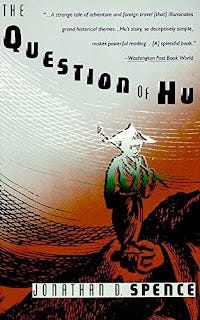
Jonathon Spence compiles a list of letters/diaries by Father Francis Foucquet (1663-1741), who has spent a long time living in China. Foucquet is a huge collector of books and spends his time in China trying to find alignment between the Catholic churches ideas and Chinese principles.
"In China, the Jesuits also chose to treat Confucianism as a secular philosophy rather than a religion, and therefore viewed it as somewhat compatible with Christianity. The argument was that reading Confucius should be no more objectionable for a good Christian than studying such other great pagan philosophers as Plato or Aristotle. Even the traditional Chinese offerings of food at household ancestral tablets, and some of the rituals conducted for the spirit of Confucius, might be tolerated as purely social obligations rather than heathen religion.”
“Other Catholic orders, however, particularly the Dominicans and Franciscans, were outraged by this Jesuit tolerance of Confucian rites. Serious criticism of the Jesuit approach began as early as the 1640s, and altogether, no fewer than eight popes became involved in deciding the so-called rites controversy. In 1704, a Vatican decree banned Christian participation in Confucian rites, and a papal bull (Ex illa die) in 1715 further reinforced this decision. In 1773, the Jesuit order was even (temporarily) suppressed altogether by the Roman Catholic Church. In 1724, meanwhile, a Qing emperor had condemned Christianity. The unraveling of the once promising Jesuit mission to China is symptomatic of an apparently widening gap in mutual appreciation between China and Europe in the eighteenth and nineteenth centuries.”
I would argue he looks for them where they don't exist.
When Foucquet is recalled back to Europe by the Pope and to France by the archbishop, he looks to find a Chinese man who can act as a scribe to translate the texts he brings back. He finds John Hu, a simple Christian Chinese man who is a guard/door-watcher for the missionary who can read. The missionary leaders in China are against the idea of bringing Hu to Europe given tensions in Chinese relations and their philosophical disagreements with Foucquet. Nevertheless, Foucquet creates a "contract" with Hu and sneaks Hu onboard the ship back to Europe. Hu goes mad on the ship and acts recklessly and rude to all those who host him and show him kindness. Hu refuses to do any of the work that he promised Foucquet and becomes a pain in the ass to deal with. In Paris, he steals horses, attacks people, and destroys property. When Foucquet has to go to Rome from Paris, Hu is placed in a mental hospital/prison; I guess Hu is mad -- end of story. Or is he?
Words of warning: this book is very boring to read. In fact, I don't recommend it. But if you do read it, really do try to see the other side. That eye for the perspective beyond cultural dissonance and insanity may be the silver lining that we as a society need.
Beyond the book and a general timeline of China at this time:
Matteo Ricci visits China and becomes one of the first outsiders ever let in.
The Manchus who led the Qing dynasty were a banner people of diverse origins… “Chinese, Korean, Mongolic, Turkish, Tibetan, and even some Russian descent." The Qing dynasty in 1800 “contained twice the population of Europe” and Beijing was largely the center of the world
Cultural misunderstandings grow. The West grows more reliant on trade, but is siphoned only to Canton. The West industrializes quicker than the Qing, which leads to the Opium Wars a century later. What did the British want from the Opium War? For the British law to be applied, their own island (Hong Kong), and more ports. How did this affect China? Massively. This future consequences of this war left the proud people of China scarred by the hands of the Western world, which tried to pry open a country which presumed itself to be the apex of human civilization. Mao, Deng, Jiang, and others leaders of the People's Republic to this day have not forgotten about this insult. Wounded pride; economic hardships; internal rebellion --> a Qing government facing pressures on every front which eventually collapsed in on itself in 1912.
--
Next up in my China series is a review of The Prince by The Economist and On China by Henry Kissinger.