
The Power Law by Sebastian Malleby

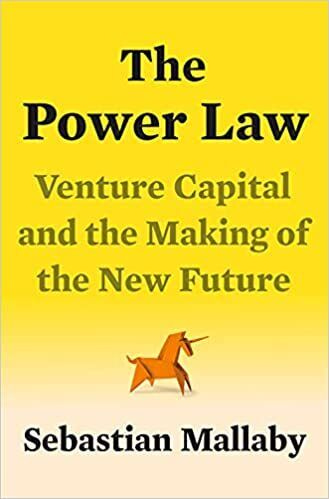
This is probably the best book I've read about the VC industry outside of Venture Deals by Brad Feld (which is much more technical). Last year I tried reading VC: An American History by Tom Nicholas and struggled to make it past the first 100 pages. That book reads more like a very long academic paper, which is a stark contrast to the storytelling dynamics and dialogue crafted by Malleby in The Power Law. Patrick Collison once said that he really enjoys reading about the history of Silicon Valley and that there was much to learn. Malleby did a ton of important work to piece together all these disparate parts of the VC ecosystem from around the world into one book.
(FYI: The Power Law is a turbo-charged concept that is based on the Pareto Principle that 20% of the causes lead to 80% of the consequences. In reality, one investment in a portfolio of hundreds of failures can make a fund the multiples on money that has made VC such a famous and dramatic asset class. For those in the industry, this well-known principle has many layers of depth, but from the layman's perspective, it is still an important point to personally internalize.)
I would love nothing more than to summarize each and every chapter so that I can train my mind to remember all the little stories. But I think I'll just end up re-reading The Power Law in a few years when I may have some more appreciation and also have real dealings with the firms mentioned. I've included a small analysis/summary about some points that are worth thinking about as the modern world tries to grasp China and how the effects of VC can be re-created in other parts of the world.
There was an entire chapter devoted to the rise of China. By re-creating business models found in the west, using American financial instruments by routing through holding companies in the Cayman Island, and taking the best of American VC learnings, China asserted itself as a market that could create returns that were bigger and better than the US. Although recent issues between the CCP and technology billionaires (Alibaba, Tencent, Piduoduo) might stifle long-term incentives to create value through massive entrepreneurship, I think China has built incredibly powerful inertia that will help it continue to speed forward. There was some very timely analysis over the battle for technological dominance between the US and China. China has a larger, more digitally-native market for products and while the US was fiddling its thumbs over cryptocurrency, China leapfrogged and asserted a strategic advantage over AI which the government has since used for military capacities. Both US VCs and the government will have to make consequential decisions that will have a large and looming effect on the future of warfare and wealth creation.
How should others government (i.e: EU, LatAm, MENA) encourage VC
Encourage limited partnerships
Avoids issues around double taxation — corporate and then personal
Don’t incentivize against wealth creation, instead make inheritance tax larger
Encourage stock options
Don’t require employees to pay tax on stock options the moment they’re granted and allow the stock options to have voting rights
Invest in scientific education and research
Create pipelines from government research/university labs to license patents to startups and connect to VCs
Think globally
Liberally hand out visas to foreign scientists & entrepreneurs
Help young companies list on foreign markets if domestic ones are underdeveloped
Don’t privilege their own firms at expense of open global competition
I made a list of some VC firms and their founders/partners I remembered (excuse the cursory-ness, I did this in class between "notes"):
Liberation Capital -
Kleiner Perkins
Tom Perkins
John Doerr
Google -- brought on Eric Schmidt to be part of the triumvarate
Climate-tech focused funds after 2000. Decline of KP as a fund; empowered woman in SV but failed to build a strong organization around these ideals.
Vinod Khosla
Benchmark Capital
Bill Gurley - Uber
Bruce Dunlevie - WeWork
Failed to build a European focused fund and grow effective larger seed funds or growth-stage funds.
a16z
Marc Andreessen from NetScape
Ben Horowitz -- Okta and Nicira
Ram Sriram -- Google
NEA
Peter Barris - UUNET
Accel - Jim Swartz and Arthur Patterson
Facebook - Jim Breyer
Sequoia
Don Valentine -- Cisco, Atari, Apple
Michael Moritz and Doug Leone -- Practically everything.
Sequoia China - Neal Shen
Meituan Dianping merger
Capital Today - Kathy Xu
Syaru Shirley Shin on behalf of Goldman Sachs
Gary Rieschel - Qiming
Softbank & Softbank Vision Fund - Masayoshi Son
Yahoo -- $100M or I'll invest in your next best competitor
WeWork
Founders Fund - Peter Thiel and Keith Rabbois
Tiger Global - Scott Schleifer and Chase Coleman III
DST Global - Yuri Milner
PayPal Mafia -- every single one of them runs some crazy company
YCombinator - Paul Graham and Jessica Livingston