
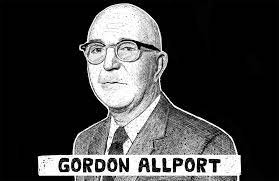
Formation of In-Groups by Gordon Allport

Today's read was "Formation of In-Groups", chapter 3 of The Nature of Prejudice by Gordon Allport (1953).
Messy notes:
What Is An In-group?
Difficult to define, but all use the term we with the same essential significance. Some are transitory, some are permanent.
Race, sex, gender, ethnicity, nation, state, town, neighborhood, clubs, team, etc.
Achieved status (a frat) vs Ascribed status (birth, race)
Memberships in groups are a kind of reward for humans
Scarcely anyone wants to be someone else. They just envy certain qualities which they may wish to have upon themselves.
Sex as an In-Group
Schopenhauer and Chesterfield were antifeminists that reflect the two basic ingredients of prejudice: denigration and gross oversimplification.
The Shifting Nature of In-Groups
When times change for the worse, in-group boundaries tend to strengthen. The outsider is excluded.
In-group memberships are not permanently fixed... how an individual identifies herself depends on her need for self-enhancement
In-groups usually created to fit the needs of individuals, often in terms of the hated-out-groups.
In-groups and Reference Groups
People may actively reject their membership with an in-group
Reference group: "those groups to which an individual relates himself as a part, or to which he aspires to relate himself psychologically" (Sherif and Sherif)
aka a group in which a person wants to be included
In-group can be a reference group, but not always
Biological in-group vs culturally defined reference group
To an extent, all minority groups suffer from a state of marginality (relating themselves to a reference group) --> insecurity, conflict, irritation
Two levels of belongingness
(1) Have you achieved membership?
(2) Do you prize that membership or do you seek to relate yourself to another group
Social Distance
A member of a ethnic group (minority group) fashions her attitudes as does the dominant majority
The dominant majority is for her a reference group --> forces attitudinal conformity
This conformity rarely extends to the point of rejecting his own in-group
Both in-groups and reference groups are important in the formation of attitudes
The Group-Norm Theory of Prejudice
"All groups (whether in-groups or reference groups) develop a way of living with characteristic codes and beliefs, standards and 'enemies' to suit their own adaptive needs. Both gross and subtle pressures keeps every individual member in line"
It's easier to change group attitudes than individual attitudes
Involving leaders/policy from top down --> create new norms --> individual attitudes tend to *approximate conformity*
Individuals conform in different ways, representative of their personality and development
No individual would mirror his group's attitude unless he had an personal need or personal habit
Can there be an in-group without an out-group?
This paper refutes the concept that "the existence of an outsider is in the beginning an essential condition of any warmth or togetherness of a group."
Does one's loyalty to an in-group automatically imply a form of negativism to out-groups
Emphasis should be on the desire for security, not hostility.
Hostility towards out-groups helps strengthen our sense of belonging, but is not required.
What is unknown can sometimes be seen as inferior or less "good", but there is not necessarily hostility against it
"The unity of the people is a unity of attitude--of tolerance and love--not a unity of conformity" - Pope Pius XII
Can humanity constitute an in-group?
Symbols, as mental anchorage points, are needed to make a human in-group seem real
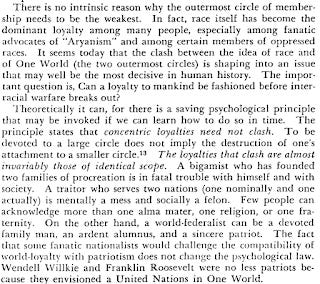
No intrinsic reason why the outermost circle of mankind needs to be the weakest one...
BIG question: Can a loyalty to mankind be be fashioned before interracial warfare breaks out?
Concentric loyalties need not clash. To be devoted to a large circle does not imply the destruction of one's attachment to a smaller circle. The loyalties that clash are almost inevitably those of identical scope.
A particularly intriguing two paragraphs:
Future read:
The Moral Equivalent of War by William James.