
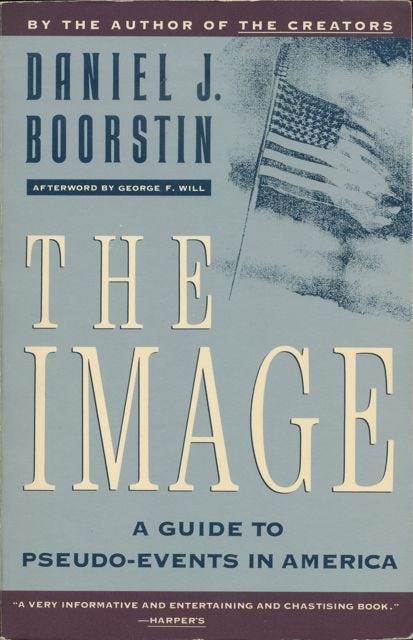
The Image: A Guide to Pseudo-events in America by Daniel Boorstin
There is no danger so long as we do not think that by chewing gum we are getting nourishment

Rating: once you see it, you can’t unsee it
Our most recent read in English class was The Image: A Guide to Pseudo-events in America by Daniel Boorstin. Although written in the 1960s, Boorstin highlights some core understandings of human nature and media. Specifically, he defines a pseudo event and builds intuition for understanding how they create a dearth of authenticity which makes them even stronger, why they are different than stereotypes, and how they exist in a more modern society in a sneakier way than you’d expect. I’ve attached my notes from class below.
Egan's work is on media culture and their impact on our lives and our mind
Some of Boorstin’s thinking still applies today
Extravagant expectations
Pseudo events
Celebrity
Authenticity
Boostin was born in 1914. Massive tech change from 1914 to 1960’s
Humans have become "masters of their environment"
Technology changes: Press, radio, sound systems, automobile, planes
Post WW2 American boom. $200B (1940) → $500B (1960). Mass consumption was a vast contrast to the Depression in the 1930's. Interstate highways also made the world accessible
As the world became mole accessible, people came to expect more from it (expectations for "novelty") even though the "world" itself has not fundamentally changed
Demanding more than the world can give us, we turn to mass media
Pseudo events: events designed specifically for media / constructed to be reported on, whose success is measured by how widely it is reported
The interview, the press conference, the awards ceremony
They are made more compelling bc it is controlled storytelling
Generally underwritten by a party that has a vested interest in amplifying them.
Jumped up effort do stress the hyper importance of the article before you get into the subject of them
They are photogenic and meant to de recorded
Attractive ambiguity from their artificiality
Did they really mean what they said? Implications of certain actions?
Effort to satisfy ambiguity increases the amount of pseudo-events
“The story behind the story”
He is like the woman in an Elinor Glyn novel who describes another by saying, "She is like a figure in an Elinor Glyn novel."
“5 takeaways From”; Conjectures: “may” or “might” in article headlines, which is not news but is often presented as such
While unmasking the illusory nature of pseudo events (advertisements), we are even more compelled to it. It spoils the appetite for plain secrets. Spontaneous events are branded and broadcasted as blockbuster events
Nowadays anyone and everyone can be a media outlet. Individual motives are more complicated than corporate ones. Platforms, however, still are corporations. So economics still supports: conflict → engagement → $
“Making things seem true” is a socially rewarded art
People can be made famous without doing anything, leading to the debasement of achievement
Egan showed a NYT column of a Pseudo- pseudo event
The column itself is a tongue and cheek unmasking of itself. It’s based around an overplayed pseudo pseudo event of Taylor Swift and Travis Kelsey
Egan’s take: Boorstin is an elitist. His snobbery undercuts his arguments, which are good
Nowadays, trying to be famous for being famous is a sophisticated “skill”
Kardashians, J. Lo, etc.
As long as you are up there talking about them, they win
Talent + Spotlight is needed not to “disappear”
Passion for new about crime and sports shows our desperation for an uncontrived event
“Authenticity hunger”
Reality TV (high curated, scripted, even more fake than real TV)
BeReal (you’re still taking the pics and posting it online)
Oversharing (genuine urge to connect with others in a raw and real way)
Pseudo events are often created by authentic people doing industrious, authentic work
Quotes Public Opinion by Walter Lippman
Stereotypes are useful to help find meaning in the world but generally are closer to propaganda. They simplify rather than complicate to create emotional satisfaction
Pseudo events become more fascinating the more complex they are
The cycle that you see over and over again: pseudo-event → craving authenticity → mass media trying to simulate authenticity → even more cravings for authenticity
Suggests that certain laws and principles are at play, which makes sense given human nature has not actually change
Selected Quotes:
It is we who keep them in business and demand that they fill our consciousness with novelties, that they play God for us.
"The 'interview,' " The Nation complained (January 28, 1869), "as at present managed, is generally the joint product of some humbug of a hack politician and another humbug of a reporter.
The mania for news was a symptom of expectations enlarged far beyond the capacity of the natural world to satisfy. It required a synthetic product
Consequences to our nation
Kennedy's great strength in the critical first debate, according to White, was that he was in fact not "debating" at all, but was seizing the opportunity to address the whole nation; while Nixon stuck close to the issues raised by his opponent, rebutting them one by one.
This greatest opportunity in American history to educate the voters by debating the large issues of the campaign failed. The main reason, as White points out, was the compulsions of the medium. "The nature of both TV and radio is that they abhor silence and 'dead time.'
the television-watching voter was left to judge, not on issues explored by thoughtful men, but on the relative capacity of the two candidates to perform under television stress.
Pseudo events → Pseudo qualifications
In the democracy of pseudo-events, anyone can become a celebrity, if only he can get into the news and stay there.
these new-model "heroes" are receptacles into which we pour our own purposelessness
So in our society heroes survive by acquiring the qualities of celebrities. The best-publicized seems the most authentic experience. If someone does a heroic deed in our time, all the machinery of public information-press, pulpit, radio, and television-soon transform him into a celebrity. If they cannot succeed in this, the would-be hero disappears from public view
Democratic faith was not satisfied that its hero be only a dauntless flier. He had to become a scientist, an outspoken citizen, and a leader of men. His celebrity status unfortunately had persuaded him to become a public spokes man.
Feels like my direct view on why we shouldn’t give JK Rowling so much attention for her views on gender/sexuality
My uneasy relationship with pop culture
The images themselves become shadowy mirror reflections of one another: one interview comments on another; one television show spoofs another; novel, television show, radio program, movie, comic book and the way we think of ourselves, all become merged into mutual reflections. At home we begin to try to live according to the script of television programs of happy families, which are themselves nothing but amusing quintessential of us” This is why I don’t like pop culture. This irksome feeling.
Chewing gum metaphor
Television was "chewing gum for the eyes
There is no danger so long as we do not think that by chewing gum we are getting nourishment
But the Graphic Revolution has offered us the means of making all experience a form of mental chewing gum, which can be continually sweetened to give us the illusion that we are being nourished