
The Hard Thing About Hard Things by Ben Horowitz

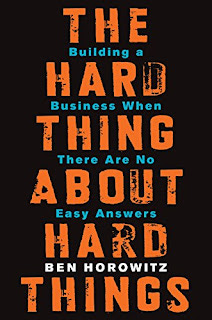
In The Hard Thing About Hard Things, Ben Horowitz gives us a first hand account of his experiences before starting a16z in "building a business when there are no easy answers." This is a required reading for anyone who is looking to build intuition about what makes a good CEO and executive. There are lots of counterintuitive and highly practical life lessons and I'd specifically recommend it to anybody getting ready to operate a company, build a culture, or folks who want to identify what makes an executive the real deal. It's also colored with some fire rap verses.
Quick synopsis of Horowitz:
Ben Horowitz was a talented and contrarian football player from California who was educated at Columbia. His parents were very left. He started off working for Marc at Mosaic and was the founding CEO of LoudCloud. LoudCloud was the tech company to invest in right before the dot-com bubble. In order to get the last minute funding needed, Horowitz took the company public during the worst IPO period for tech companies and turned it around. After years of keeping the company alive in a wartime environment, Horowitz divested most of the core business and turned the company around into Opsware. After 8 years of as a CEO, Horowitz and his team sold the business for $1.65B to HP. He then started a16z with long-time friend, Marc Andreessen.
His career was a f*ck'ing movie.
--
Most management books are kinda BS. HBS case studies can sometimes make you feel like you're in the shoes of the CEO who needs to pull the trigger on a decision, but 9 times out of 10 you won't have that much information and what you should do is actually based on counterintuitive principles.
Horowitz has had a unique ability to be both a wartime and peacetime CEO, both of which require completely different hats and skillsets. He gives some pretty vivid personal examples where he has had to make tough decisions (which is evidently a daily habit for CEOs) and outlines the tried and true principles he has used and now uses to advise his portfolio companies.
Quotes:
This is a handbook that I want to keep in my room at all times. At no point during the process of scaling a tech company would I want to not have Ben Horowitz's management counsel besides my bed.
The whole book was gold -- . I'm reluctant to even include this part because the whole book should be quoted and these are by no means the best ones or the most relevant.
The Freaky Friday Management Technique:
"We walk the same path, but got on different shoes, live in the same building, but we got different views" -- Drake
"The very next day I informed the head of Sales Engineering and the head of Customer Support that they would be switching jobs. I explained that, like Jodie Foster and Barbara Harris, they would keep their minds, but get new bodies."
Lead Bullets
Sometimes there are no growth hacks and silver bullets; there is no alternative to a non-stop hustle and grit it takes to build a business from the ground up.
Focus on the people, product, and profits -- in that order
How to hire/fire executives at various stages. How to demote a loyal friend. How to tell it as it is. How to avoid management debt and keep quality high. How to minimize politics. Culture: one on ones, titles and promotions, finding the right kinds of ambitions. What is the CEO skillset? Ones and twos -- a framework for CEO succession. Peacetime vs wartime CEOs. How to evaluate a CEO. How to balance accountability vs creativity. Should I sell my company?
In the weekly staff meeting, I inserted an agenda item titled “What are we not doing?” Sometimes the things you’re not doing are the things you should actually be focused on.
When you fired the person, how did you know with certainty that the employee both understood the expectations of the job and was still missing them. The best answer is that the manager clearly set expectations when she trained the employee for the job. If you don’t train your people, you establish no basis for performance management.
Evaluating people against the future needs of the company (or your future self) based on a theoretical view of how they will perform is counterproductive. Deciding (with woefully incomplete data) that someone who works their butt off, does a terrific job, and loyally contributes to your mission won’t be with you three years from now takes you to a dark place. It’s a place of information hiding, dishonesty, and stilted communication. It’s a place where prejudice substitutes for judgement. It’s a place where judgement replaces teaching. It’s a place where teamwork becomes internal warfare. Don’t go there.
Mediocre CEOs point to their brilliant strategic moves or their intuitive business sense or a variety of other self-congratulatory explanations. The great CEOs tens to be remarkably consistent in their answers. They all say, “I didn’t quit.”
Do you know the best thing about startups? You only ever experience two emotions: euphoria and terror. And I find that a lack of sleep enhances both. -- Marc Andreesen