
The Goal by Eliyahu Goldratt
Why is it that common sense is seldom common practice?

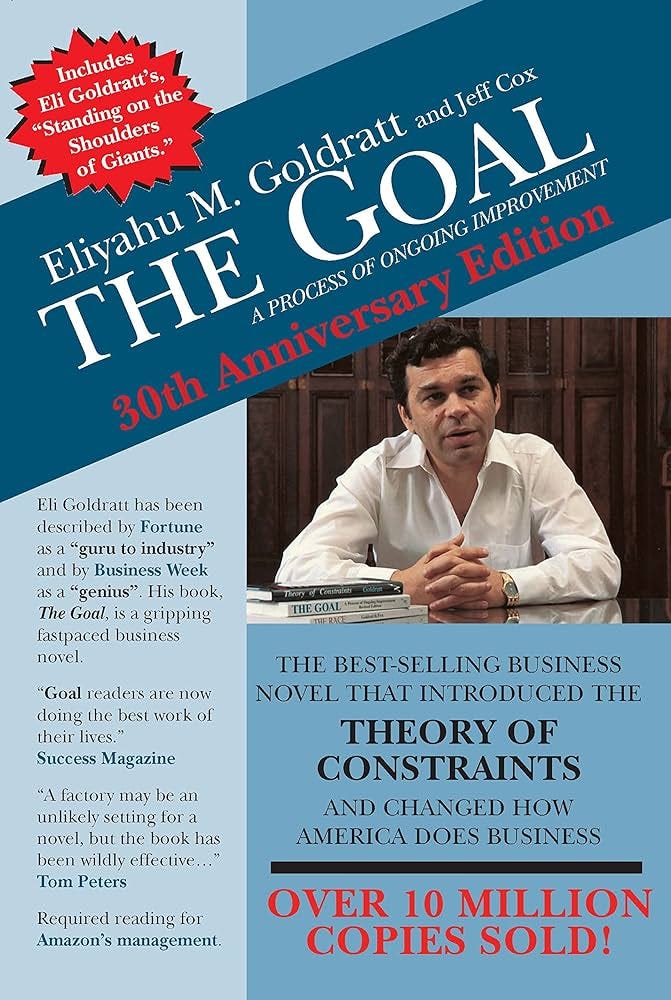
Rating: 7/10
Thank you to Professor Gad Allon for reccomending one of the best business books of all time.
The Goal by Eliyahu Golratt is a business novel that uses the narrative form (there is also an alternative comic book and movie) to teach the reader how to think about identifying and exploiting constraints.
I’m experimenting with formatting my outline as a series of questions and answers (it’s good for building intuitions + more accessible to go back to).
Q&A
What is productivity / What does it mean to be productive?
When you are productive you are accomplishing something in terms of your goal, right? Every action that does not bring a company closer to its goal is not productive. Every action that brings a company closer to its goal is productive.
Hence, productivity is meaningless unless you know what your goal is
What are 3 measurements that show a holistic measure for the health of a company?
Net profit
An absolute measurement of money made
ROI
Comparison of money made relative to the money invested
Cash flow
It's still possible to go bankrupt without the cash flow required to make payments
What are some examples of false standalone goals? Thus, what is the real goal of a manufacturing organization?
Cost-effective purchasing, employing good people, high technology, producing products, producing quality products, selling quality products, capturing market share, communication, customer satisfaction
These are all means to an end but not the end itself
Real goal →
To make money by increasing net profit, while simultaneously increasing return on investment, and simultaneously increasing cash flow.
Aka, to make money by increasing throughput while simultaneously reducing both inventory and operating expense.
Why though??
Because there’s nothing on the list that’s worth anything if the company isn’t making money
What is an equivalent set of measurements which permit you to develop operational rules for running the plant? (highly precise definitions… don’t miss the right words)
Throughput:
The rate at which the system generates money through sales
*Through sales—not production.* If you produce something, but don't sell it, it's not throughput.
Why though??
Because produced items can just sit as inventory and never be sold. The rate of piling stuff up to never be sold is not an effective measure
Inventory
All the money that the system has invested in purchasing things which it intends to sell
Operational expense
All the money the system spends in order to turn inventory into throughput
Any money we've lost is operational expense; any investment that we can sell is inventory. Notice how each of the three definitions contains the word money
In this definition of inventory, why isn’t the value added to the product via direct labor included?
It is defined this way because it's better not to take the value added into account. It eliminates the confusion over whether a dollar spent is an investment or an expense.
Based on these measurements, what are the three questions that Jonah asked Alex?
Did we sell any more products (i.e., did our throughput go up?)
Did we lay off anybody (did our operational expense go down?)
Did our inventories go down?
Why were robots causing problems at the plant?
TL;DR: To give the robots more to do, we released more materials. Which, in turn, increased inventories, which has increased our costs
Long: They were expensive and could not pay themself off in the projected time at the current level of efficiency. Thus, they decided to release more materials to the floor, giving the robots more to produce and thus increase their efficiencies, which lead to a surplus in work-in-process inventory at the end of each month. But then you can’t get enough of certain other parts when they need them to assemble and ship orders
What are examples of edge cases where you think something isn’t inventory, throughput, or OpEx but it actually is?
A machine
The depreciation on the machine is operational expense
Whatever portion still remains in the machine, which could be sold, is inventory
Knowledge
It depends, quite simply, upon what the knowledge is used for. If it's knowledge, say, which gives us a new manufacturing process, something that helps turn inventory into throughput, then the knowledge is operational expense.
If we intend to sell the knowledge, as in the case of a patent or a technology license, then it's inventory.
But if the knowledge pertains to a product which UniCo itself will build, it's like a machine—an investment to make money which will depreciate in value as time goes on. And, again, the investment that can be sold is inventory; the depreciation is operational expense.
A chauffeur for the CEO
You don't have to have your hands on the product in order to turn inventory into throughput. Maybe the chauffeur helps the CEO have more time to think and deal with customers, etc., while he's commuting here and there
When you see one of your workers standing idle with nothing to do, is that always good or bad for the company?
It’s not always bad – buffers are very useful. A plant in which everyone is working all the time is very inefficient.
Keeping everyone working all the time means you’ll have a lot of excess inventory at the bottlenecks, and that means you have excess manpower
What is a balanced plant and why is it that the closer you get to having a balanced plant, the closer you are to bankruptcy?
Balanced plant: It's a plant where the capacity of each and every resource is the same as market demand
When capacity is trimmed exactly to marketing demands, no more and no less, throughput goes down, while inventory goes through the roof," he says. "And because inventory goes up, the carrying cost of inventory—which is operational expense—goes up. So it's questionable whether you can even fulfill the intended reduction in your total operational expense, the one measurement you expected to improve
What are the two phenomena found in every plant which cause queues?
Dependent events
An event, or a series of events, that must take place before another subsequent event can begin
Statistical fluctuations
Types of information which vary from one instance to the next
Examples: How long will it take the waiter to bring us our check? Or how long will it take the chef to make an omelet? Or how many eggs will the kitchen need today?
What is Herbie and what does he represent?
Herbie represents a bottleneck in the system. He is the slowest and he carries extra sh*t with him.
Thus Herbie is the throughput, or the the rate at which the slowest walker walks the trail.
Explain what inventory, throughput, and op ex are in the Herbie analogy?
The inventory is the amount of tail between the first and last person.
The operational expense is the energy the group needs to walk.
The throughput is the rate at which the slowest walker walks the trail (the fat kid, Herbie).
OpEx is increasing any time they hurry to catchup, bc they expend more energy than they otherwise would
Alex Rogo uses the game with the matches to create a brief scientific study of the concepts in a balanced system
Inventory moves through the system not in manageable flow, but in waves. The mound of matches in Dave's bowl passes to Evan's and onto the table finally—only to be replaced by another accumulating wave. And the system gets further and further behind schedule… which happens when there is no buffer/reserve
How does Alex solve the hiking trip problem?
He turned the entire troop around so that the boys have exactly the opposite order they had before. Herbie’s at the front now and the fastest kids in the back.
He also realizes Herbie has a ton of excess junk in his bag which other kids can hold instead so he can go faster
What does the mathematical principle on bottlenecks say?
In a linear dependency of two or more variables, the fluctuations of the variables down the line will fluctuate around the maximum deviation established by any preceding variables
Hence, the maximum deviation of a preceding operation will become the starting point of a subsequent operation.
What is a bottleneck?
Any resource whose capacity is equal to or less than the demand placed upon it. And a non-bottleneck is any resource whose capacity is greater than the demand placed on it.
Should I balance flow or capacity with demand?
Always balance flow with demand… it should be a tiny bit less than demand from the market so you can work in a buffer
How to find a Herbie (a bottleneck)?
(1) Know the total market demand for products coming out of this plant
Pull together data. It’s the the complete product mix for the entire plant, including what we "sell" to other plants and divisions in the company
(2) Find out how much time each resource has to contribute toward filling the demand… relative effort per resource
The process of calculating the hours each "work center" has to contribute. We're defining a work center as any group of the same resources. Ten welders with the same skills constitute a work center. Four identical machines constitute another. The four machinists who set up and run the machines are still another, and so on. Dividing the total of work center hours needed, by the number of resources in it, gives us the relative effort per resource, a standard we can use for comparison.
(3) Use gut instinct and on-the-ground expertise… the machine probably has a huge pile of WIP inventory right next to it
The parts most frequently in short supply are probably the ones that would pass through a bottleneck, And the department where the expeditors go to look for them is probably where we'll find our Herbie.
What to do when bottlenecks are not maintaining sufficient flow to meet demand and make money?
Increase the capacity. Although against first intuition, you can let the bottlenecks stay bottlenecks. What we must do is find enough capacity for the bottlenecks to become more equal to demand
Does having two bottlenecks mean you can’t make money?
Nope. In fact, most manufacturing plants do not have bottlenecks. They have enormous excess capacity. But they should have them—one on every part they make.
How often should I run my bottlenecks? How about my non-bottlenecks?
24/7! The cost of not running your bottleneck was the opportunity cost for the whole system, not just the one part
An hour lost at a bottleneck is an hour lost for the entire system. Lost time on a bottleneck part means lost throughput.
On any non-bottleneck machine in your plant, no problem. Because, after all, some percentage of a non-bottleneck's time should be idle. So who cares when those people take their breaks? It's no big deal. But on a bottleneck? It's exactly the opposite.
If you lose one of those hours, or even half of it, you have lost it forever. You cannot recover it someplace else in the system. Your throughput for the entire plant will be lower by whatever amount the bottleneck produces in that time. And that makes an enormously expensive lunch break.
But if you have a union to deal with?
So talk to them. They have a stake in this plant. They're not stupid. But you have to make them understand.
How to calculate the cost of a bottleneck?
The actual cost of a bottleneck is the total expense of the system divided by the number of hours the bottleneck produces
Are there alternatives to using this bottleneck, like an outside vendor? Is it even actually needed or is it some process implemented long ago for an archaic reason?
How to think about quality control at the bottleneck?
I am suggesting you use quality control in a different way." I ask, "You mean we should put Q.C. in front of the bottlenecks?" Jonah raises a finger and says, "Very perceptive of you. Make sure the bottleneck works only on good parts by weeding out the ones that are defective. If you scrap a part before it reaches the bottleneck, all you have lost is a scrapped part. But if you scrap the part after it's passed the bottleneck, you have lost time that cannot be recovered.
How does cash flow relate to the bottleneck?
Make the bottlenecks work only on what will contribute to throughput today . . . not nine months from now," says Jonah. "That's one way to increase the capacity of the bottlenecks. The other way you increase bottleneck capacity is to take some of the load off the bottlenecks and give it to non-bottlenecks.
What are the 3 ways time at the bottleneck is wasted in the story?
(1) One way is for it to be sitting idle during a lunch break
(2) for it to be processing parts which are already defective—or which will become defective through a careless worker or poor process control.
(3) Making it work on parts you don't need
How to increase bottleneck capacity?
Do all of the parts have to be processed by the bottleneck? If not, the ones which don't can be shifted to non bottlenecks for processing. And the result is you gain capacity on your bottleneck
Why is it important to communicate to everybody which parts are bottleneck parts?
In the story, about 90% of the current overdues have parts that flow through one or both of the bottleneck operations. Of those, about 85% are held up at assembly because we're waiting for those parts to arrive before we can build and ship.
Alex Rogo’s speech to employees
“All work-in-process on the floor will be marked by a tag with a number on it," he says and holds up some samples. "The tag will be one of two colors: red or green. "A red marker means the work attached to it has first priority. The red tags go on any materials needing to be processed by a bottleneck. When a batch of parts with that color marker arrives at your work station, you are to work on them right away." Bob explains what we mean by "right away." If the employee is working on a different job, it's okay to finish what he's doing, as long as it doesn't take more than half an hour. Before an hour has passed, certainly, the red-tagged parts should be getting attention. "If you are in the middle of a setup, break the setup immediately and get ready for the red parts. When you've finished the bottleneck parts, you can go back to what you were doing before. "The second color is green. When there is a choice between working on parts with a red marker and parts with a green marker, you work on the parts with the red marker first. So far most of the work-in-process out there will be marked by green. Even so, you work on green orders only if you don't have any red ones in queue. "That explains the priority of the colors. But what happens when you've got two batches of the same color? Each tag will have a number marked on it. You should always work on the materials with the lowest number."
What’s an example of how someone on the ground found a way to optimize an old process to make a bottleneck more efficient?
It takes anywhere up to an hour or so to change a furnace load using the crane or doing it by hand. We could cut that down to a couple of minutes if we had a better system." He points to the furnaces. "Each one of those has a table which the parts sit on. They slide in and out on rollers.
Make those tables interchangeable. That way we could stack a load of parts in advance and switch loads with the use of a forklift. If it saves us a couple of hours a day, that means we can do an extra heat of parts over the course of a week.
What’s an example of archaic processes?
I just found out that in three cases, it wasn't engineering that specified heat-treat. It was us.
about five years ago some group of hotshots were trying to improve the efficiencies of several of the machining centers. To speed up the processing, the cutting tool "bite" was increased. So on each pass, instead of shaving a chip that was a millimeter thick, the tool took off three millimeters. But increasing the amount of metal taken off on each pass made the metal brittle. And this necessitated heat-treating. "The thing is, the machines we made more efficient happen to be non-bottlenecks," says Bob. "We have enough capacity on them to slow down and still meet demand.
What is the problem with resorting to expediting in a system?
If you resort to expediting now, you'll have to expedite all the time, and the situation will only get worse.
What is the problem of releasing more material to a non-bottleneck than needed?
You get excess inventory or excess finished goods + carrying costs
When you make a non-bottleneck do more work than the bottleneck , you are not increasing productivity. On the contrary, you are doing exactly the opposite. You are creating excess inventory, which is against the goal
Therefore, we can form a simple rule which will be true in every case: the level of utilization of a non-bottleneck is not determined by its own potential, but by some other constraint in the system.
Let non-bottleneck production equal the lesser of the bottleneck or market demand
making an employee work and profiting from that work are two different things.
What is the constraint for excess finished goods?
Marketing’s ability to sell
What is the difference between activating a resource and utilizing a resource?
"Utilizing" a resource means making use of the resource in a way that moves the system toward the goal.
"Activating" a resource is like pressing the ON switch of a machine; it runs whether or not there is any benefit to be derived from the work it's doing. So, really, activating a non-bottleneck to its maximum is an act of maximum stupidity.
A system of local optimums is not an optimum system at all; it is a very inefficient system
What’s the goal of a marriage?
Throw away for the moment all the pre-conceptions we have about our marriage, and just take a look at how we are right now," I tell her. "Then we ought to figure out what we want to have happen and go in that direction."
Why should you cut your batch sizes in half on the bottlenecks?
At any one time we'd have half the workin-process on the floor. We'd only need half the investment in work-in-process to keep the plant working. If we could work it out with our vendors, we could conceivably cut all our inventories in half, and by cutting our inventories in half, we reduce the amount of cash tied up at any one time, which eases the pressure on cash flow
Aka, Reduces working capital needs. Frees up cash for the division VP to use in other parts of the business. Less inventories in materials, work in progress, and finished goods --> better cash flow
To reap those benefits fully, we'd have to have our suppliers increase the frequency of deliveries to us and reduce the quantity of each delivery
→ better lead times → become a more competitive firm in the marketplace
What are the 4 elements to consider for the total time from the moment the material comes into the plant to the minute it goes out the door as part of a finished product?
(1) Setup: the time the part spends waiting for a resource, while the resource is preparing itself to work on the part.
(2) Process time: the amount of time the part spends being modified into a new, more valuable form.
(3) Queue time: the time the part spends in line for a resource while the resource is busy working on something else ahead of it
Resource utilization
(4) Wait time: the time the part waits, not for a resource, but for another part so they can be assembled together.
Measure of synchronization between resources
Which of these 4 times take the longest?
Queue and wait often consume large amounts of time—in fact, the majority of the elapsed total that the part spends inside the plant
Setup and process are usually a small portion of the total elapsed time for any part
For parts that are going through bottlenecks, queue is the dominant portion. The part is stuck in front of the bottleneck for a long time. For parts that are only going through non-bottlenecks, wait is dominant, because they are waiting in front of assembly for parts that are coming from the bottlenecks.
In each case, the bottlenecks are what dictate this elapsed time. Which, in turn, means the bottlenecks dictate inventory as well as throughput
Why do reduced batch sizes help make processes quicker?
Before we reduced batch sizes, it wasn't uncommon for a work center to be forced idle because it didn't have anything to process—even though we were wading through excess inventory. It was usually because the idle work center had to wait for the one preceding it to finish a large batch of some item. Unless told otherwise by an expediter, the materials handlers would wait until an entire batch was completed before moving it. In fact, that's still the case. But now that the batches are smaller, the parts are ready to be moved to the next work station sooner than they were before.
In managerial accounting using direct-labor hours, why do costs seem to go up?
I'll give you an example. Suppose we have a batch of 100 parts. The time to set up the machine is 2 hours, or 120 minutes. And the process time per part is 5 minutes. So we've invested per part 5 minutes plus 2 hours of set-up divided by 100. It comes to 1.2 minutes of set-up per part. According to the accountants, the cost of the part is based upon direct labor of 6.2 minutes. "Now if we cut the batch in half, we still have the same amount of set-up time. But it's spread over 50 parts instead of 100. So now we've got 5 minutes of process time, plus 2.4 minutes of set-up for a grand total of 7.4 minutes of direct labor. And the calculations are all based on the cost of direct labor.
Then I explain the way costs are calculated. First, there is the raw material cost. Then there is the cost of direct labor. And finally there is "burden," which essentially works out to be cost of the direct labor multiplied by a factor, in our case, of about three. So on paper, if the direct labor goes up, the burden also goes up. "So with more set-ups, the cost of making parts goes up," says Julie.
"It looks that way," I tell her, "but in fact it hasn't really done anything to our actual expenses. We haven't added more people to the payroll. We haven't added any additional cost by doing more set-ups. In fact, the cost of parts has gone down since we began the smaller batch sizes." "Down? How come?" "Because we've reduced inventory and increased the amount of money we're bringing in through sales," I explain. "So the same burden, the same direct labor cost is now spread over more product. By making and selling more product for the same cost, our operating expense has gone down, not up.
What is an example of understanding the needs and incentives of your customer in a negotiation?
You can re-engineer the deal! date by a mile, as we used to do. You come back with a counter-offer that was feasible and that the client liked even more than his original request.
We didn't say a flat no, or a flat yes, and then miss the due dates.
There is no way we can deliver the full thousand units in two weeks. But we can ship 250 per week to them for four weeks
Maybe the quoted lead times should be done case by case, according to the load on the bottlenecks. And maybe we shouldn't regard the quantities required as if we have to supply them in one shot
Shipping via air freight may be more expensive, but not enough to eat up the profit on a million-dollar sales
What are TOC’s problems with cost-accounting?
(1) According to the cost-accounting rules that everybody has used in the past, we're supposed to balance capacity with demand first, then try to maintain the flow," I say. But instead we shouldn't be trying to balance capacity at all; we need excess capacity. The rule we should be following is to balance the flow with demand, not the capacity
(2) The incentives we usually offer are based on the assumption that the level of utilization of any worker is determined by his own potential. That's totally false because of dependency. For any resource that is not a bottleneck, the level of activity from which the system is able to profit is not determined by its individual potential but by some other constraint within the system.
That's the reason Insight doesn't necessarily fire an analyst if they didn't bring any live deals. Because sometimes conditions like the composition of the fund, the economy, etc, may prevent certain deals from getting done. There are dependencies, thus assuming he is still bringing interest things to the table, the analyst isn't the constraint
How to evaluate the performance of operations?
By the bottom line. Not efficient or utilization.
What are good management techniques?
→ High Output Management by Andy Grove
Don't give the answers, just ask the questions!' I'll have to practice that.
Spelling out the answers when you are trying to convince someone who blindly follows the common practice is totally ineffective. Actually there are only two possibilities, either you are not understood, or you are understood
What is the most important management technique?
How to persuade other people, how to peel away the layers of common practice, how to overcome the resistance to change
Whenever I'm talking with Jonah, I have the distinct feeling that not only is he ready with his questions, he's also ready with my questions. It must be that the Socratic method is much more than just asking questions. One thing I can tell you, improvising with this method is hazardous, believe me, I've tried. It's like throwing a sharpened boomerang.
Whenever I tried just to ask questions it was interpreted as patronizing, or even worse, that I was simply negative.
What is a buffer?
A "buffer" is a term used to describe a safety margin of inventory or work-in-process (WIP) situated before a production stage or bottleneck to ensure smooth and continuous operation
What is the 5 step process for bottlenecks?
STEP 1. Identify the system's bottlenecks.
(After all it wasn't too difficult to identify the oven and the NCX10 as the bottlenecks of the plant.)
STEP 2. Decide how to exploit the bottlenecks.
(That was fun. Realizing that those machines should not take a lunch break, etc.)
STEP 3. Subordinate everything else to the above decision.
(Making sure that everything marches to the tune of the constraints. The red and green tags.)
STEP 4. Elevate the system's bottlenecks.
(Bringing back the old Zmegma, switching back to old, less "effective" routings. . . .)
STEP 5. If, in a previous step, a bottleneck has been broken go back to step 1
What is the fallacy of the ‘product cost’ concept?
It doesn’t take into account spare capacity, where the only out of pocket costs are cost of materials
We took more orders, which by themselves didn't turn any resource into a new bottleneck, but they did drastically reduce the amount of spare capacity on the non-bottlenecks, and we didn't compensate with increased inventory in front of the bottleneck
How does Eliyahu Goldratt draw management techniques?
The scientific method
What they actually do is to derive the unavoidable results logically from their hypothesis. They say: IF the hypothesis is right THEN logically another fact must also exist. With these logical derivations they open up a whole spectrum of other effects. Of course the major effort is to verify whether or not the predicted effects do exist. As more and more predictions are verified, it becomes more obvious that the underlying hypothesis is correct. To read, for example, how Newton did it for the law of gravity is fascinating.
What does upstream and downstream mean?
Upstream is pre-production
Downstream is post-production
Why are external constraints easier than internal constraints?
What are the three questions every manager must ask?
(1) What to change?
(2) What to change too?
(3) How to cause the change?
What is the purpose of management?
To being able to hone in on the core problem even in a very complex environment? To be able to construct and check solutions that really solve all negative effects without creating new ones? And above all to cause such a major change smoothly, without creating resistance but the opposite, enthusiasm?
How to prevent overproduction? Then, how to balance the flow?
Abolish local efficiencies. Do not allow production if it is not needed.
Then take away all the disruptions that slow down the flow, then deal with local disturbances to improve things by another order of magnitude
Many approaches try to increase inventory while increasing throughput. TOC focuses on increasing throughput while decreasing inventories
How does one correct an erroneous measurement or other policy?
What are the core competencies of a manager?
Hone in on the core problem even in a very complex environment
Construct and check solutions that really solve all negative effects without creating new ones
Above all, cause such a major change smoothly, without creating resistance but enthusiasm
What is the process to Stand on the Shoulders of Giants?
Identify a "giant", not a chupchik. Intuition will guide you - important enough subjects for you.
Identify the enormity of the area not addressed by the giant. Reality gives the signals that so much more can be done. You are aiming for a broader, not a more confined, area than what was addressed by the giant.
Get on the giant's shoulders. Gain the historical perspective - understand the giant's solution better than he did.
Identify the conceptual difference between the reality that was improved so dramatically by the giant and the area untouched.
Identify the wrong assumption.
Conduct the full analysis to determine the core problem, solution, et.
What is an example of throughput metrics (compared to cost accounting metrics)?
For a printing press
If market demand isn’t the constraint:
Throughput contribution per press hour (TCP)
Choose which products and which customers to bring in
If market demand is the constraint:
Contribution margin per resource hour (CRH)
Only capture hours that represent value that customers pay for
Contribution / hours consumed
Take the contribution—which is sales less materials—and we divide by the hours consumed and come up with a relative measure that has validity across the whole organization.
What conditions must be met for people to seriously try to implement TOC?
Other selections:
This feels like good leadership
Until they kick me out of here, I'm not giving up. What you decide to do is your own business, but if you want out, I suggest you leave now. Because for the next three months, I'm going to need everything you can give me
It is very unlikely your people are lying to you. But your measurements probably are
There is a great fallacy of the ‘product cost’ concept
Rigorous application of the scientific method is the answer for the needed management techniques because it reveals the intrinsic order of things
Management shouldn’t be about fire fighting. Unless you’re growing fast enough that the basic order changes rapidly, it means there is a root problem
Hypothesis testing. IF, THEN
Sometimes, in order to think, you need to get yourself out of the office and take a break. Perhaps you’ll find a Herbie moment on a boy scout camping trip
Always question if bottleneck processes are actually required, or if they are archaic…
Heat treat wasn’t req in the book by the engineering department
Mark Twain: common sense is not common at all.
We refer to something as common sense only if it is in line with our own intuition
What was the nature of the answers, the solutions, that Jonah caused us to develop? They all had one thing in common. They all made common sense, and at the same time, they flew directly in the face of everything I'd ever learned. Would we have had the courage to try to implement them if it weren't for the fact that we'd had to sweat to construct them? Most probably not. If it weren't for the conviction that we gained in the struggle—for the ownership that we developed in the process—I don't think we'd actually have had the guts to put our solutions into practice.
Always let the finance and accounting people know you’re working towards the same goal as them:
“I'm going to demonstrate to you that regardless of what our costs look like according to standard measurements, my plant has never been in a better position to make money.”
I'm not asking you to develop the management techniques, only to determine what they should be.
Determining the management techniques must come from the need itself, from examining how I currently operate and then trying to find out how I should operate
Triggering breakthrough ideas by itself is not enough. An even bigger obstacle is to verify that this idea really solves all the resulting bad effects without creating new ones
Everything is a tradeoff
A business model I loved:
The situation?
The company was pretty big, it was number four or five in the Netherlands. It was making an awful loss. Competition was suddenly fierce and only concentrated on price. Other companies were very subtly sending brochures to every small business in the Netherlands with prices on the front cover that I couldn't get for myself as a wholesaler. This was really awful. All our good customers became suddenly more and more interested in price. They said, "How is it possible that we pay twice as much as what's on the front cover of this brochure?"
Well, it was, it was really awful. We had something like four or five thousand customers, 20 sales people. The only thing we could think of was to also lower prices, and do it only on items where we had to. That was not a long-term solution but that was what everybody else was doing. So the conventional way of doing business in office supplies was pretty soon completely gone. We got tenders for office supplies-which was unheard of—where you had to fight with three or four competitors. In the past, orders for office supplies were just given to a local good-performing company. Now everybody was focusing on price.
In most offices where you open drawers, there's more stock in the office than anybody can imagine. While at the same time they are screaming for a specific item which has to be brought to them by taxi in crazy short delivery times. In Rotterdam we are down to four-hour delivery times! Not even 24, just four-hour delivery times, which is completely crazy for office supplies. I mean, we're not saving lives here.
The solution?
So this is what we offered our customers: That we would take over all this hassle of supplying everybody in the office with the right equipment, the right articles, at the right time. We offered them cabinets with office supplies in them. We owned both the cabinets and the contents. The supplies were for a specific working group. Whatever they took out was considered sold, whatever was left was still ours. We replenished these cabinets every week. We made it very easy for them to check on us. And more importantly, we could give specific data about each department, explaining that certain items were consumed fast. For instance you might need a new pair of scissors once in three months, but not every week.
When you change a printer, for example, and you don't tell me, I will find out you don't use this cartridge any more and I'll adjust. These cartridges are very expensive, do you want the responsibility? That's the main difference of consignment.
What about theft?
Everybody knows that people take pencils home; you do that by accident and it doesn't cost anything. Toner cartridges, that's a bigger problem. So when the theft of these ink-jet cartridges went up very much, we advised them to buy bigger printer machines, which we could also supply, to make them different than the machines people had at home. Things like that.
What were the numbers?
Normal gross margins in the industry were very much below 20%. Above 20% was suspicious. We were above 30%, which makes a lot of difference. And we were not ripping people off. They were extremely satisfied with our service.
The total cost of providing office supplies for their workers dropped by 50% because they didn't have the internal hassle of misplacements, overstocking, and things like that.
How did you go about selling the concept to your customers?
We had a department which was making appointments with financial directors, not the guy normally responsible for purchasing office supplies. That other guy was scared for his job when you came with this solution. And we made a short movie to show the current situation in their office and how people were screaming for office supplies and things like that, and how great it would be if we could take over their stock and their responsibility and solve this problem. And this worked really great. Something like 30% of the sales visits were successful sales. Again, the prices we were charging for supplies was no longer an issue
We still had some customers who were focused on price. We didn't chase them away. We just gave them completely different conditions. We told them that if price is what matters most, you have to buy big quantities and you shouldn't care about delivery times: "You can get the lowest price possible but you have to stand in line." Now a good thing for us about the cabinet system was that we had one-week advance notice on our purchasing needs. I mean, what the customer used last week I didn't bring the day I was checking. I would bring it the week later. So I hardly needed any stock anymore. My suppliers could deliver in a day but I had a week. So now I could start buying on price. And I could combine my orders with those of the bigger customers who still wanted to do business just on price.
As long as we don't have a breakthrough idea I'm not going to make any changes
It takes Eli (author of The Goal) about five minutes to find the constraint and how to break it. In most cases, I can find the same within a week
On competition:
This funny story about two guys on a safari. And after a couple of days they hear the first tiger and they think, well, great! So they go for their guns and discover they forgot their bullets. So one of them puts his pack down and grabs his running shoes, and the other guy starts laughing: "Do you think you can outrun the tiger?" He says, 'I don't need to outrun the tiger, I only have to outrun you!"
I called on one boy—let's say his name was Mike-who I knew was struggling. He was rambling on and on. He did not get it. And I did not know what to ask Mike to get the answer out of him. So then I looked at my other students. And I knew if I called on John, for example, who did get it, he would just tell Mike the answer, and that's not what I wanted. So I said, "No one can give Mike the answer. You can ask Mike a question to help him think of the answer." And that is when one of my other students raised her hand. She said, "Remember when we were doing the cloud on teach fast, teach slow? The problem of making sure everyone understands but the fast ones don't get bored?" That's when I saw what was happening. As the other students began asking Mike questions designed to draw the answer out of him, I could see that everyone was engaged. It was a wonderful example of cooperative learning. Because everyone had to think. Even if they already knew the answer, they were thinking hard about how to guide others to the answer.
Eli has said that his overriding ambition in life is to teach the world how to think.
How do these principles apply in modern startups — eg social networks or an Uber that takes 20 years to become profitable? It seems to me profit is the last thing on the mind of these companies