
The Death of a Banker by Ron Chernow (1997)
You can keep alive the spirit of a man but not the world that sustained him

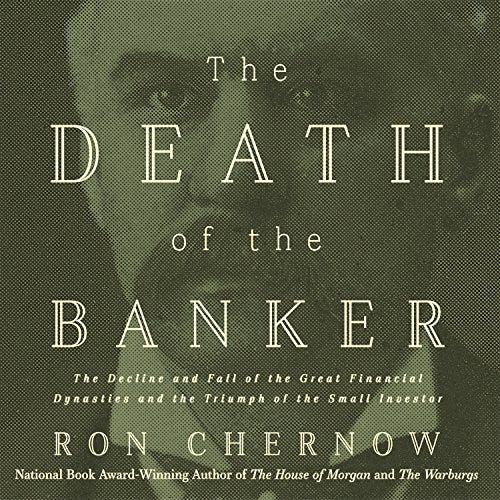
Rating: 8.5/10
This is my first Chernow book. As the author of biographies on Washington, the Warburgs, JP Morgan, and Rockefeller, Chernow stands alongside Robert Caro in his ability to illuminate the creation and transition of power in the modern era.
In “The Death of a Banker,” Chernow tracks power over time through a simple framework of (1) suppliers of capital, (2) consumers of capital, and (3) the middlemen (the bankers), crafting a compelling financial history. For someone entering the finance industry, it serves as an excellent primer on understanding my place in a value chain that shapes not just individuals and corporations, but entire states and nations.
If you do read it, ask yourself: where do Elon Musk, Steve Jobs, Bill Gates, and Warren Buffet fit in this? Additionally, while capital is a commodity in America, it most definitely is not in many parts of the world. How does that change your view on risk?
Rothschilds
They were bankers for European governments. The original Rothschild founder was a collector of rare coins to the Prince of Hesse and then other noble patrons. Soon, the family provided not only coins but also banking services to Germany, France, Britain, etc. They did not expand into the US, which they saw as more of a 2nd rate risky country and which would ultimately wane their influence
JP Morgan.
Born and raised in a more European society going to boarding school in Hartford, Switzerland/Germany, and vacationed in London. His lifetime saw the rise of relationship banking. He held the entire US economy in his hands, benefiting from the interest from European (London) capital to get to these high-yield railroad securities.
these companies were often mismanaged and investors wanted boots on the ground to be able to represent their interests. JP Morgan was happy to play the part with the power from the shareholders.
He was able to bring discipline to the industry via his brand name. People would be more likely to invest in him than the stock itself, and so he was able to be on the board of dozens and dozens of companies, even though he wasn’t a technical railroad man himself (he had people for that)
Vanderbilt Railroad saga
Morgan’s strength was due to the immaturity of the financial markets. If the markets were as deep as they are today, he could’ve used the trading desk of multiple global investment banks, but back then he used his relationships to find receptive pools of capital
in the US there was a deep distrust of a centralized power, and so the government had killed the 2nd bank of the United States, putting power in the decentralized hands of local banks. If regional banks had existed with the power to fund the growing needs of the Industrial Revolution, JP Morgan may never have had a place and Wall Street may not have taken up the power that it did
John D Rockefeller
Took advantage of the oil boom and brought discipline to the industry. He had a deep distrust of bankers. Back then, bankers had a distaste for oil stocks because they were speculative compared to railroads which were already speculative enough. Rockefeller grew standard oil to become mighty and used retained earnings to fund growth and acquisitions. SO was always wary that Wall Street would turn its back on the company and so Rockefeller wanted to keep control. Rockefeller and JP Morgan disliked each other, being radically different people in terms of lifestyle and morality, as well as in terms of business ethos.
Rockefeller and JP Morgan operated in the United States which lacked the anti-trust measures of the early 1900s. They worked in a financial market that didn’t have the Glass Steagle Act (1933) or the US Securities Act which mandated information disclosures.
After this investment bankers no longer were able to “inside trade” legally, and so their information advantage came to an end. Decades later we saw the rise of mutual funds and institutional investors displace the power of traditional investment bankers
Cher argues that both Japanese and German banks had the same problem. They were strapped to a dying lending business and not exposed enough to more efficient, albeit dynamic, stock/bond markets.
Japanese banks heaped cheap loans on client companies until they staggered with unhealthy debt, whereas American banks would abandon banks for the stock and bond markets.
The absence of commercial markets restricted financing to a group of long-term banks with a monopoly on blue-chip lending.
The Japanese preferred growth, security, and stability to corporate profitability and high ROA in the post-war period. Govt fixed lending rates so companies didn’t have incentives to search for better — bankers behaved like diligent civil servants. “Loss Leaders.”
Japanese companies shifted to euro-dollar bonds (the 1970s). Strong export business, so Japanese companies reinvested their capital in subsidiaries and real estate.
Interest rates deregulated in the 1990s --> companies lost the incentive to stay hitched to their historic bankers.
In the early 1990s, the real estate bubble popped —> Japanese companies lost their collateral behind many loans and increased bad debt. While the companies were in a worse place, the banks were happy they didn’t need to continue propping up overextended clients on nominal, cheap interest rates.
Disillusionment with the cross-shareholding system
This reminds me of how when Standard Oil was trust-busted, the value of each individual corporation became greater than the value of the whole.
The exclusivity of the investment banker was destroyed when IBM brought Solomon Brothers in, where the historical relationship was with Morgan Stanley —> IBs competing for deals based on price… profit margins on underwriting went down which led to relational to transactional structure
Providers and consumers of capital became more powerful than bankers in the post-war era
New revenue source was as strategists, helping outsiders storm the executive suites.
The downfall of the banker with high switching costs —> corporate raider of the 1980s. Deadly short-term orientation (downsizing vs long-term growth strategy).
Takeover wars —> Multimillion dollar fees, bridge loans, and issuing junk bonds (the 1980s)
In retail banking, they bundle loans (credit cards, mortgages, etc) into securities that can trade like bonds. They blended the line between securities and underwriting… making it meaningless.
Glass Steagall Act was repealed by Clinton in 1999: ratifying, not revolutionizing, what was already happening
Many buyers had IBanks issue fairness opinions for mergers, but gone were the high-priced fees
At this point, GM, GE, IBM, AT&T, and Ford all had large corporate “bank” operations within themselves… All of them had tons of cash, just like Standard Oil used to (high liquid assets)
We hear this often in the story of Jack Welsh, and this ultimately led to a lack of focus on GE's core focus and a bad focus on "earnings"
History showed us this got unwinded
Same story: Banking emerging from successful commerce
IBankers haven’t fully declined, as they have nimbly shifted to fee-based work, brokerage commissions, their own capital providers doing proprietary trading, their own buyout funds, and portfolio management (their own mutual funds, pampering corporate or institutional clients).
But banking (wholesale lending) has declined
Human life expectancy lengthened —> (1) Can an overextended welfare state support aging populations at existing funding levels? (2) Can corporations afford adequate retirement programs in a globally competitive environment, (3) Can medical insurance keep pace with medical technology costs
The inflation of the 1970s killed faith in long-term bonds. The deflation of the 1980s killed faith in real estate. —> The stock exchange became souped up retirement plan
Americans now manage their own retirement plans, whereas before corporations would do that for them
Classic corporate raider strategy
Mutual funds can be seen as a wholesale raid on bank deposits
As of 2024, 52% of American households hold money and mutual funds
However, they don’t have a moat because it’s so easy to transfer money from one to another. For the most part, they ride the bull market and the bear market relatively similar to the S&P 500.
The Morgan Stanly Dean Witter merger was symbolic of the convergence of the banking, brokerage, and even insurance industries into a single all-encompassing financial services industry
Famous JPM quote 1:
Q: Is not commercial credit based primarily upon money or property?
JPM: No, sir. The first thing is character.
Q: Before money or property?
JPM: Before money, or anything else. Money cannot buy it.
Famous JPM quote 2:
Q: But the basis of banking is credit, is it not?
JPM: Not always. That is an evidence of the banking, but it is not the money itself. Money is gold, nothing else.
Gold is a physical good, while credit is essentially a promise. Gold can never default, but credit is only as good as the character of the borrower
The Warburgs
Jewish people were pushed into the role of banking because Christian people viewed interest as a sin and they looked down on these types of roles.
After the 30-Years War, many princes were starved of the capital that they needed and so would go to these Jewish bankers to arrange financial services.
Because Jewish people had a diaspora across many states they were well-equipped to handle cross-border transactions. For these services, they got titles from the crown and wealth
The Warburgs served the German state to a tee. They had not devised or plotted against it. They were a perfect emissary for diplomatic missions because of the secrecy their craft relied on.
5 brothers
The first was a bibliophile who collected over 531 boxes of books that eventually were shipped to London to start the Warburg Institute
The second wanted to join the army but became a banker. He bankrolled his brothers' book collection
Two Warburgs had marriages with the American Wall Street elite allowing them access to a pool of capital.
Paul Warburg moved with his wife Nina to New York and worked for Kuhn, Loeb & Co., at which point he had seen one of America’s financial panics. He had discussed the need to create a central bank and had published a famous letter during the next financial panic. He architected the Federal Reserve Bank and was appointed as vice chairman
Siegmund Warburg
Created a major British investment bank after escaping from Germany. Super uphill battle and had insane attention to detail
Eventually got absorbed into the predecessor of UBS
"You can keep alive the spirit of a man but not the world that sustained him"