
Slaughterhouse-Five by Kurt Vonnegut

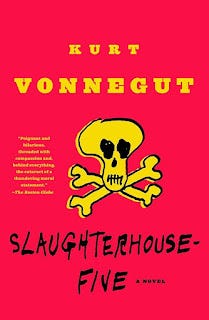
I had always heard of Slaughterhouse-Five (Schlachthof-Fünf) as an American classic. It's one of the great anti-war books of its era and it does so not by depicting tear-filled horrific scenes, but through distant observation and deeply ironic humor. Billy Pilgrim, the main character who can allegedly time travel throughout his life, has accepted what is, was, and will be. He was abducted by an alien race called the Tralfamadorians who have shown him the truth about time and the nature of the universe. More likely, Billy has gone mentally crazy and relates to life around him in a somewhat insane and emotionally distant way to protect himself.
Why do I like the book:
"So it goes" --> a phrase used to shrug off or accept death. It's a different way of looking at life
Traflamadore as an extended metaphor for the evasion of life's hardships or as a less emotionally cruel way to look at tragedy
It's an easy read, but Vonnegut clearly tells his story well
I love absurdism
The line between Vonnegut's personal memoir and Billy Pilgrims experiences tends to blur, leaving a lot of room for gray area and interpretation
References back to Mother Night, a different book in the series
It's built on history
The mini metaphors always pack a punch. Especially Kilgore Trout's good ideas with terrible deliveries.
Quotes:
From Words for the Wind by Theodore Roethke: I wake to sleep, and take my waking slow. / I feel my fate in what I cannot fear. / IO learn by going where I want to go.
Like so many Americans, she was trying to construct a life that made sense from things she found in gift shops. And the crucifix went up on the wall of Billy Pilgrim.
Billy coughed when the door was opened, and when he coughed he shit thin gruel. This was in accordance with the Third Law of Motion according to Sir Isaac Newton. This law tells us that for every action there is a reaction which is equal and opposite in direction. This can be useful in rocketry.
I am a Tralfamadorian, seeing all time as you might see a stretch of the Rocky Mountains. All time is all time. It does not change. It does not lend itself to warnings or explanations. It simply is. Take it moment by moment, and you will find that we are all, as I've said before, bugs in amber." "You sound to me as though you don't believe in free will," said Billy Pilgrim.
"If I hadn't spent so much time studying Earthlings," said the Tralfamadorian, "I wouldn't have any idea what was meant by 'free will.' I've visited thirty-one inhabited planets in the universe, and I have studied reports on one hundred more. Only on Earth is there any talk of free will."
And Tralfamadorians don't see human beings as two-legged creatures, either. They see them as great millepedes-"with babies' legs at one end and old people's legs at the other," says Billy Pilgrim.
Each clump of symbols is a brief, urgent message describing a situation, a scene. We Tralfamadorians read them all at once, not one after the other. There isn't any particular relationship between all the messages, except that the author has chosen them carefully, so that, when seen all at once, they produce an image of life that is beautiful and surprising and deep. There is no beginning, no middle, no end, no suspense, no moral, no causes, no effects. What we love in our books are the depths of many marvelous moments seen all at one time.
Before you kill somebody, make absolutely sure he isn't well connected. So it goes. The flaw in the Christ stories, said the visitor from outer space, was that Christ, who didn't look like much, was actually the Son of the Most Powerful Being in the Universe. Readers understood that, so, when they came to the crucifixion, they naturally thought, and Rosewater read out loud again: Oh, boy-they sure picked the wrong guy to lynch that time! And that thought had a brother: "There are right people to lynch." Who? People not well connected. So it goes.
The guide invited the crowd to imagine that they were looking across a desert at a mountain range on a day that was twinkling bright and clear.
They could look at a peak or a bird or a cloud, at a stone right in front of them, or even down into canyon behind them. But among them was this poor Earthling, and his head was encased in a sted sphere which he could never take off. There was only one eyehole through which he could look, and welded to that eyehole were six feet of pipe. This was only the beginning of Billy's miseries in the metaphor. He was also strapped to a steel lattice which was bolted to a flatcar on rails, and there was no way he could turn his head or touch the pipe. The far end of the pipe rested on a bi-pod which was also bolted to the flatcar. All Billy could see was the little dot at the end of the pipe. He didn't know he was on a flatcar, didn't even know there was anything peculiar about his situation. The flatcar sometimes crept, sometimes went extremely fast, often stopped went uphill, down-hill, around curves, along straightaways. Whatever Poor Billy saw through the pipe, he had no choice but to say to himself, "That's life."
Speeches by Howard Campbell Jr.
America is the wealthiest nation on Earth, but its people are mainly poor, and poor Americans are urged to hate themselves. To quote the American humorist Kin Hubbard, "It ain't no disgrace to be poor, but it might as well be." It is in fact a crime for an American to be poor, even though America is a nation of poor. Every other nation has folk traditions of men who were poor but extremely wise and virtuous, and therefore more estimable than anyone with power and gold. No such tales are told by the American poor. They mock themselves and glorify their betters. The meanest eating or drinking establishment, owned by a man who is himself poor, is very likely to have a sign on its wall asking this cruel question: "If you're so smart, why ain't you rich?" There will also be an American flag no larger than a child's hand glued to a lollipop stick and flying from the cash register.
Americans, like human beings everywhere, believe many things that are obviously untrue, the monograph went on. Their most destructive untruth is that it is very easy for any American to make money. They will not acknowledge how in fact hard money is to come by, and, therefore, those who have no money blame and blame and blame themselves. This inward blame has been a treasure for the rich and powerful, who have had to do less for their poor, publicly and privately, than any other ruling class since, say, Napoleonic times. Many novelties have come from America. The most startling of these, a thing without precedent, is a mass of undignified poor. They do not love one another because they do not love themselves. Once this is understood, the disagreeable behavior of American enlisted men in German prisons ceases to be a mystery.
Howard W. Campbell, Jr., remained standing, like the guards. He talked to the guards in excellent German. He had written many popular German plays and poems in his time, and had married a famous German actress named Resi North. She was dead now, had been killed while entertaining troops in the Crimea. So it goes.
Note to self: I had just finished reading Mother Night, of which Campbell is the main character. In the book, his wife is Helga North (Resi's older sister) and Resi only becomes his lover decades later while he is in America. I think this was an oversight
These fictitious people in the zoo had a big board supposedly showing stock market quotations and commodity prices along one wall of their habitat, and a news ticker, and a telephone that was supposedly connected to a brokerage on Earth. The creatures on Zircon-212 told their captives that they had invested a million dollars for them back on Earth, and that it was up to the captives to manage it so that they would be fabulously wealthy when they were returned to Earth. The telephone and the big board and the ticker were all fakes, of course. They were simply stimulants to make the Earthlings perform vividly for the crowds at the zoo--to make them jump up and down and cheer, or gloat, or sulk, or tear their hair, to be scared shitless or to feel as contented as babies in their mothers' arms. The Earthlings did very well on paper. That was part of the rigging, of course. And religion got mixed up in it, too. The news ticker reminded them that the President of the United States had declared National Prayer Week, and that everybody should pray. The Earthlings had had a bad week on the market before that. They had lost a small fortune in olive oil futures. So they gave praying a whirl. It worked. Olive oil went up.
"If you're ever in Cody, Wyoming," he told himself, "just ask for Wild Bob."
Trout lost his argument with the boy who wanted to quit. He told the boy about all the millionaires who had carried newspapers as boys, and the boy replied: "Yeah—but I bet they quit after a week, it's such a royal screwing.
"That's not a human being anymore. Doctors are for human beings. They should turn him over to a veterinarian or a tree surgeon.
Robert Kennedy, whose summer home is eight miles from the home I live in all year round, was shot two nights ago. He died last night. So it goes. Martin Luther King was shot a month ago. He died, too. So it goes. And every day my Government gives me a count of corpses created by military science in Viet-nam. So it goes. My father died many years ago now—of natural causes. So it goes. He was a sweet man. He was a gun nut, too. He left me his guns. They rust.
The earthling figure who is most engaging to the Tralfamadorian mind, he says, is Charles Darwin—who taught that those who die are meant to die, that corpses are improvements. So it goes.