
Siddartha by Herman Hesse

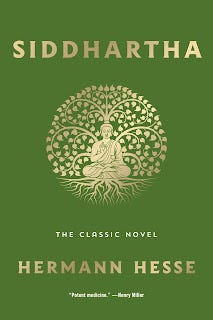
Siddartha by Herman Hesse explores the evolution of "the self." No matter where you start, whether as a monk, merchant, or marine, you can't fully grasp what others experience. The story covers riches, deprivation, detachment, and immersion. Siddartha, the main character (not to be confused with the Buddha, who is a separate character), believes that enlightenment must be lived, not taught. He leaves his life as a brahmin to learn about love, business, gambling, and more. At his lowest point, he realizes that he suffering is a truer form of understanding than being ignorant from struggles of the people around us. For him, it's about connecting to the world and having a childlike wonder. The story has many ups and downs, even after the point where Siddartha seems to find salvation. The book challenges the idea of detaching from worldly things and encourages people to experience life and form their own conclusions. I felt a strong connection to the idea that there are no rules (quote, Ryan Baudo) or doctrines we must follow. Life is its own teacher.
Everyone gives what he has. The soldier gives strength, the merchant goods, the teacher instructions, the farmer rice, the fisherman fish. I can think, I can wait, I can fast.
Now he saw it and saw the secret voice had been right. No teacher would ever have been able to bring about his salvation. Therefore he had to go out into the world. Lose himself to lust and power, to woman and money; had to become a merchant, a dice gambler, a drinker, a greedy person, until the priest and sumana in him was dead. Therefore, he had to continue bearing these ugly years, bearing the disgust, the teachings, the pointlessness of a dreary and wasted life up to the end, up to bitter despair. Until Siddartha the lustful, Siddartha the greedy, could also die. He had died. A new Siddartha had woken up from the sleep. He would also grow old. He would also eventually have to die. Mortal was Siddartha. Mortal was every physical form, but today he was young as a child — the new Siddartha was full of joy.
(Express to each person or thing how special what is special to them. Admire the beauty and serenity of the river to the ferrymen; the virtue of silence to the monk; the diligence and regiment for the warrior or athlete. Let them know that you also find the object of their life’s worship as mutually sacred.)
Did you too learn that secret from the river, that there is no time… the river is everywhere at once. At the source and at the mouth, at the waterfall, at the ferry, at the rapids, at the sea, at the fountains: everywhere at once. And that there is only the present for it. Not the shadow of the past; not the shadow of the future. This it is, and when I looked at my life, it was also like a river. And the boy Siddartha was only separated form the man Siddartha and the old man Siddartha by a shadow, not something real. Also Siddartha’s precious births were no past and his death and his return to brahma was no future. Nothing was, nothing will be, everything is. Everything has existence and is present. Oh, was not all suffering time, were not all forms of tormenting oneself snd being afraid: time. Was not everything hard everything hostile in the world gone and overcome as soon as one had overcome time. As soon as time would have been put out of existence by ones thoughts.
In the story, the sound you hear when you succeed in hearing all of the rivers infinite voices all at once is "ohm." This is such a mystical thing for me to think about, especially growing up in a Hindu household and hearing my dad chant "ohm" every morning.
When someone is searching, then it might easily happen that the only thing his eyes still see is that which he searches for. That he is unable to find anything. To let anything enter his mind because he always thinks of nothing but the object of his search. Because he has a goal, because he is obsessed by the goal. Searching means having a goal, but finding means being free. Being open, having no goal.
Wisdom cannot be passed on. Wisdom, which a wise man may pass on to someone, always sounds like foolishness. Knowledge can be conveyed but not wisdom. It can be found, it can be lived, it is possible to be carried by it; miracles can be performed by it — but it cannot be expressed as words or taught. It’s what has driven me away from the teachers.
The opposite of every truth is just as true. Every truth can only be expressed (put into words) when it is just one-sided. Everything is one-sided when it is thought with thoughts and said with words. It’s all one-sided; all just one half; all lacks completeness, roundness, oneness.
The world itself and what exists around us and inside us is never one-sided. A person or an act is never entirely sansara or entirely nirvana; a person is never entirely holy or entirely sinful. It does really seem like this because we’re subject to deception, as if time were really real.
The sinner is not on his way to become a buddha. He is not in the process of developing, though our capacity for thinking does not know how else to picture these things. No, within the sinner is now and today already the future Buddha. His future is already all there. You have to worship in him, in you, in everyone, the buddha that is coming into being. The possible, the hidden buddha.
All sin already carries the divine forgiveness in itself. All small children already have the old person in themselves. All infants already have death. All dying people, the eternal life. It is not possible for any person to see how far another one has already progressed on his path. In the robber and the dice gambler, the buddha is waiting. In the brahmin, the robber is waiting. In deep meditation, there is the possibility to put time out for existence to see all time that was is and will be. As if it was simultaneous.
Death is to me like life. Sin, like holiness. Wisdom like foolishness.
I’ve experienced on my body and on my soul that I needed sin very much. I needed lust, the desire for possessions, vanity, and needed the most shameful despair in order to learn how to give up all resistance. In order to learn how to love the world. In order to stop comparing it to some world I wished, I imagined. Some kind of perfection I made up. But to leave it as it is, to love it, and to enjoy being a part of it.
The words are no good for the secret meaning. Everything always becomes a bit different as soon as it's put into words. Gets distorted a bit, a bit silly... This, what is one man's treasure and wisdom always sounds like foolishness to another person.
I can love a stone, Govinda. And also a tree or a piece of bark, these are things and things can be loved. But I cannot love words. Therefore, teachings are no good for me. They have no hardness, no softness, no colors, no edges, no smell, no taste. They have nothing but words. Perhaps it is these which keep you from finding peace. Perhaps it is the many words. Because salvation and virtue as well, sansara and nirvana as well, are mere words Govinda. There is no thing that would be nirvana, there is just the word "nirvana."