
Negative Space by Robert Steiner

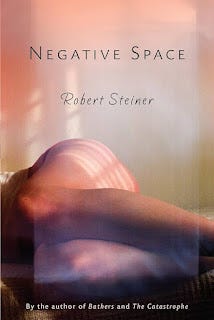
I was reading with Aagam last semester and we were talking about how to choose a book. Aagam preferred serendipity -- picking up a random book and giving it a chance. I decided I would do that for my next read. A few days later, outside of the Free Library of Philadelphia (outside Gutmann College House) was a cart full of books that were free to take. The first few pages of Negative Space seemed totally outside what I normally read, so I decided to pick it up.
In the book, Robert Steiner tries to crack and explore the cavity of infidelity and uses the harrowing experience of a man who is cheated on by the “the woman I love.” Steiner works backwards starting with the case of infidelity and then creating the silhouette of a life and the principles of both his main character and the woman.
Right in the beginning, there is a cognitive dissonance, as the narrator refers to the woman as both “the women I love” and “my wife”; later in the book, unable to choose the latter, she singularly becomes “the woman I love” – an all-purpose general statement which begs the question of identity. Who is she to him, or anyone else for that matter? This is a really long list of quotes – some more striking than others, but all of them a really fresh perspective on what the “ecosystem” of infidelity may be feel like.
Everyone lives with the truth that the person to whom they are closest in the world is different from them and, because of it, capable of anything.
Loving her had made a hostile universe livable
→ MC views the universe as a cold place, a glass half-empty. Denotes weakness in his own sense of self and purpose
She accused me of driving her into someone else's arms, or if not, then yearning for it, which seemed to her more perverse than the perverse acts she enjoyed, and continued to enjoy, with her lover
A mauvaise foi, which, she insisted, might have encouraged her infidelity the way learning your loved one loves pornography can lead to pornographic acts with someone other than your loved one
→ bad faith (mauvaise foi) is the psychological phenomenon whereby individuals act inauthentically, by yielding to the external pressures of society to adopt false values and disown their innate freedom as sentient human beings.
Because the woman I love had found a different voice at sunset on our terrace, she renewed my passion for her, and because another man had touched her body, I wanted to touch it, too.
→ Jealousy evoking passion
She had to confess so that, afterward, she could celebrate her passion… Her love for me, she insisted, ran so deep that being swept away by her lover had left her feeling as if she might die, and not only from guilt and fear, but also from her sexuality, which made her realize that she had been alive without breathing. After twenty years with you, she said, I’ve forgotten how to breathe
Desire desires nothing so much as an end to itself, turning into memory, then turning memory into the idea of desire, or the passionate contemplation of it
Like adultery, jealousy acts out our direst dreams without thinking of consequences, though there are consequences. Jealousy’s sufferings are unthinkable, I said, until they’re thought of, and then they’re unbearable until avenged. I told my wife that I wanted to touch every inch of her body in order to know if it felt as if I had never touched it before, or if I had touched too much of it too many times, or if it was repellent because someone else had touched it
In twenty years of marriage, I have never interpreted my wife because I did not need to, or thought I did not. Suddenly, because she was leaving, she would be known to me as variations on the theme of the woman I love, of the woman I cannot help but love, as angles of complexity that rest side by side
→ cognitive dissonance
By abandoning our marriage, my wife would make me an object to myself, my own otherness, replacing no less than herself as the otherness in my life.
If the world does not come to an end after my wife deserts me, then I will be a man who is waiting for the world to come to an end, and that would mean being a man for whom the world is irreparable.
The perfect intimacy conferred by inferred endings to each other's thoughts and sentences was provably untrue. Even though the woman I love constituted the content of most of my thinking, most of the day any day, it occurred to me, in the dark, on our terrace, that rather than knowing her because of all this thinking about her, my assumption of intimacy had made me an accomplice to her adultery.
I know who I am because I know you, I would say to my wife of twenty years.
→ Identity being linked to another person is dangerous.
Once it occurred to me we could have spent twenty years together, every day and every night, without knowing each other at all, I wondered if the woman I love had ever been the woman I should have married, or if I should have married anyone, ever.
If she were to leave me for the lover, it would be because she viewed her life as meaningful without me and that she had come to view her life with me as inauthentic, false, or lacking conviction. Because she now saw that our life of twenty years was based on false consciousness, she could conclude that I would be better off without her, as she without me, free to seek an authentic consciousness
My newlywed wife assumed that someone as passionate as I was, and am, would desert someone like her once I discovered how little she understood her own passions and how poorly she could articulate her deepest needs. I'm visual, my wife liked to say, not verbal. She believed that I would leave her once my ambitions in the external world began to be realized so that I could realize the passions of my private life as well.
Within a few years of telling me this, my wife began to be successful in her career, then noteworthy, and now it was she, not I, who had fallen in love and was about to leave. She said at the time of our wedding, twenty years before she fell in love with someone other than me, that she expected one day I would leave her for someone more interesting and beautiful, which meant to me, twenty years later, since she had now fallen in love, that she must have concluded the new lover was more interesting and more handsome than I.
→ Someone with this insecurity is bound to do the same, if given the chance and enough time. Shows the importance of choosing a partner out of more than just desire or admiration, but as someone who could sustainably contribute to “two” people attacking something as a team (instead of “one”)
Deserting me for a new lover, let alone reminding me of misgivings about herself that she had expressed the day of our marriage because her misgivings were now proving convenient.
Because she fell in love with adultery, the adultery became a adult romance, so not knowing herself was both the explanation for falling in love and its reward
→ the nature of love in adultery is a self-fulfilling vicious cycle unless if made with a common third, sustainable passion between the two people cheating?
When she said during the confession, I don't know what I want, I realized that she knew what she wanted and I was not going to be happy about it.
The end of the world is the next thing to happen because it is the only thing that has not happened.
When the woman I love was in Sri Lanka, St. Petersburg, or Berlin promoting the exhibition of her works, weeks could pass before I received so much as a postcard, and if I telephoned her hotel or leased apartment, I invariably spoke to a machine or had to ask a clerk to leave my wife a message. Often the clerk's hesitation or the tone of his voice made me believe he was lying beside my wife at that moment, that I had not reached the desk in the lobby but my wife's hotel room, an absurd notion suggesting how my wife's neglect unnerved me. I did not think she was having an affair with a desk clerk or that a lover was pretending to be a desk clerk if I telephoned, but her indifference when we were not together reminded me of the indifference of someone in the throes of an affair.
I enjoyed the solitude and enjoyed missing her, remembering what her presence meant to me, indulging the loneliness that made me feel calm and wise, reclusive rather than lonely, that prepared me to be a better person once she returned home. Occasionally, I hoped my wife would remain longer than she did so that I could appreciate her presence even more. Gradually, however, the separations bewildered me. As the separations grew longer, as she was more and more absent, she would return home just as distant from me as if she were still gone.
When we were apart, I suspected she was trying to miss me, hoping she would be eager to return, but once she was home she would also be disappointed because she realized she preferred where she had been to where she was, and that while she had been away, she had been dreading coming home.
When she returned home, not fully present, she immediately began new work that would take her away as soon as it was completed, a way of being cheerful and optimistic around the house, instead of being full of dread because she was in it.
→ I suspect many working professionals that struggle with their relationship are like this. I also feel like the odd benefit of reading a book like this is to put your feet inside the shoes of another character, so as to have the requisite distance required to know what the pain of such an action is and to where it can lead if unchecked. Thus in the future, it allows a reader to (over?)think for oneself.
I permitted my wife to know me completely over twenty years, and, as a result, she decided that she would prefer to know someone else instead.
My wife could not believe in the reality of her new love if she did not believe in the unreality of the old. The new reality required a new language that envisioned a new world, a new way of seeing, a way that must begin as an alternative vision to the vision she would have mastered over twenty years and which now would be displaced, or even erased, because she had come to suffer rather than enjoy it, concluding that the vision had been false compared to the new needs embodied in the new reality. Perhaps darkness and silence were different for my wife too, but she enjoyed the difference.
My wife had earlier carped that our marriage had swallowed her, which was why the affair began, but now that the affair had swallowed her, she realized our marriage had not, and that being swallowed whole had been what was missing from it.
→ Seems like the personality of someone who is not comfortable with the idea of moderation; someone who lacks 2nd degree consequences. Life should be passionate, but to what end? (Question to mull on)
If the woman I love deserted our marriage, I would be free for the first time in twenty years and so would face the truth that I did not want freedom, that not only would I not feel enlivened by the freedom to do anything I had not done while I was married, but also I would face the recognition that there was nothing I wanted to do.
→ Fear of freedom, fear of being purposeless… it forces one into a choice of questioning their individuality and inescapable alone-ness in the universe. I don’t think that’s a bad thing to routinely remind and ask yourself about.
It occurred to me that my wife had come to despise me for my emotional indolence, as she named it from her new universe, because I had spent years without questioning why they were passing the way they did.
I had never loved my wife more than when she was leaving me. No matter how banal or ridiculous the end of our marriage might become, I needed to salvage my wife’s erotic power over me… Once my wife returned to the terrace, I would explain that I intended to hold in my imagination her constantly nude image, years after she was gone, perhaps decades.
→ This guy is a simp HoLy sHit. He’s also caught in a delusion and is going absolutely hysterical. It’s like a weird confusion of sadness and eroticism mixed in with the image of his nude wife
I knead the fat of her buttocks as if preparing her for an oven.
→ that’s some Hansel & Gretel shiz
It is necessary for me to believe that one day my wife will feel the loss of me as painfully as I will feel the loss of her and that she will discover pleasure is not as pleasurable as she expects and pain more painful than she ever dreamed.
Having attributed to her so much intrinsic value, as soon as I knew she intended to leave, I was condemned to eliciting no meaning whatsoever from the external world.
Our intimacy must have ended before the adultery began, or the adultery would not have happened, or happened once, but not twice, or at least love would have remained out of the question.
→ Wonder if that part is true for most people who cheat. How often can one romantically love many people at the same time?
As soon as I realize I will never see her again, everything I want to say and hear will rush into my head, incoherent, incomplete, raving. By the time I could be certain I was asking the important questions, or stating the important statements, my wife would be no longer interested in statements or answers because she had abandoned our space and our time, sighing relief, with a stride into a future of nothing but possibility.
→ People should conserve room for “possibility” within the various spheres of their life (career, family, hobbies)
I would harbor the conviction that my wife must return to me, believing it in order to remain the person I have been for decades.
→ S.I.M.P.
You've said, my wife said, that eventually everyone is miserable because they age, and aging tenderizes us for the slaughter. Eventually, everyone feels sorry for himself out of self-preservation, my wife said I said.
Because she was in love, her lover's opinion was all she needed to flourish, so now she could clarify how much she had disagreed with me over two decades, since now she was in agreement with him, just as his desires were the only desires she desired to meet. His needs were hers, his urges her urges, her urges his, and all of their urges urgent.
→ Correction: “her prediction” of his needs were hers, “her prediction of” his urges her urges, “her prediction” of his needs were his, and all of “their predictions” of their urges urgent.
Lol we can’t read minds duh
My wife often said she could not imagine being happier, which I understood to mean that she was happy, instead of which she could have meant that she was unhappy but did not expect the situation to improve, that our marriage was beyond salvation
Nothing happened because everything happened
→ Out of context, but in the world of terrorist plots, it’s because of defense, espionage, and national security that we stop the natural entropy and see so relatively few bombings
I lost interest in finding my hotel, instead strolling in search of other people's privacy, hoping to violate it. I had an urgent desire to think I was more like the people on the street than not because it was evening, and I could not bear the prospect of myself for company am fortunate that to overcome the dread of being alone, I need only overhear human conversation, and not much of it, and not often, so I stepped into the spaces of couples who were trying, in the wide arc of things, to justify sharing the planet.
Everything that happens in the ordeal will have already happened, and nothing that happens has not already happened, hundreds of thousands of times before, not to me, but to others. The ordeal has happened elsewhere, to someone else, hundreds of millions of times, but it is no less mortifying to me than if it were happening for the first time in human history.
→ Ahhhhh, the wonderful human experience.
Before the end of anything, I realized, people have a lot to say. I had things to say to my wife before she left, if she was leaving, and would have a thousand things more after she was gone. Imagine if, after death, we were allowed to speak. That is what the ordeal is going to be, I realized, millions of words spoken out of one void and into another, and were there an audience, it could only be a force of evil.
→ I like this roundabout definition of ordeal
At the outset of the ordeal, I would not want to sacrifice the love I have had for my wife, and continue to have, by eviscerating her memory. I would need to preserve our love, including her love for me, which she had forgotten as if she had been struck by a bus and did not remember her name or her life before the accident. Because she is the person I thought I knew, but did not, I am the person responsible for wrong thinking. I am here; she is not; she is somewhere else, I thought on our terrace. None of these simple sentences would crack the cavity of our marriage.
Darkness, silence, nudity–death threats.
After the confession, I would learn that loving my wife was easier in her absence than with her in front of me to contradict my feelings because of her feelings for someone else. The more I expressed my love for her, the more the woman I love regretted having lost her love for me, eventually resenting my love for her, calling it a claustrophobic love. When she loved my love, it was liberating, but when she did not, it was not.
→ Always the question of if one gets moe or less affectionate when there is trouble in a relationship
Without my wife, everything will be more distinct because everything will be shaped by her absence, as if she had been standing between me and everything else for twenty years, blotting out the sun with her large, nude, rapacious body.
→ Especially for him, the physical is so directly connected to the emotional and mental
After two decades, I was suddenly shy about my wife observing the most vulnerable moment of my life, even though she had been present at the previous one, when I knew I wanted to marry her.
So she would patronize me in conversation, offering to others her fulsome praise of me, the praise that victimizes the victim over and over again
If she lied during the confession, it would be to spare my feelings, but also to spare herself my feelings about her adultery and, therefore, she would lie to spare herself her feelings about herself, possibly even feelings about the lover for whom she was abandoning me and our marriage of twenty years.
I was certain about one thing only, that my wife’s behavior toward me during the months before her confession constituted lies of commission, devotions to my personal well-being designed to provide me a sense of secu-rity, even a deeper warmth, an indulgence of me that was a sign of maturated love. Cooking, baking, bathing me, massaging me, masturbating me-for a time, I feared I had a terminal illness but was not being told.
I thought I was discovering how much I still loved you, she admitted, but instead it was how, not how much, and the conclusion was not good, unless I wanted a roommate. Then too, I felt guilty, she said, because the sex with him made me feel so good, I wanted you to feel good too, but I couldn't do for you what he did for me because I love him. In addition to being disgusted by it, I found that having the same sex with you as I was having with him was impossible because I felt that I was betraying him with you, not the other way around. I've felt more unfaithful to him than to you, my wife confessed.
I realized my wife suffered nothing by looking at me because for her everything had already changed.
I walked our house as if it were a museum instead of a small house in the country, though small houses often become museums
The woman I love was always preparing to leave and knew it, or she became the woman I love preparing to leave. What would it mean for her to be the woman she has been and the woman she has become.
→ Identity
The reason I believed the say sh of her on even of myself. while could not say tha I knew my wife better than I knew myself was that I hat observed her for twenty years, and l considered often and ar length what I observed of her, all that I gathered to be her authentic self, but I could not observe myself in the same way because I was occupied being myself, as often as not being the husband observing the woman he loves, though not always, not until recently, not incessantly, until the last few months. I believed I knew my wife better than she knew herself because, like me, she was busily being herself, being and becoming herself, busier being and becoming than she could have been if she had been observing herself. What I did not know was that she reserved her being for our mar-riage; her becoming, the lover.
→ Being vc. Becoming. Observing is being himself but being himself is becoming
What had been he difference between our authentic passion and what had become my inner experience
my jealousy over her decision to share her body with her lover had increased my desire for her, and that the new lover loving her nudity only made it more valuable to me
→ Objectification??
She was already a distant object to me, with no interior life.
SHe was no longer in love with me, certain that she could not fall in love with me again, could not be swept away by me no matter which sensual, or sexual, or romantic gestures I might perform in the future, a future rife with bitterness and regret
→ There’s an Anderson Paak song called Make It Better
That is why people who leave other people are eventually divided into parts, becoming human remains discovered at the scene of the crime.
I would undergo the unspeakable sensations of dread and formlessness and would not be thinking about her after she was gone so much as thinking of the thought of her. I would be trapped in my thought of her, thinking I was thinking of her, but I would always be thinking of losing her. I would experience an even more powerful emotion than my love for her because my love would no longer have my wife as its object.
→ Objectification again.
What had been for decades you and I had become he and I, italicizing the fact that we must have always been separate and alone, that in spoons at night in bed, we may as well have been thousands of miles apart, planets apart, different species on planets apart, because human beings delude themselves that someone will love and understand them until they die. First, you and I will understand each other until we die, then he and I will do it.
Without her, I could not be anything other than the result of her absence, but with her, for two decades, I could not have been anything other than the husband waiting for his wife to leave.
I had not been fulfilled by our marriage, but I had accepted that neither is anyone else by theirs.
She said, with bitterness, that I used regret for the past to sabotage the present. She had never thought of herself as disloyal, she said with anger, until she became dis-loyal, then became dishonest because of it, then cunning, a word she would never have used about herself until now. Once she had become all these things, she knew she was in love
Was my wife reassuring me of her love or trying to convince herself of it or forcing herself to remain in our marriage by committing herself to words she knew I would believe?
Once the ordeal began, I would only be interested in everything I associated with my failed marriage, whatever pointed to our ruin, to our annihilation as husband and wife, including gratuitous images of sexual excess, then betrayal.
By leaving her lover, my wife left me again.
Only today, I discovered the maroon Burberry hanging on a hook behind a door in the cellar. It looked like a suicide.