
Mother Night by Kurt Vonnegut

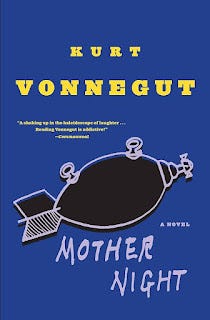
We are what we pretend to be, so we must be careful about what we pretend to be. What a nice one line moral of thee story.
Mother Night follows the journey of Howard Campbell Jr., a forsaken American spy in Nazi Germany who never really believed in anything except the love between he and his wife, his "nation for two." With the rise of nationalism, closing oneself off to the idea of 'fealty' seems like a natural opposite reaction to what otherwise feels like silly behavior, such as killing one based on ethnicity or race. Campbell does his job as a spy a little to well and climbs thee ranks of the Nazi regime to become one of the most influential members of the propaganda department, notably making incredible speeches and plays against the American cause. Campbell doesn't believe in anything, period. Nobody knows that, nor that he is a spy. The fictional character Campbell had moved to Germany when he was ten and then was recruited by a Colonel Frank Wirtanen, aka his Blue Fairy Godmother -- a fitting name given that nobody had ever seen him interact with him and thus doesn't believe he exists.
I'll admit I liked Mother Night more than Slaughter-House Five. It was a simpler narrative structure and the main character was more witty and engaging.
Plot twist that Resi fell in love with Campbell's writing and pretended to be Helga
Resi's nihilism, searching for a reason to keep going
Kraft as a painter first, a double agent second. What Vonnegut refers to as schizophrenia in people like Campbell -- perhaps we all have that in us
The ending comments on the nature of humanity to never be able to stop violence. Very Attack on Titan-esque, but with absurdist style
Vonnegut's dry, sarcastic, dark humorous absurdist style always hits home.
Shoutout to Adam; I wouldn't have picked up Mother Night or Slaughterhouse-Five if we hadn't walked into the Last Word Bookshop for fun.
Quotes:
I saw a huge steam roller, It blotted out the sun. / The people all lay down, lay down; / They did not try to run. / My love and I, we looked amazed Upon the gory mystery. / "Lie down, lie down!" the people cried. / "The great machine is history!" / My love and I, we ran away, The engine did not find us. / We ran up to a mountain top, Left history far behind us. / Perhaps we should have stayed and died, But somehow we don't think so. / We went to see where history'd been, And my, the dead did stink so.
I had hoped, as a broadcaster, to be merely ludicrous, but this is a hard world to be ludicrous in, with so many human beings so reluctant to laugh, so incapable of thought, so eager to believe and snarl and hate. So many people wanted to believe me! Say what you will about the sweet miracle of unquestioning faith, I consider a capacity for it terrifying and absolutely vile.
And these last-named patriots were right in having confidence. I doubt if there has ever been a society that has been without strong and young people eager to experiment with homicide, provided no very awful penalties are attached to it.
My case is different. I always know when I tell a lie, am capable of imagining the cruel consequences of anybody's believing my lies, know cruelty is wrong. I could no more lie without noticing it than I could unknowingly pass a kidney stone. If there is another life after this one, I would like very much, in the next one, to be the sort of person of whom it could truly be said, "Forgive him-he knows not what he does."
Eichmann made a joke. "Listen—" he said,
"about those six million--." "Yes?" I said. "I could spare you a few for your book," he said. "I don't think I really need them all." I offer this joke to history, on the assumption that no tape recorder was around. This was one of the memorable quips of the bureaucratic Genghis Khan.
The game of Old Maid broke up, with Father Keeley the loser, with that pathetic old virgin still stuck with the queen of spades. "Well," said Keeley, as though he'd won much in the past, as though a rich future were still his, "you can't win them all."
"You'd be good at public relations," said Kraft. "I certainly don't have any powerful convictions to get in the way of a client's message," I said.
"For your information," said the G-man in cool triumph, "I am a Jew." "That proves what I've just been saying!" said Jones. "How's that?" said the G-man. "The Jews have infiltrated everything!" said Jones, smiling the smile of a logician who could never be topped. "You talk about the Catholics and the Negroes—" said the G-man, "and yet, here your two best friends are a Catholic and a Negro." "What's so mysterious about that?" said Jones. "Don't you hate them?" said the G-man. "Certainly not," said Jones. "We all believe the same basic thing." "What's that?" said the G-man. "This once-proud country of ours is falling into the hands of the wrong people," said Jones. He nodded, and so did Father Keeley and the Black Fuehrer. "And, before it gets back on the right track," said Jones, "some heads are going to roll." I have never seen a more sublime demonstration of the totalitarian mind, a mind which might be likened unto a system of gears whose teeth have been filed off at random. Such a snaggle-toothed thought machine,
I had taught myself that a human being might as well look for diamond tiaras in the gutter as for rewards and punishments that were fair. It was not the thought that I was so unloved that froze me. I had taught myself to do without love. It was not the thought that God was cruel that froze me. I had taught myself never to expect anything from Him. What froze me was the fact that I had absolutely no reason to move in any direction. What had made me move through so many dead and pointless years was curiosity.
"There are plenty of good reasons for fighting," I said, "but no good reason ever to hate without reservation, to imagine that God Almighty Himself hates with you, too. Where's evil? It's that large part of every man that wants to hate without limit, that wants to hate with God on its side. It's that part of every man that finds all kinds of ugliness so attractive.] "It's that part of an imbecile," I said, "that punishes and vilifies and makes war gladly."
"I'm not your destiny, or the Devil, either!" I said. "Took at you! Came to kill evil with your bare hands, and now away you go with no more glory than a man sideswiped by a Greyhound bus! And that's all the glory you deserve!" I said. "That's all that any man at war with pure evil deserves.
He faced me, his eyes still filled with undiluted hatred. "I'll get you yet, brother," he said. "That may be," I said. "But it won't change your destiny of bankruptcies, frozen-custard, too many chil-dren, termites, and no cash. If you want to be a soldier in the Legions of God so much," I told him, "try the Salvation Army."
"Who will I call?" said Epstein. "I'm not a Zionist. I'm an anti-Zionist. I'm not even that. I never think about it. I'm a physician. I don't know anybody who's still looking for revenge. I have nothing but contempt for them. Go away. You've come to the wrong place."
She understood my illness immediately, that it was my world rather than myself that was diseased. "This is not the first time you've seen eyes like that," she said to her son in German, "not the first man you've seen who could not move unless someone told him where to move, who longed for someone to tell him what to do next, who would do anything anyone told him to do next. You saw thousands of them at Auschwitz."
The letter is from a stockbroker in Toronto, Canada. It is addressed to the capitalistic aspect of me. It wants me to buy stock in a tungsten mine in Manitoba. Before I did that, I would have to know more about the company. I would have to know in particular whether it had a capable and reputable man-agement. I wasn't born yesterday.
"Leichenträger zu Wache” -- "Corpse-carriers to the guardhouse."
Currently Reading:
I May Be Wrong, But I Doubt It: How Accounting Information Undermines Profitability by Douglas T. Hicks
The Prize: The Epic Quest for Oil, Money & Power by Daniel Yergin
Next on my list:
Infinite Jest by David Foster Wallace
Given the deaths of two large and looming figures:
Poor Charlie's Almanack by Charlie Munger
Leadership: Six Studies in World Strategy by Henry Kissinger
Skimming through High Growth Handbook by Elad Gil