
Lessons from Vipassana Meditation: 10 Days of Silence and Meditation
Building awareness & equanimity

From July 17 to July 29, I took on the life of a Buddhist monk. Many friends have asked me about this experience, but it’s difficult to convey the depth of what I went through and its impact on me in a brief phone conversation. I truly believe it was one of the best decisions I've ever made, and I’m especially grateful I could do it at 21, knowing the long-term benefits of such a practice and how rare it is to carve out 10 days (plus travel time) from life. This long-form piece is my attempt to break it all down.
The Mentality Going In
Earlier this year, I watched in awe as my roommates, who had never run more than a few miles in their lives, completed a half-marathon. The discipline and mental rigor they displayed in running 13 miles left me astonished. Having never run more than 4 miles myself, the idea of running over three times that distance seemed impossible—a clear “yeah… no” moment for me. However, as I stood at the finish line on race day, watching runner after runner cross it with smiles, greeted by friends and family, I was deeply moved. I knew then that I had to take on this challenge, regardless of the pace.
Months later, I not only completed the half-marathon but exceeded all my previous expectations. I went from being an anorexic hermit crab, afraid to grow into a new shell, to someone who believed in the power of incremental and compounding effort. The mental challenge was exhilarating, and I relished every bit of it.
One day, I went on a run with a professor of mine who held “running office hours.” My intention was to stick with him for 5 miles, but we ended up running 14 instead. He was an ex-Israeli military officer, and I was fascinated by his stories of building mental toughness and his belief that endurance is what separates the strong from the weak. Intrigued by his mindset, I asked him over lunch what he thought the mental equivalent of a marathon was. Without hesitation, he mentioned the 10-day meditation courses he had heard about, though he had never done one himself. This wasn’t my first time hearing about these courses; I knew a couple of people who had done them during breaks or gap semesters. With 3 months off during the summer before starting work, I immediately reached out and decided that this had to be my top priority.
As I reflected on these experiences, I realized they were more than just physical feats; they were part of a larger journey of confronting my fears and insecurities. For years, the feeling of failure had loomed over my consciousness. Despite convincing myself that I had always failed upwards in my startup endeavors and tennis journey, I knew this bred a deep-rooted insecurity. Although I had received a return offer at Insight, I knew in my heart that it wasn’t a mark of success but just entry-level permission to start on a path that would require far more intensity. The half-marathon and the run with my professor were steps towards proving to myself that I could push beyond my limits. Now, I’m determined to continue this journey—not just to be successful, but to become an undeniably true hard worker, improving my odds of achieving the goals I set for myself.
I once read that there are five types of hard work: Outthinking (a better strategy, a shortcut), Pure Effort (working longer, intensity), Opportunistic (positioning yourself to take advantage of change), Consistency (doing average things for longer), and Focus (saying no to distractions). Each of these requires a different type of dedication. If an experience can truly enrich you with all five of these traits, then it deserves top priority on the bucket list.
I was craving a way to prove myself to myself. The half-marathon was my first test. The meditation would be the next. I found myself yearning, not just for success, but for the transformation that comes from chasing “it”—the elusive essence of what it means to truly push beyond who I was and step into who I could become.
As the seed is, so the fruit will be.
With every action, we water the seed of our future, yet many of us spend our lives running on a treadmill that only accelerates, until the inevitable crash leaves us shattered, counting our blessings if we manage to escape with just a few bruises.
When was the last time you paused to examine the seed you’re nurturing? Introspection is rare, and rarer still is the courage to act on those reflections.
Were you ever taught to truly see yourself, to embrace the reality of your being? Making lasting, habit-level changes is like carefully tending to a garden—it’s difficult, yet it yields the most meaningful fruits of all.
Breakdown of the technique
There are three parts to this technique, each building on the last. Shila (morality), Samadhi (concentration, the development of tranquility), and Panna (wisdom - the development of insight).
Shila
For the duration of the course, you take a vow of complete silence and adherence to 5 precepts.
To abstain from killing any living creature
To abstain from stealing
To abstain from sexual misconduct
To abstain from false speech
To abstain from intoxicants.
These are practical steps required to clear the mind of distractions. While they are on your mind, you cannot properly focus on developing your own concentration.
Samadhi: Day 1 and 2
The first two days are dedicated to a simple yet profound task: finding your natural breath (through the technique of ānāpāna-sati). The goal is to train the mind to focus on a single object and resist distractions—two essential qualities for developing concentration.
Natural respiration is chosen because it serves as a bridge between your conscious and unconscious mind, constantly occurring whether you’re awake or asleep. By observing it, we tune into our natural state and take the first step towards connecting with our true selves.
As a scaffold, you’re allowed to take a few intentional deep breaths at the start or when your mind begins to wander; however, there are no chants, mental images, or manifestations to artificially focus you—this is a non-sectarian practice, after all.
Gradually, the periods of forgetfulness shorten, and the periods of sustained awareness—samādhi—lengthen. Little by little, the breath changes, becoming softer, more regular, light, and shallow instead of hard and deep. At times, it may seem as though breathing has stopped altogether. In reality, as the mind calms, the body follows suit, slowing down metabolism so that less oxygen is required.
These are two incredibly frustrating days. I sat on a mat in a position that, after 10 minutes, felt more painful than any plank. My only task was to breathe and battle the relentless distractions that flooded my mind.
I discovered that if I classified my thoughts the moment I became aware of them, I could more easily come to peace with them and return to my breath. I labeled each thought on a 2x2 matrix: based in the past or future, pleasant or unpleasant.
“Ah, this mind just had a pleasant memory from the past. Now let it return to its task.”
“Ah, this mind just had a pleasant thought about something that could be in the future. Now let it return to its task.”
And so, over dozens of hours, I learned a few vital lessons:
How to concentrate without relying on crutches that could be harmful in the long run.
How to mechanically bring myself back from inevitable distractions.
How to accept my wandering mind and move on quickly, forgiving myself and returning with calmness.
A habit of a lifetime is not changed in just a few hours. There is much monotonous work to be done in the first few days to ensure real progress later on. The effort was enough to make the following days fruitful, allowing me to scaffold up to the other advanced parts of the technique. Yet, I knew I had only just begun to scratch the surface of Samadhi, like a child who has just learned the basic rules and form of a sport—grasping the fundamentals but still far from mastering the art.
Samadhi: Day 3
On the third day, the focus shifts to developing physical awareness, achieved through the process of making smaller and smaller circles of attention.
You begin by observing the sensations in the small area beneath your nose and above your upper lip. Whether it’s heat, cold, or a subtle vibration—sensation is sensation. This area is specifically chosen because, having attuned yourself to your natural breath, you can now sense the cool air as you inhale and the warmth as you exhale. The exhalation creates a natural, automatic sensation, providing a scaffold for deepening your awareness.
I found myself able to observe how frustration would stir within me—manifesting as small sensations of sweat or subtle trembling. Before these feelings could escalate into actions like leaving the meditation hall for a ‘break’ or clenching my fists in anger, I was able to recognize the mental disturbance and gently return to a faint sense of calm.
Panna: Day 4
After spending dozens of hours observing the sensations within the nose and the small triangular area beneath it, your mind has likely developed a basic awareness of sensation. On the fourth day, this awareness begins to expand. You start to explore various parts of your body, from the scalp to the toes, feeling each and every sensation that arises. You may also notice areas that remain blind to your awareness.
At this stage, you’re reminded that what truly matters is not the depth of your awareness, but the equanimity of your mind. Awareness will grow with time and effort, but your first task is to cultivate equanimity when the inevitable frustrations arise—such as encountering a blind spot with no sensations. The practice is not about perfection, but about maintaining a steady mind in the face of challenge.
Panna: Days 5-9
As the journey continues, you refine the practice of feeling sensations without reacting to them.
Sensations come in all forms—pleasant and unpleasant. They might manifest as intense vibrations, tingles, or even the eerie sensation of insects crawling across your skin. But your task is clear: you must not react. You must remember “anitya,” the understanding that this too shall pass, and that all sensations are impermanent.
It is during these days that you begin to gain an experiential understanding of equanimity. Each sensation arises and fades with varying lengths and intensities, but your role is to observe them with objective awareness, resisting the urge to create craving or aversion. This is the essence of the practice—to witness without attachment, to experience without reaction, and to find stillness in the midst of constant change.
Daily schedule
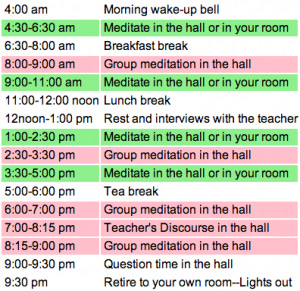
As you can see, lots of meditating. I’ll be honest, the “meditate in your room” often turned into an extended nap. Hopefully that won’t happen the second time around.
Reflections: A Few Weeks After
My meditation practice has continued sporadically, perhaps four or five times a week. While it’s recommended to meditate for an hour every morning and evening, I find myself realistically doing 30 minutes most days. At one point, I temporarily lost the ability to sense subtle sensations and had to restart the entire process. Ten days of intense practice can establish a benchmark for what ‘excellence’ feels like, but it is far from enough to imbue that quality deep within. Only consistency can do that.
In the weeks following the meditation, I found it difficult to maintain equanimity. Traveling with family proved to be a significant mental challenge—I love them dearly, but they are the ones who test my calm the most. On top of that, I often felt anxious about falling behind in preparing for my upcoming job—there was so much finance and engineering knowledge I could have gained, but I chose to pursue other side quests instead. While I don’t regret those choices, the rush of everyday concerns made it increasingly difficult to hold onto the compassion and equanimity I had begun to develop.
Yet, I’m glad I took the first step. If I can commit to meditating an hour each day in New York City, I would be incredibly satisfied. The stress of professional life will be greater than ever before, and I hope to let the compounding effects of mental fortitude begin on Day 1. I believe in the outcome of this practice, but before I return for another 10-day session, I must cultivate my own samadhi, because that is something no one else can teach me.
This experience has given me the gift of solitude and focus. It’s not perfect—loneliness and restlessness creep in when it stretches beyond a few days—but I see a clear trend in how I treat my time, my resistance to trivial chatter, and my need to fix things around me.
In my interactions with others, I find I have less to say. I’d like to believe that my natural curiosity hasn’t waned, but rather that my capacity for indulging in non-fruitful moments has significantly diminished. I notice that it’s harder for me to engage in conversations centered around trivial matters. Initially, this worried me, and I tried to fill the silence with empty chatter to cope. But I could feel my mind and body resisting it.
For better or worse, the urge to fix the world around me has diminished. Each person finds their own path to understanding spirituality and the roots of their joy and suffering. Some, it seems, are content to skim the surface and don’t feel a true calling to get to the bottom of their self. A friend once told me a story about his mother, who converted to Catholicism simply because she liked the aesthetics of the cross and enjoyed the social gatherings on Sundays. He also said she knew little about Jesus or the Bible, which was not very surprising. Many are content with adhering to traditions, rites, and rituals without delving into the deeper ‘why’ behind them.
When I saw these traits in my own extended family when I went to India, it initially vexed me. In fact, despite all my meditation training, I allowed myself to react to it. I needed some time away to rediscover my sense of compassion and come back to it with less of a reaction. When I encounter people who seem uninterested in exploring their own physical and emotional awareness (again, this is not meant to be mixed up with spirituality or religion, though there is certainly overlap) I can’t help but feel a sense of indifference. A better, wiser version of myself will no doubt be more sympathetic, understanding that it’s simply not in everyone’s nature to seek self-knowledge.
Some other takeaways:
Recognize trivial quarrels and don’t react. Stay still, breathe through them, let them dissipate.
All virtuous people display certain traits. Admire those traits, not the rites and rituals. You don’t need to be Christian/Muslim to admire Jesus/Mohammed.
Do not react. Equanimity is the measure; awareness comes with effort and time, as well as with better morality and better concentration
Make choices with compassion in mind. Hard choices (big stick) only after analyzing your reaction. Speak softly and carry a big stick, with compassion.
Hard choices are like a parent using force to hold their child back from a snake they want to play with.
Stop giving food for your reactions and they will naturally die.
Nobody can fault someone who preaches only what he practices. Similarly, do not speak about what other people should do before leading the way yourself.
When filled with compassion, you are naturally happy. You make choices for the good of others. No malice.
All love is self-centered unless it is a truly one-way street. It’s hard because being entirely ‘egoless’ seems down-right impossible for 99% of us that haven’t committed to becoming monks. True love is egoless. I’m not sure most of us may ever experience that, despite experiencing the different flavor of love that we may talk about in regards to our significant other, children, parents/siblings, and friends.
100% of my happiness is my own choice
Four types of individuals: those who move from darkness to darkness (living in misery, blaming others, and perpetuating negativity), from brightness to darkness (enjoying current success but becoming arrogant and planting seeds of future suffering), from darkness to brightness (enduring hardship with wisdom, responding with love and compassion, and thus creating a brighter future), and from brightness to brightness (Once beyond the ego, one is driven fully by compassion and serves society).
Memories
Popcorn. “1 fruit each.” Tanginess: orange. Saltiness: soup & seaweed. PB&J. Dates. Kimchi. 15-minute bell. Damma hall. ~100 second walk. Meditation mat. Small cushion. Wooden floor chair. Back support. Plush big cushion. Thin big cushion. Meditation cells. Face damma hall. 1 male master. 1 assistant-male teacher. 2 female masters.
Umbrella holders. Yellow umbrellas. Fake wood floors over concrete.
Cicadas. Oasis. Chirping birds. Sound of silence. Sound of nature. “Lee” tree leaves. Sunshower. Morning fog. Violet flowers. Bees. Ants. Worms. Millipedes. Frogs.“Garden of Jinan” – like Eden. 9-10-11 “Peaks of Jinan” Valley. Hand wash clothes. Air dry. Laundry to pass time. Bidet. Broken fan. Open window. Joe’s gait. Attachable sunglass lenses. Self-conscious of my rustling. Self-conscious of my speed of eating. Beard. Boredom. Humidity. 5-minute planks.