
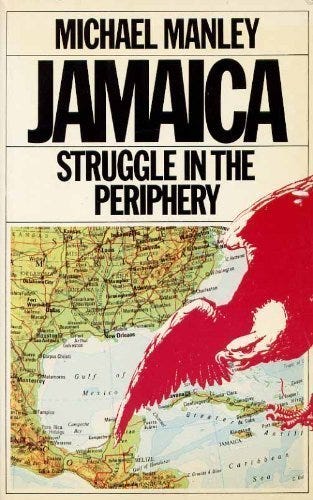
Jamaica: Struggle In The Periphery by Michael Manley
To be part of an empire, as distinct from its centre, is to be part of the periphery. Imperialism had made us all peripheral

“To understand today’s politics, one must always begin with yesterday’s economics.”
Our political present was forged in the shadow of post–World War II divisions, where rival superpowers shaped not just borders and economies, but the very destinies of newly independent nations. The West championed capitalism and liberal democracy; the Soviet Union advanced communism; and a third path emerged for those who sought non-alignment. Many smaller countries, like Jamaica, found themselves pulled into the orbit of one bloc or another.
Yet scale often determined the degree of autonomy. Large non-aligned nations like Brazil, India, China, and Iran were able to carve out unique paths, drawing on national identity, cultural consciousness, or the vision of transformative leaders to resist external pressure. By contrast, smaller states were frequently swept up by more powerful interests, their agency curtailed by economic dependencies and geopolitical intrigue.
Michael Manley’s Jamaica: Struggle in the Periphery shows what this dynamic looks like on a smaller stage. Jamaica’s postcolonial hurdles ran deep—a nation economically reliant on bauxite and tourism, burdened by an uneducated and impoverished majority, and plagued by crime often exacerbated by foreign meddling. Lacking the sheer mass of bigger nations, Jamaica could not avoid the gravitational pull of the superpowers. A comparison with Lee Kuan Yew’s Singapore, which started with similar colonial legacies yet found a path to rapid development, underscores how leadership and strategy can produce starkly divergent outcomes.
In the first half of his book, Manley details Jamaica’s colonial roots and the socioeconomic constraints that followed. In the second, he presents his vision for self-governance, critiques prevailing economic systems, and grapples with IMF negotiations and outside efforts to undermine Jamaican independence. Manley’s broader commentary on democracy, socialism, and the complexities of leadership illuminates how challenging it is for smaller nations to assert themselves—economically, culturally, and ideologically—amid the pressures of a world shaped by “yesterday’s economics.”
Although Manley’s legacy is debated, his insights capture the broader struggle of countries on the periphery to transcend the historical burdens left behind by empires and superpowers.
I’d be curious to read the recollections of today’s leaders as they navigate a world with multiple superpowers and far more multilateral institutions.
Thank you, Ritvik, for another great recommendation.
Selections & Notes:
The liberated spirit cannot exist on a diet of freedom alone
By the time Norman Manley came to make his speech in 1968 and talked of economic independence as a task of the generation of leadership that was to succeed him, he did so against the background of a growing recognition that political independence confers no magic of its own other than the benefits to the national psyche. He, the most rational of patriots, as far back as 1961 had come to realise that no national aspirations were likely to be realised in Jamaica or elsewhere in the Third World unless and until their economies could be modified and restructured.
The economic lens:
The industrial revolution, which was financed by slave labor, eventually made the opportunity cost of slavery (food, housing, putting down rebellions) too high.
This is what Griffin talks about in Babel.
The indigenous population of Jamaica, the Arawak Indians, had been quickly wiped out.
The plight of the middle class (half white, half black) is a cornerstone of Babel’s plot.
Constantly knocking at the door of social and economic acceptance, it was a class driven by the desire to get inside the citadel of privilege.
But they also knew and identified with the side abjected to literal or economic slavery.
Marcus Mosiah Garvey sowed the seeds of black liberation.
He never experiences the changes in his lifetime.
He traveled to Jamaica, US, and England.
Jamaica went from self-government as a crown colony to independence in 1962.
The National Heroes together symbolise the critical elements of struggle in Jamaica’s history.
Nanny was the slave who took to arms and won freedom for the Maroons by black military prowess in the mountains of Jamaica.
Sam Sharpe symbolised the unquenchable thirst for freedom of slaves after more than a century in bondage.
Paul Bogle died for the right of the people to own land and George William Gordon joined him on the gallows symbolising the capacity of men to champion worthy causes at the behest of conscience alone.
Marcus Mosiah Garvey was the messenger of black equality and racial pride.
William Alexander Bustamante symbolised the struggle of the workers for recognition at the workplace.
Norman Manley was the great patriot and political thinker, the symbol of Jamaica’s nationalism, the intellectual who understood the nature of political power and who, together with his cousin, established the modern political system.
More than any part of the Third World, the Caribbean was entirely a product of the colonial process.
There never was any attempt to produce what was needed but only to produce what someone else needed. Trade did not involve a calculated exchange involving surpluses but the importation of virtually everything that was needed and the export of virtually everything that was produced. Finally, the surplus which a group normally uses to increase its production was largely exported in the form of profit to the centre of colonial power. Hence, at every single level of importance, the natural economic process was diverted, thwarted, frustrated and ultimately destroyed.
The Puerto Rican Model
Industrialization by invitation 
Jamaica employed the economic components of the Puerto Rican Model, and although statistical markers of development were increasing, most were still unemployed, malnourished, and uneducated.
Where there is general hope of relief from poverty it will be endured with fortitude as people patiently await their turn for better things to come. However, if it is clear that the great majority will never have the better things that are so visibly there for the few, deep and dangerous divisions and frustrations emerge in the society.
The model failed because they imported both the machinery and raw materials. The percentage of imports grew more than exports, which meant more dependency.
Throughout all of this the common threads of purpose were: reducing dependence of the economy as a whole, reducing dependence on foreign ownership, reducing the degree of control of the local oligarchy, widening the degree of social control over the economy through direct state activity, and widening the participation of the people at large in beneficial economic activity.
We were clear that we would never expropriate property, but would make acquisition in the public interest on a basis of fair compensation.
Did not believe in a pure free enterprise model of economic development and, consequently, saw the private sector as having a particular place and filling a particular role. But we did want that place to be permanent, and the role to be dynamic. Communicating this intention was another matter. But that was the intention. In fact, we were to bend over backward time and time again to help the private sector and to reassure its members of the sincerity of our commitment to their role. However, we were to discover that a certain type of private sector man approaches society on an all-or-nothing basis. There must either be the appearance of a complete commitment to their kind of system or they become suspicious and uncooperative. The economy was to suffer considerably from the refusal of this element in the private sector to take advantage of the many incentives offered to stimulate increased production.
In 1972, Jamaica only got wages and $25M per year for the exploitation of their bauxite/aluminum industry. A $550M US investment employed 10K people there; comparatively, sugarcane employed 60K people.
Aluminum is a ‘soft’ product; oil is ‘hard.’
Outright nationalization would have been a bad tactic.
Key objectives with aluminum:
(1) Tie taxation to an index that reflected inflationary factors.
(2) Develop local managerial and technical skills.
(3) Coordinate negotiation strategies by unionizing.
At the time, most Jamaican children were literally and legally bastards.
Unemployment led to concubinage, and they weren’t allowed to vote because of it either.
It is astonishing the extent to which the education systems of post-colonial societies are actually counterproductive unless radically reorganized.
The key question: How to create a prosperous country, where the people share in the prosperity and create a genuinely independent nation?
How to detribalize politics, where the people would be literally happy if things went badly for the country under the ‘other’ party, since that indicated victory for ‘their’ party at the next election.
How to remove the spoils systems, where handouts would be given to the strong party supporters?
In the end, supporters of the two parties tended to become more like members of opposing armies than citizens with different views about their country.
The parliamentary system can be like a building without a foundation. The political parties cannot be a complete foundation because they divide the society in too many ways at too many levels.
It is causes that justify all struggle and all real causes are difficult.
Jamaica chose the non-aligned movement whilst making it clear they weren’t part of an anti-US campaign.
Jamaica’s experience in colonialism was multiplied a hundred-fold throughout the developing world. As time passed, it would cost more and more to buy machinery, or tractors, or automobiles by comparison with the prices fetched for sugar, cotton, sisal, coffee, copper, and the rest. More and more production of these primary commodities would be needed to maintain the same level of imports and hence the same standard of living.
When countries processed their own commodities (cocoa or cotton), developed countries would create high tariffs or freight rates, making the product uncompetitive.
Proposals for change are labelled communistic. An historical coincidence between the emergence of plural democracy, the recognition of human rights, and the underlining of personal liberty, on the one hand, and the capitalist system, on the other, is emphasized. It is implied that there is a natural link between these things, and that to change any one of them is to undermine them all.
To be part of an empire, as distinct from its centre, is to be part of the periphery. Imperialism had made us all peripheral. It may be true that before imperialism we did not amount to all that much as measured by the values that European nations proclaim. But little as we may have been, we were ourselves and certainly not peripheral to an external, foreign system. Here, of course, one does not speak of particular areas which may have been suffering from recent conquest by a neighbouring group as was often the case in Africa. Nor is there any suggestion that what we now call the Third World was the scene of some sort of idyllic, splendid, simple past, each of us in a ‘simple state of natural liberty’. Far from it. Rather, the point is that now some two-thirds of mankind have been reduced to a peripheral status in political, economic, and even social terms. It is the degree, the scale, the ruthlessness, and the completeness of the exploitation which marks this imperialism, that sets this apart.
Three major objectives:
(1) Avoid East/West polarization.
(2) Increase attention by the Third World to questions of economic strategy and strengthen negotiation with developed countries.
(3) Cooperation with other Third World countries.
“The challenge of foreign policy was to make the term ‘Third World’ the badge of a cause rather than the description of a sad condition. It represented a positive assertion of a new sense of what international relations could be about.”
Campaign slogan: “Better Must Come.”
The National Housing Trust (adapted from a Mexican model):
Workers and employers put up a compulsory 2% for a housing construction fund. When houses were built, they were distributed by drawing lots among all contributors within a certain radius.
Random selection ensured no political favors.
Putting the cash to direct housing absorbed inflationary pressures from millions of cash collected.
Upward mobility but little downward empathy.
Colonial oligarchies love the colony as long as it is indisputably theirs. When there is doubt, they revert to the metropolis, as if following a prior historical attachment. Rather than stay, they migrate.
American values came not through war, but media.
Hollywood represented not only entertainment but propaganda — it was hard to tell where it ended or began.
The three-piece suit worn in the tropics is a valuable support for the heavy textile industries of the developed countries, but incredibly inappropriate for the tropics. We changed the rules and made tropical dress acceptable in protocol. Whereas our predecessors in office had banned much of the protest music of the ghetto, we opened the doors and, on the contrary, worked to assist in the promotion of the cultural energy of the ghetto as expressed in reggae music. Malcolm X was forbidden reading. We opened those doors also.
For every step taken, there was a group which claimed Communist intent.
Touch a man’s pocketbook and you will pull the first trigger for his political acts.
Inflation benefited the global North. Jamaica locked in prices for their raw material equivalent to the inflated final product (aluminum).
Danger lurks everywhere for the regimes which stand firmly against imperialism, and for a different configuration of power in the world. They are threatened by internal sabotage and external pressure. They cannot count on the solidarity of some of their neighbours. The survival of each is affected by the solidarity of the group. The margins are as fine as the dangers are real. It is in this context that we must understand the survival of a progressive Angola in 1975.
Sides had been taken. The battle lines were drawn. By now propaganda was perceived as truth and truth as propaganda, depending on who was listening.
We were reluctant. A State of Emergency signals to the outside world that you are in crisis. It is damaging to the tourist industry and investment prospects and generally involves the tacit admission that the normal democratic process has failed. In any event, we were warned that we were in no condition to impose a State of Emergency. Although large criminal gangs were operating all over Kingston, criminal intelligence was such that a State of Emergency would scarcely have helped. When asked the question: “Do you know whom to detain and where to find them, were you to possess these powers?”, the answer of the security chiefs was an emphatic, if regretful, “no”! It was thereupon suggested that there should be a complete overhaul of our methods in the field of criminal intelligence as part of a precautionary preparation.
Destabilisation describes a situation where some source either inside or outside a country — or perhaps two sources working in concert, one outside and one inside — set out to create a situation of instability and panic by design.
CIA was likely in Jamaica, not ‘crime,’ but destabilization.
After the meeting, there had been a row between Duncan and an officer of the Reserve Battalion of the Army. The officer had struck Duncan while the latter was requesting protection for a group of PNP supporters returning from a meeting. They had to pass through a hostile group of JLP trouble-makers. Things were tense, and I was urged to come to Old Harbour before they got out of hand. I duly arrived and began questioning the officer, a captain, about the incident. Suddenly he turned his back and strutted away. In a flash, his men surrounded me. There must have been ten or twelve of them. There was the rattle of rifles readied to fire. I hesitated for a moment and then decided this was a situation which could not accommodate two bosses. I walked straight at one of the men, doubtless looking as angry as I felt. It was his turn to hesitate. The moment before he lowered his rifle and stepped aside seemed interminable. The others followed suit.
If I could, I wanted the party to see the election result not as an occasion for either rejoicing or recrimination, but as a challenge to work and effort.
The combination of oil prices and world inflation. Jamaica is 97% dependent on oil for energy. In addition, it is a surprisingly big user of energy per capita for a Third World country. This is so because of the substantial growth in manufacturing which had taken place during the previous thirty years. Ironically, the situation had been exacerbated by a decision of purest folly taken by the sugar industry a few years before. Most of Jamaica’s sugar factories used to burn the sugar cane waste, bagasse, to supply the energy for the sugar factories. This involved quite a labour force since the bagasse had to be stored and shovelled into furnaces. Needless to say, bagasse workers were a fractious, not to say militant group. Bagasse dust is a miserable business, particularly when facing the heat of a furnace into which it is being shovelled. Many are the days I had spent as a trade unionist arguing for respiratory masks and premium pay for these groups. In due course, the sugar manufacturers were seduced by the low price of oil and the prospect of no more bagasse workers. At a stroke, and at the cost of an investment which is best forgotten, they converted the entire industry to oil-burning furnaces. At the time, the foreign exchange needed to pay for all the new equipment was bad enough. So was the loss of more than 1,000 jobs. However, all that was to pale into insignificance beside the implications of $11.00 a barrel oil, which was soon to become $14.00, $21.00, $28.00, and now $36.00 a barrel. By such means does the Puerto Rican model flatter to deceive.
The monetarist demand management approach of the IMF was designed by the representatives and planners of developed capitalist economies for the typical ailments of those economies. The left pointed out that there was not a single case where these prescriptions cured a Third World economy. On the contrary, there were a number of cases where economies had remained sick, but democratic government had died. To them, reliance upon an IMF programme for adjustment and recovery meant delivering Jamaica into a trap. Once in the trap, they argued, the Jamaican economy would not recover but merely stagger deeper and deeper into the very position of dependence from which we were pledged to extricate it. In the meantime, the democratic socialist process would be the most probable casualty of the exercise.
IMF demand management is predicated on two basic factors which are supposed to provide a particular result. The two factors are devaluation, which reduces the demand for imports by making them expensive, while stimulating exports by making them comparatively competitive, and a compression of local demand by reducing government expenditure or increasing taxation, or both, so as to leave less spending money in the economy. Tight wage controls are imposed to ensure that both factors are effective. With less spending money in the economy, the producer finds he can sell less on the local market and so is driven to make up his lost markets through exports. This is the ‘stick’ of the process. The ‘carrot’ of the process is that the devaluation has made his product more competitive overseas and so helps provide the opportunity for the market which he is driven to seek. This is all well and good where you have a developed economy with substantial industrial, manufacturing, and agricultural productive capacity in place. The medicine is then applied where this productive machine is not being fully utilised because the basic economic equations have gone out of kilter. If local costs, for example, have made exports uncompetitive, the system earns less. Where there has been a lot of surplus demand in the economy bringing in imports for its satisfaction, the system spends more. There would be a cumulative effect upon the country’s reserves of foreign exchange because of increased expenditure upon imports. In due course, this would lead to a balance of payments crisis, which would then be solved by the IMF demand management prescription. For this prescription to work, two conditions should be present. Firstly, there must exist a productive capacity which can respond to the challenge and the opportunity which the medicine provides. Secondly, it is important for the society to have in place a system of social welfare which can shield the population from the worst effects of the medicine when it is first applied and before its benefits can begin to be felt. IMF medicine may produce temporary unemployment in the distributive trades that are accustomed to handling large volumes.
Now, let us consider the situation of the average Third World country. To begin with, one can assume that this type of economy is not blessed with a sophisticated productive apparatus in manufacturing and agriculture already in place and merely awaiting the right stimuli to produce. On the contrary, it is of the very nature of the Third World condition that development is what is needed and, by the same token, what is lacking. In the absence of developed factors of production, the stimulus of IMF medicine cannot apply by definition because there is little for it to work on. In the average Third World country, the problem is not the search for markets for, say, a sophisticated wheat farmer already capable of high levels of productivity. The problem is how to get a simple peasant hillside farmer to become an efficient producer in the first place; how to find the capital with which to help him terrace his hillside; how to find the money for the extension services to ensure that he is trained in the use of fertilisers and followed up, at first, to ensure that he applies the right ones at the right times in the right amounts; how to find the capital to provide him with some modicum of the modern machinery which is a key to agricultural productivity. The problems, therefore, are structural and fundamental. The right demand climate can provide the framework within which production increases, but it cannot, as it is assumed to do in a developed country, create the increased productive capacity. The basic premise of an IMF formula, therefore, is misconceived in the Third World situation. Given the need for the development of productive capability, typical two- or three-year IMF agreements simply miss the point of the Third World dilemma. One sees, therefore, a situation in which the population is subjected to severe pressure in pursuit of benefits that are unattainable. To compound the crisis, however, this social pressure is applied in a society which probably does not have the kind of social welfare system which can protect its people from the worst initial consequences of the medicine. Therefore, people are hurt in a situation where they enjoy no safety net and for gains which cannot materialise.
The IMF was created by the capitalist countries after World War II. It is designed to apply capitalist techniques and to serve the ends of those who created it originally. For developing economies, this kind of short-term, sharp, demand management approach is inappropriate. What is needed is that the whole analysis should begin at a different point. The fact of the foreign exchange shortage is not the correct point of departure. That is to be found much earlier in the process by an examination of the structural deficiencies of the particular economy. The approach should therefore begin with a plan for the development of the necessary productive capability. There should be no attempt to impose upon the client economy a particular type of economic model. If the country wishes to pursue a capitalist path — well and good. If they wish to pursue a socialist path — well and good. If theirs is a mixed economy option, so be it. Whichever the model, the search must be for the development of a productive capability that exploits the natural advantages of the society and aims for the most rapid development of its production for home needs and for trade. Clearly, this contemplates development planning of seven to ten years’ duration at least. The second essential involves the provision of foreign exchange on a consistent and reliable basis over the period. Particular attention must be given to the foreign exchange that is needed early, upfront: an economy cannot recover under a plan which begins to stumble and gasp for air at the very first hurdle because there is not enough oxygen for the system at the start. Thirdly, great care has to be taken with demand management itself lest the social shocks to which the population in the ailing economy is subject are greater than it can bear. In short, we need a genuine international institution, controlled internationally and flexible enough to assist different types of economies. There has been an attempt to spread a canard to the effect that Third World countries do not want to manage their economies. Excepting corrupt regimes or the governments of deranged despots, this is just stupid. We never questioned IMF insistence on strict financial controls. We tried to apply these ourselves and were glad of their assistance in devising better methods. The quarrels were about strategies, time-spans, capacity to endure, levels of shock, maintenance of foreign exchange flows, relative roles for private and public sectors.
I certainly spent many hours at the time considering resigning either on behalf of the government or personally. In the end, I rejected both and stayed on. It may have been my biggest personal mistake. If plural democracy is to work, it must rest upon two acts of self-restraint, firstly on the part of those who hold power, and secondly on the part of those who seek it. No constitution can provide for this. Rather, it must flow from an understanding of the delicate human balances that must be preserved. Power needs to be used; but a judgment has always to be exercised concerning the limits which must be imposed upon its use. Oppositions must oppose, but must likewise exercise judgment about the degree and the manner of that opposition. The Reichstag fire was a brilliant political tactic. Granada and its revolutionary government came up for inevitable mention. I said that I thought it was a serious mistake for the US to behave with hostility to Maurice Bishop’s government, which could only drive him to react correspondingly. I reminded them that external pressure upon any revolutionary government forces the radicalization of the internal process. Surely the wiser course was to hold out the hand of friendship.
I suggested that a friend can advise moderation with some hope of response. An enemy can demand what he likes with no hope of attention.
I realized that we represented an enigma to many US policy-makers. The ‘hawks’ could simply dismiss us as crypto-communist surrogates of Moscow via Havana and conclude that we must be removed forthwith. To the more sophisticated exponents of US foreign policy, the ‘doves’ of the liberal establishment, it could not have been that simple. We were obviously democratic. One could pick any day at random and know that there was the fullest freedom of speech and press. Our human rights record was untarnished. We had never so much as threatened, much less expropriated, a dollar’s worth of US property, or anyone else’s for that matter. We had a vigorous opposition which had operated without let or hindrance even during the State of Emergency. From the point of view of the classic liberal, the credentials were impeccable. Yet the position was frankly anti-imperialist, aggressively non-aligned, openly trying to maintain good relations with Latin America, with Western Europe, and with Washington and Ottawa; but equally with Moscow and Havana. Now it seemed to me that only an election announced with a lead time of approximately eight months could create the conditions in which one could hope to confront the people with a choice which they might understand. Such a decision would have to include a choice between a future with the IMF and all which that implied, this being the JLP alternative; and a future without the IMF and all which that implied, the PNP alternative. Whatever the outcome, I was convinced that the whole country had to make the choice.
The JLP obviously had big money to spend. Their advertising campaign was massive and had gone for years. They seemed to have more cars and jeeps than they knew what to do with. For months, the opposition had claimed that they were raising this money from Jamaican migrants in various parts of North America. There is no doubt that they held fund-raising meetings. There is also no doubt that they had developed very close relations with some of the most right-wing elements in the US political system. Seaga’s close relations with reactionary figures, such as Congressman Larry McDonald of Georgia, were notorious. Making every allowance for what the JLP could raise from the local oligarchy and the overseas migrant population, it is simply not on the cards that they could have raised money by ordinary means to match the level of their expenditure. They obviously had a godfather or godfathers somewhere in the international system. Two clear patterns can be distinguished. First, we have the case where domination is used to guarantee the transfer of wealth from one set of people to another. Second, the case where domination is exercised to protect national borders, to ensure the absence of hostile governments who threaten security. If the second happens without an actual process of economic exploitation, then clearly we have a distinct kind of domination. Both forms may involve political, cultural, and psychological consequences that are utterly objectionable, but I believe it dangerous to confuse them. Therefore, I prefer to use the word imperialism to describe the first form of domination and hegemony to describe the second. Imperialism thus describes a situation in which domination and exploitation are both present; hegemony, one in which domination exists for purposes other than economic exploitation
On a general level, political awareness needs to be raised throughout society. Otherwise political movements become the mirrors of popular confusion rather than the mobilisers of change.