
"If you could see your whole life from start to finish, would you change things?" - Arrival (2016)

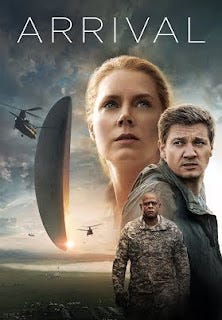
Yesterday night I watched Arrival (2016), directed by Denis Villeneuve. Here's a description [spoilers ahead]:
Linguistics professor Louise Banks leads an elite team of investigators when gigantic spaceships touchdown in 12 locations around the world. As nations teeter on the verge of global war, Banks and her crew must race against time to find a way to communicate with the extraterrestrial visitors. Hoping to unravel the mystery, she takes a chance that could threaten her life and quite possibly all of mankind.
Louise is able to see the future; more accurately, Louise can see and exist in the past, present, and past all at once. It's a little mind-fucking but you should get it if you watch the movie. Just like the language of the aliens in which Louise learns, the story is partly non-linear; however, it feels like one cohesive story, even without that immediate understanding.
What the viewer perceives as flashbacks to Louise's late child, who has seemingly died of a rare & incurable form of cancer, are actually foreshadowing of events to come. The daughter's father, who we later find out is Ian (Louise's academic colleague in the alien expeditions), will eventually become Louise's husband and have their daughter. A few years later, Ian leaves Louise because he finds out that she knew of their daughter's inevitable death and still decided to have the child with him -- subjecting them both to that terrible suffering.
One line has been looping non-stop in my head for the past day.
Louise Banks : If you could see your whole life from start to finish, would you change things?
After watching Arrival, that one question so many levels of meaning for me. It's not about simply hearing the question and responding with a yes or no with a justification. Villeneuve's out-of-body and out-of-time narrative powers makes the question intensely existential. It becomes about how you actually live (non-linearly speaking) --in the past, present, and future-- and thereby is actually a dynamic question.
I relate it back to a famous Shakespeare line which I originally heard from the show, Blast of Tempest, which is heavy inspired from Hamlet and The Tempest.
Hamlet : The time is out of joint: O cursed spite,
That ever I was born to set it right.
Although you can look at the line with respect to Hamlet's royal lineage and all that who should ascend-the-throne good stuff, I prefer to interpret the word "time" literally, especially in this context. Hamlet feels the responsibility thrust upon him, that he was "born to set it right." The "time" itself being out of joint may be a reference to the pain he feels, similarly to that of an out of joint limb.
The character feels that something should never have occurred and that the only thing he/she can do now is make things right no matter the cost. Whether that be Hamlet in Hamlet, Aika in Blast of Tempest, Ian (had he the understanding non-linear time) in Arrival, the Marvel cinematic universe, or even yourself; it's a trope that rings true, time and time again.
As I was sitting there in deep thought with my eyes closed, contemplating the relevance of any of this career bull-crap I'm searching up, I remembered Louise's question. If you could see your whole life from start to finish, would you change things?
Louise, an all knowing and all non-linearly existing human, gives a complicated answer. She does act in the present with future understandings, notably when she reciting the famous line "There are no winners in war, only widows" to General Shang in the last minute phone call to Shang's private number. This may make it seem like the answer to the original question should be a yes... but I'd argue her ultimate answer leans more towards a no. She decides/decided to marry Ian, have a daughter, get divorced, and lose her child. And she knew all of it would happen. She consciously decided to exist, feel, and receive the extreme forms of love and loss that her future held. She let herself fall into undeniably terrible pain.
What excuse do I, or anybody else who doesn't have the power of foresight, have to live in my future. She knew the past, present, and the future, and she decided to live in the present.
In the scene where Louise asks the question, she's addressing Ian. Here's what Ian responded with.
Ian Donnelly : Maybe I'd say what I feel more often. But I... I don't know. You know, I've had my head tilted up to the stars for as long as I can remember. You know what surprised me the most? It wasn't meeting them. It was meeting you.
Ian saying he looks at the stars is an allusion to both the fact of aliens and the future. But it was neither the Heptapods nor thoughts about the future that took him by surprise, it was meeting Louise (present).
I can't tell the future, but that’s not the lesson. Even if the future was tragic and emotionally abusing, I don't think I would change it anyway. Being more pure, more intentional, and maybe saying what I feel more often; that's more important.