
Goodbye, Columbus by Philip Roth
Me, the outsider, who may one day be an insider.

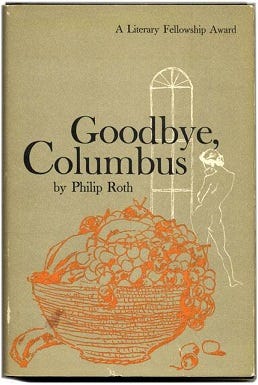
(Read in my Fiction class with Professor Jennifer Egan.)
Goodbye, Columbus by Philip Roth is about a summer fling (relationship) between Neil Klugman, a Newark Jew, and Brenda Patimkin, a wealthier jew from Short Hills. Neil spends his time at Brenda’s summer house and experiences a culture shock. Roth calls into question postwar prosperity by satirizing materialism, middle-class lifestyles, and parts of Jewish-American culture. The Patimkin family is a prime example of a group that has benefited directly from WW2.
Published in 1959 when Philip Roth was 26, Goodbye Columbus won the National Book Award. Roth wrote 30 works of fiction over his life and also taught Comp Lit at Penn. He died in 2018, may he rest in peace.
Themes
Identity and exclusion
Social class
The drive from Newark to Short Hills is described as closer to heaven, where the ascension is built on the exclusion of people like Neil and his family. There is a strong sense that once one has ascended to the suburb, they won’t come back to Newark
Neil edits his experience to try and blend into Brenda’s world. When he feels class inferiority, his critical side kicks in
Neil is terrified of losing Brenda (pool scene). He also feels like she has no curiosity about him.
Wealth
All the main characters featured in the book from both sides of the wealth divide are Jewish. People on both sides of the class divide ask if the other is Jewish enough
He has a phone in the main house, but she has one just for her room
Fantasy
Neil sympathizes with the black boy who wants to read Tahiti. The boy is regarded with suspicion and racism by others. He equates the boys fantasy with his own of seeing Brenda.
Neil is naive in how describes how black people will be like the jews: how they will come to Newark, and then leave to the suburbs after they make their wealth until nobody is left in Newark
Catalyst for the demise of the relationship between Neil and Brenda
Diaphragm (birth control)
Premarital sex is normal at college, yet it is very expected for girls to be pure before marriage. This leads to Neil not understanding Brenda’s POV
He has no sympathy for her. He forbids her to cry. He suggests Brenda should cut off contact with her family. He suggests she wanted the diaphragm to be found. He then thinks he never truly loved her anyway.
Tech we see in action:
Cars, commercial flying, trains, letters, TV, radio, phonograph, refrigerators, fluorescent light bulb, AC, glass doored oven, dishwasher, vacuum, garbage disposal, sprinklers
Settings:
Open green quiet spaces, country clubs, running tracks (lots of sports), fast food
Loved the description of Brenda’s father, Mr. Patimkin: “Tall, strong, ungrammatical, and a ferocious reader.”
Character descriptions
Neil
Witty, critical, sardonic, cynical, bold, observant, and disparaging
I admit, my internal narration tends to be disparaging. I think it’s the funniest type of tone. Like in any good Douglas Adams book
Brenda: entitled, aware of her attractiveness.
Mr. Patimkin, Brenda’s Father
Loved the description: “Tall, strong, ungrammatical, and a ferocious reader.”
The US moved from an atmosphere of survival to playfulness in a single generation, which is exhibited by the attitude towards ‘play’ through sports rather than street games (as seen in Call It Sleep) and the prominence of fruit.
More than 5M African Americans moved to northern cities, which is three times the 1.6M from the Harlem Renaissance.
David Scherl from Call It Sleep would be the same as as Neil/Brenda’s parents in the book
Pseudo events in the novel
Television is ubiquitous
The photoshoot with a model in front of the cathedral
The Patimkin household
Narration
1st person. Always somewhat performative
Neil is witty, critical, sardonic, cynical, bold, observant, and disparaging
I admit, my internal narration tends to be disparaging. I think it’s the funniest type of tone. Like in any good Douglas Adams book
Differences from Sashs in Good Morning, Midnight
The verb tense:
Goodbye, Columbus: past tense. Control. The narrators knows more than the reader
Good Morning, Midnight: Present tense. Narrator and reader knows the same amount. The author has the most control.
Neil talks in a chronological order. No long interludes from the past
Many narrative modes in GM, M. Neil has a more controlled mode bc he mainly has one frame of mind
Neil has humor.
Selected Annotations and Quotes:
“No, I go to school in Boston.” I disliked her for the answer. Whenever anyone asks me where I went to school I come right out with it: Newark Colleges of Rutgers University. I may say it a bit too ringingly, too fast, too up-in-the-air, but I say it. For an instant Brenda reminded me of the pug-nosed little bas- tards from Montclair who come down to the library during vacations, and while I stamp out their books, they stand around tugging their elephantine scarves until they hang to their ankles, hinting all the while at “Boston” and “New Haven.” “Boston University?” I asked, looking off at the trees. “Radcliffe.”
She-still-thinks-we-live-in-Newark
We sat a while longer, watching the soundless bodies on the screen eating a silent dinner in someone's silent restaraunt.
I love this line because it's such a matter of fact description of the setting. The sound is muted while the characters are still moving about. It becomes poetic when you put it into the context where Brenda and Neil are about to make love.
There's always such a contrast between their lives. Brenda lives a private life in a room with a phone and no noise. Neil has the noise of his Aunt and Uncle going around him. Brenda has a beautiful backyard with two oak trees, a large basement with an industrial sized refrigerator and fresh fruit and a ping pong table, and also a family that looks beautiful together, while Neil does not.
The irony of trying to be the invisible hand when Neil tries to warn the child to check the book out, fearful of the other man who complains about the book being on hold, but the child says “nah it’s been here all the time”
When Neil thinks “Me the outsider who may one day be an insider”, when he helps Mr. Patimking at the business for the wedding.
Neil sees the idealized version of money and comfort and wonders what he is truly loving when he likes Brenda, who has both but isn’t satisfied
Let there be light.. and Leo Patimkin
Goodbye, Columbus phonograph theme? → Being stuck in that transition between sheltered and trying to be an adult
What was it inside me that had turned pursuit and clutching into love, and then turned it inside out again? What was it that had turned winning into losing, and losing — who knows — into winning? I was sure I had loved Brenda, though standing there, I knew I couldn't any longer. And I knew it would be a long while before I made love to anyone the way I made love to her. With anyone else, could I summon up such a passion? Whatever spawned my love for her, had that spawned such lust too? If she had only been slightly not Brenda . . . but then would I have loved her? I looked hard at the image of me, at that darkening of the glass, and then my gaze pushed through it, over the cool floor, to a broken wall of books, imperfectly shelved.