
Fuzzy Math by Paul Krugman

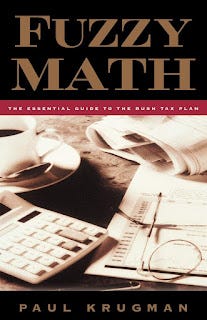
I picked up Fuzzy Math: The Essential Guide To The Bush Tax Plan in a used bookstore the other day. Written in 2001 by NYT columnist and American Economist Paul Krugman, Fuzzy Math is an argument against the proposed tax cuts that President Bush had planned to make during the recession back in 2000.
The book explains the politics and economics of tax cuts and briefly delves into the widely misunderstood world of government benefits, such as social security, medicare, and medicaid. During this era, most people misunderstood the government surplus as an inefficient allocation of capital that was allowed to build up due to high tax rates.
(1) Fiscal policy (Govt tax cuts) are not as quick nor effective as monetary policy (The Fed cutting interest rates) on impacting an economies ability to recover from a recession
(2) It's very easy for the Treasury to skew data about how tax cuts affect different classes. You can lump the top 1% into one group, even though the variation in the proper amount they make drastically differs compared to any of the other classes. You can focus on only one type of tax, such as income tax, while ignoring the effects and changes in holistic tax (payroll and estate tax).
(3) Income tax cuts affect poorer economic classes less because they already don't pay much of their share of income from them. Refunds to income tax means that middle and upper classes benefit more. Meanwhile, payroll tax cuts don't effect upper classes as much (bc it's capped at a specific value, I believe at a $75k salary), therefore poorer economic classes benefit from these much more. These payroll taxes are paid by employers for people, but they're usually reflected in salary so they usually end up getting passed through to employees anyway. Estate tax doesn't affect anybody except upper classes. Income and payroll taxes make up similar amounts of tax budgets.
(4) The govt benefit programs operate with implicit debt, which means they take money from people today and give them out to older folks today as well. Because Boomers are such a large group of the population, the overhead of covering them is insanely high. They'll likely have to be bailed out by taking money from the governments right pocket and putting it to the left pocket. They're not all bad though... these government programs make a society with income inequality more socially equitable. Still, their financing leaves a ton to be pissed off at. I'll have to do more research into the state of it today... almost 20 yrs later.
(5) Because the financing of government benefit programs is so messed up, the government has been creating a trust fund to be able to pay it off in the future bc they know taxpayers can't support the overhead alone. This creates the facade of government surplus, where in reality the government has a ton of growing expenses from regular operations and even more implicit debt. This means the positive we would see on the balance sheet is a false positive in reality.
Although the book was historically relevant for voters in 2001, it was a good intro to some of the tax structures and issues that face Americans today. I'm going to dive deeper into these throughout the year.
Next on the reading/finishing up list:
How Boards Work
Incentives
Bad Pharma