
Flowers For Algernon by Daniel Keyes
I am not only a thing, but also a way of being--one of many ways--and knowing the paths I have followed and the ones left to take will help me understand what I am becoming.

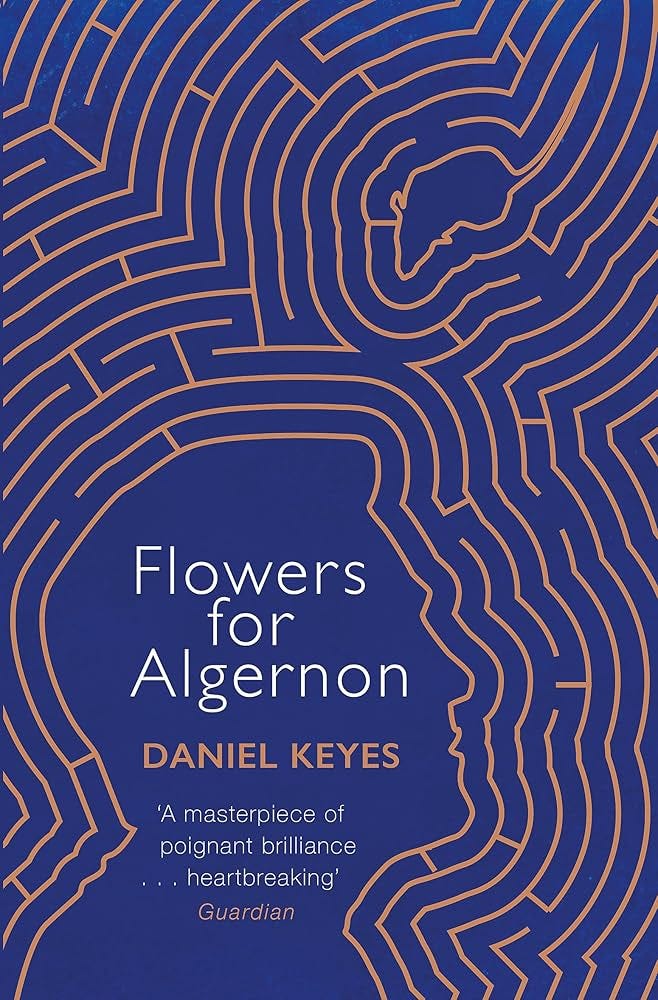
I finished this book on my plane ride to Shanghai last December. It was beautiful and I remember crying. I remember landing with my head dizzy, filled with thoughts and intense reflections. I practiced a mental exercise on the train from the airport to the hotel. I closed my eyes and played the book like a mental movie in reverse. It was a beautiful film, only possible for all the little details Keyes included.
You know when you procrastinate something so much that you don’t even bother starting anymore? I’ve been like that with writing about books for the past six months. It’s sad because I don’t recall my fresh impressions. I’m left with watered-down thoughts and a list of quotes. I used Claude to ingest the full book and all my annotations and help me craft something from the residue. In a funny way, the book brought me to a height of experience (it made me cry!) - the imprint had been made but months later I could only recall faint glimpses of memory and feeling without re-reading. I know . There’s something fitting about that, given what this book is about.
Charlie Gordon, a man with an IQ of 68, undergoes an experimental surgery that triples his intelligence. The story is told through his own progress reports, so the reader watches him change in real time through his spelling, his syntax, and his ability to perceive the world around him. His transformation is experienced not only from the outside but from the inside, which is what makes the book devastating rather than merely sad.
The middle of the book shows the gap between intellectual growth and emotional capacity. Charlie gets smart very fast. He learns languages, absorbs entire disciplines, outpaces the professors who created him; however, his EQ doesn’t keep up with his IQ. He can see clearly that the people at the bakery that employed him were never really his friends, that his mother’s love was conditional, that the scientists who built him treat him as a specimen. He can name all of this with extreme self-awareness, and he becomes aware of his own loneliness in a way he never was before.
This felt similar to the later years of high school and college. Anyone who has gone through a period of rapid growth, intellectual, professional, personal, knows this feeling. You gain the ability to perceive things you couldn’t see before, and the perception arrives faster than your ability to hold it. You can see how people use you (and usually not for cynical reasons). You can remember your past with adult eyes. What do you do with that perception before you have the emotional infrastructure to carry it?
One of the most interesting structural choices in the book is how Charlie’s romantic life mirrors this asymmetry. He has two women in his life. Alice Kinnian, his former teacher, who he loves but can’t touch because old low IQ Charlie panics every time they get close. And Fay, his neighbor, who he can sleep with easily because there’s no emotional weight to it. Alice represents everything he wants but can’t reach. Fay represents pure sensation without meaning.
The reason he can’t be with Alice is rooted in trauma his mother inflicted. She beat him for showing sign of sexual awareness as a child and she threatened to cage him. The surgery removed his cognitive ceiling but left the emotional wiring intact. So his intellectual self can articulate exactly what’s happening and his body still freezes. You can understand your trauma perfectly and still be imprisoned by it. Awareness without integration is simply a more articulate cage.
There is also a very special relationship between Charlie and Algernon, the mouse who had the same surgery. Algernon is the only being in the book who shares Charlie’s exact experience. Charlie breaks Algernon out of a conference where he’s being displayed as a specimen. He builds him a home. Ultimately, he watches Algernon decline and knows he’s watching his own future… and when Algernon dies, Charlie buries him in the back yard and cries deeply.
The last line of the book, after Charlie has lost nearly everything, after his intelligence has faded and his spelling has regressed and he’s preparing to leave for an institution, is this. “Please if you get a chanse put some flown on Algernons grave in the bak yard.” He’s not asking anyone to remember his research or his IQ or his contribution to science. He’s asking someone to remember a mouse. If Algernon’s experience could have mattered to someone (anyone? himself?), then so does his?
There is a section in the middle of the book where Charlie visits the Warren State Home, the institution where he’ll likely end up when he becomes low IQ again. He finds kindness without hope - he sees a psychologist who keeps a baby bottle on his shelf because sometimes you have to cradle a grown man and let him nurse. Staff who have built their lives around giving sustained care to people who will never thank them, never outgrow the need, never reciprocate in the way another adult can.
The Warren State Home staff aren’t full of surplus compassion they’re distributing. They’re tired and overworked. The act of giving creates what it appears to require. This is a kind of love that is so rare and so hard to practice.
“Upward, moving, like a leaf in an upcurrent of warm air. Speeding, the atoms of my body hurtling away from each other. I grow lighter, less dense, and larger ... larger ... exploding outward into the sun. I am an expanding universe swimming upward in a silent sea.”
He’s on the verge of dissolving into something universal, losing himself entirely. And then “the pull from below” drags him back. He can’t transcend. He’s tethered and the thing tethering him is the old Charlie, the part of him that still needs, still reaches for other people even when reaching has only gotten him hurt. It’s the call of being a particular person in a particular body with particular people who need you and whom you need. The transcendence Charlie keeps reaching for keeps dissolving. The human connections he keeps trying to escape are the only things that hold.
At the end of the book, Charlie’s intelligence is mostly gone. He can’t read the scientific paper he wrote. He can’t remember what he learned. But… he retains the emotional residue of having known. He’s like someone who can’t remember a dream but wakes up with the mood of it still on them. As they say in Kimi No Na Wa, ‘it was as if a scene from a dream, nothing more, nothing less than a beautiful view.’
The book asks what a human life should optimize for, and then burns through every answer. Charlie wants belonging, but the bakery workers only liked him when they could laugh at him, and when he outgrew that role they signed a petition to have him fired. He turns to knowledge, devouring books and languages and entire fields, but the smarter he gets the fewer people can talk to him, until even Alice, the woman he loves, can’t follow his thinking. He tries independence, running away from the lab with Algernon, getting his own apartment in Times Square, but freedom without anyone to share it with just means wandering the streets alone at night. He tries sensation, drinking and dancing with Fay, but it can’t hold meaning and he knows it. He tries mission, pouring himself into research that might help millions of people like him, but the research reveals that his own intelligence is temporary and already decaying. The only thing that doesn’t fail him is presence. Being fully with Alice while there’s still time, without pretending it will last.
I think about this book when I think about what it means to move fast, to grow rapidly, to commit yourself to something that changes you. There is a risk is that you’ll succeed in a way that outruns your ability to stay connected to the people and feelings that made the success worth wanting in the first place. Charlie wanted to be smart so he could have friends. He got smarter than everyone and ended up more alone than ever. The operation gave him everything except the thing he wanted it for.
The last thing he writes before leaving for Warren is, “Im going to have lots of fiends where I go.” It’s the same desire he had from his first journal entry. Something has changed, even if he can’t name it, even if I as the reader can’t fully name it either. Whatever he carries with him into that institution, it includes the faintest memory of what it felt like to understand everything, to love someone completely, and to ask for nothing more than flowers on a small grave.
Selections:
“Dr Strauss said dont be so superstishus Charlie. This is sience. I dont no what sience is but they all keep saying it so mabye its something that helps you have good luk.”
“I dont think its right to make you pass a test to eat. How woud Burt like to have to pass a test every time he wants to eat. I think Ill be frends with Algernon.”
“But, she says, everybody, uses commas, so Ill, use them, too,,,”
“One thing? I, like: about, Dear Miss Kinnian: (thats, the way? it goes; in a business, letter (if I ever go! into business?) is that, she: always; gives me’ a reason” when—I ask.”
“Punctuation, is? fun!”
“I’m ashamed. And another thing. I dreamed about that girl Ellen dancing and rubbing up against me and when I woke up the sheets were wet and messy.”
“The more intelligent you become the more problems you’ll have, Charlie. Your intellectual growth is going to outstrip your emotional growth.”
“I had reached a new level, and anger and suspicion were my first reactions to the world around me.”
“all of the pleasure is gone because the others resent me. In a way, I can’t blame them. They don’t understand what has happened to me, and I can’t tell them. People are not proud of me the way I expected—not at all.”
“I was seeing them clearly for the first time—not gods or even heroes, but just two men worried about getting something out of their work.”
“Ordinary people,” she said, “can see only a little bit. They can’t change much or go any higher than they are, but you’re a genius. You’ll keep going up and up, and see more and more. And each step will reveal worlds you never even knew existed.”
“I was somebody before I went under the surgeon’s knife. And I have to love someone.”
“Not knowing about it, I was outside it—not to blame. But now that I know, by my silence I am as guilty as he is.”
“It’s amazing the way things, apparently disconnected, hang together. I’ve moved up to another plateau, and now the streams of the various disciplines seem to be closer to each other as if they flow from a single source.”
“I find no pleasure in discussing ideas any more on such an elementary level. People resent being shown that they don’t approach the complexities of the problem—they don’t know what exists beyond the surface ripples. It’s just as bad on a higher level, and I’ve given up any attempt to discuss these things with the professors at Beekman. Burt introduced me to an economics professor at the faculty cafeteria, one well known for his work on the economic factors affecting interest rates. I had long wanted to talk to an economist about some of the ideas I had come across in my reading.”
“I wish this memory were a photograph so that I could tear it up and throw it back into her face.”
“’No, you’re not growing duller every day! You’re not losing your intelligence! You’re not getting senile and dullwitted. It’s Charlie exploding forward so quickly that it makes it appear as if you’re slipping backwards.’ I say that to myself, Charlie, but whenever we meet and you tell me something and look at me in that impatient way, I know you’re laughing.”
“I had been so absorbed in myself and what was happening to me that I never thought about what was happening to her.”
“Suddenly, it was important to know if I could be like other men, if I could ever ask a woman to share a life with me. Having intelligence and knowledge wasn’t enough. I wanted this, too. The sense of release and looseness was strong now with the feeling that it was possible.”
“I pictured myself being caught by this eager mob and beaten and torn by them. I deserved it. I almost wanted it.”
“Why did I want to be punished? Shadows out of the past clutch at my legs and drag me down. I open my mouth to scream, but I am voiceless. My hands are trembling, I feel cold, and there is a distant humming in my ears.”
“Matt paces the floor like a man who has given up hope but will make one last attempt to reason.”
“I realize there’s nothing we can do. When you’ve got a child like him it’s a cross, and you bear it, and love it. Well, I can bear him, but I can’t stand your foolish ways. You’ve spent almost all our savings on quacks and phonies—money I could have used to set me up in a nice business of my own. Yes. Don’t look at me that way. For all the money you’ve thrown down the sewer to do something that can’t be done, I could have had a barbershop of my own instead of eating my heart out selling for ten hours a day. My own place with people working for me!”
“Nemur’s constant references to having made me what I am, or that someday there will be others like me who will become real human beings. How can I make him understand that he did not create me?”
“phonies”
“I’m exceptional—a democratic term used to avoid the damning labels of gifted and deprived (which used to mean bright and retarded) and as soon as exceptional begins to mean anything to anyone they’ll change it. The idea seems to be: use an expression only as long as it doesn’t mean anything to anybody. Exceptional refers to both ends of the spectrum, so all my life I’ve been exceptional.”
“A short while ago I foolishly thought I could learn everything—all the knowledge in the world. Now I hope only to be able to know of its existence, and to understand one grain of it. Is there time?”
“What is my place? Who and what am I now? Am I the sum of my life or only of the past months?”
“I’ve got to guard against the natural tendency to look down on them now that I have surpassed them.”
“devoting themselves to something important and uncertain rather than to something insignificant and safe.”
“We who have worked on this project at Beekman University have the satisfaction of knowing we have taken one of nature’s mistakes and by our new techniques created a superior human being. When Charlie came to us he was outside of society, alone in a great city without friends or relatives to care about him, without the mental equipment to live a normal life. No past, no contact with the present, no hope for the future. It might be said that Charlie Gordon did not really exist before this experiment....”
“when Norma flowered in our garden I became a weed, allowed to exist only where I would not be seen, in corners and dark places.”
“To see her and trace back to learn what I was? Or to forget her? Is the past worth knowing? Why is it so important for me to say to her: “Mom, look at me. I’m not retarded any more. I’m normal. Better than normal. I’m a genius?”“
“As I see him now, he is not really afraid, just withdrawing, as a bird or squirrel backs off from the brusque movements of the feeder—involuntary, instinctive.”
“Solitude gives me a chance to read and think, and now that the memories are coming through again—to rediscover my past, to find out who and what I really am.”
“She set the beers on the hardwood floor, curled up beside them in front of the sofa, and motioned for me to do the same. “I find the floor more comfortable than chairs,” she said, sipping the beer from the can. “Don’t you?”“
“I don’t know why I suddenly became so free with my place, but there was something about her that demanded complete unselfishness.”
“So damned attractive. So full of life and excitement. Her voice, her eyes everything about her was an invitation.”
“Perhaps she was right for me at this emotional level.”
“as I did it, I saw the two of us, as if I were a third person standing in the doorway. I was watching a man and woman in each other’s arms. But seeing myself that way, from a distance, left me unresponsive. There was no panic, it was true, but there was also no excitement—no desire.”
“I was watching myself through eyes that didn’t understand what I was doing.”
“Somehow, getting drunk had momentarily broken down the conscious barriers that kept the old Charlie Gordon hidden deep in my mind. As I suspected all along, he was not really gone. Nothing in our minds is ever really gone. The operation had covered him over with a veneer of education and culture, but emotionally he was there—watching and waiting.”
“I went to Times Square, from movie house to movie house, immersing myself in westerns and horror movies—the way I used to. Each time, sitting through the picture, I would find myself whipped with guilt. I’d walk out in the middle of the picture and wander into another one. I told myself I was looking for something in the make-believe screen world that was missing from my new life.”
“it wasn’t the movies I wanted, but the audiences. I wanted to be with the people around me in the darkness.”
“How strange it is that people of honest feelings and sensibility, who would not take advantage of a man born without arms or legs or eyes—how such people think nothing of abusing a man born with low intelligence.”
“I’ve got to stop this childish worrying about myself—my past and my future. Let me give something of myself to others. I’ve got to use my knowledge and skills to work in the field of increasing human intelligence. Who is better equipped? Who else has lived in both worlds?”
“Charlie Gordon exists in the past, and the past is real. You can’t put up a new building on a site until you destroy the old one, and the old Charlie can’t be destroyed. He exists. At first I was searching for him: I went to see his—my—father. All I wanted to do was prove that Charlie existed as a person in the past, so that I could justify my own existence. I was insulted when Nemur said he created me. But I’ve discovered that not only did Charlie exist in the past, he exists now. In me and around me. He’s been coming between us all along. I thought my intelligence created the barrier—my pompous, foolish pride, the feeling we had nothing in common because I had gone beyond you. You put that idea into my head. But that’s not it. It’s Charlie, the little boy who’s afraid of women because of things his mother did to him. Don’t you see? All these months while I’ve been growing up intellectually, I’ve still had the emotional wiring of the childlike Charlie. And every time I came close to you, or thought about making love to you, there was a short circuit.”
“That’s the way she is about most things that seem unimportant to her. She just can’t or won’t bother. The other day I discovered a stack of parking tickets in a corner behind a chair—there must have been forty or fifty of them. When she came in with the beer, I asked her why she was collecting them. “Those!” she laughed. “As soon as my ex-husband sends me my goddamned check, I’ve got to pay some of them. You have no idea how bad I feel about those tickets. I keep them behind that chair because otherwise I get an attack of guilt feelings every time I see them.”
“finding out who I really am—the meaning of my total existence involves knowing the possibilities of my future as well as my past, where I’m going as well as where I’ve been. Although we know the end of the maze holds death (and it is something I have not always known—not long ago the adolescent in me thought death could happen only to other people), I see now that the path I choose through that maze makes me what I am. I am not only a thing, but also a way of being—one of many ways—and knowing the paths I have followed and the ones left to take will help me understand what I am becoming.”
“we classify them as tidy or untidy”
“Fay is annoyed that I’ve stopped taking her out dancing, and she got angry and walked out on me last night. She has no idea of my work and no interest in it, and when I do try to talk to her about it she makes no attempt to hide her boredom. She just can’t be bothered, and I can’t blame her. She’s interested in only three things that I can see: dancing, painting, and sex. And the only thing we really have in common is sex. It’s foolish of me to try to interest her in my work. So she goes dancing without me. She told me that the other night she dreamed she had come into the apartment and set fire to all my books and notes, and that we went off dancing around the flames. I’ve got to watch out. She’s becoming possessive. I just realized tonight that my own place is starting to resemble her apartment—a mess. I’ve got to cut down on the drinking.”
“Whatever happens to me, I will have lived a thousand normal lives by what I might add to others not yet born.”
“Life and work are the most wonderful things a man can have. I am in love with what I am doing, because the answer to this problem is right here in my mind, and soon —very soon—it will burst into consciousness. Let me solve this one problem. I pray God it is the answer I want, but if not I will accept any answer at all and try to be grateful for what I had.”
“I’ve got to take my mind off the problem for a while and let it stew. I’ve gone as far as I can on a conscious level, and now it’s up to those mysterious operations below the level of awareness. It’s one of those inexplicable things, how everything I’ve learned and experienced is brought to bear on the problem. Pushing too hard will only make things freeze up. How many great problems have gone unsolved because men didn’t know enough, or have enough faith in the creative process and in themselves, to let go for the whole mind to work at it?”
“He’s had several experiences of perceiving himself as he was before the experiment—as a separate and distinct individual still functioning in his consciousness—as if the old Charlie were struggling for control of the body—” “No! I never said that! Not struggling for control. Charlie is there, all right, but not struggling with me. Just waiting. He has never tried to take over or tried to prevent me from doing anything I wanted to do.” Then, remembering about Alice, I modified it. “Well, almost never. The humble, self-effacing Charlie you were all talking about a while ago is just waiting patiently. I’ll admit I’m like him in a number of ways, but humility and self-effacement are not among them. I’ve learned how little they get a person in this world.”
“Intelligence without the ability to give and receive affection leads to mental and moral breakdown, to neurosis, and possibly even psychosis. And I say that the mind absorbed in and involved in itself as a self-centered end, to the exclusion of human relationships, can only lead to violence and pain.”
“Who’s to say that my light is better than your darkness? Who’s to say death is better than your darkness? Who am I to say?...”
“Unlike Charlie, I was incapable of making friends or thinking about other people and their problems. I was interested in myself, and myself only. For one long moment in that mirror I had seen myself through Charlie’s eyes—looked down at myself and saw what I had really become. And I was ashamed.”
“It has to do with my mother, and now—more than ever—I want to understand her, to know what she was like and why she acted the way she did. I mustn’t hate her. I’ve got to come to terms with her before I see her so that I won’t act harshly or foolishly.”
“She had a knife, and Alice had a knife, and my father had a knife, and Dr. Strauss had a knife....”
“Whatever the truth is, I must not hate Rose for protecting Norma. I must understand the way she saw it. Unless I forgive her, I will have nothing.”
“There was no way to stop the sands of knowledge from slipping through the hourglass of my mind.”
“Upward, moving, like a leaf in an upcurrent of warm air. Speeding, the atoms of my body hurtling away from each other. I grow lighter, less dense, and larger ... larger ... exploding outward into the sun. I am an expanding universe swimming upward in a silent sea. Small at first, encompassing with my body, the room, the building, the city, the country, until I know that if I look down I will see my shadow blotting out the earth. Light and unfeeling. Drifting and expanding through time and space. And then, as I know I am about to pierce the crust of existence, like a flying fish leaping out of the sea, I feel the pull from below.”
“As I lie here waiting, the moment passes during which I am myself in myself, and again I lose all feeling of body or sensation. Charlie is drawing me down into myself. I stare inward in the center of my unseeing eye at the red spot that transforms itself into a multipetaled flower—the shimmering, swirling, luminescent flower that lies deep in the core of my unconscious.”
“Why am I always looking at life through a window?”
“Before you had the operation, you weren’t like this. You didn’t wallow in your own filth and self-pity, you didn’t pollute your own mind by sitting in front of the TV set all day and night, you didn’t snarl and snap at people. There was something about you that made us respect you—yes, even as you were. You had something I had never seen in a retarded person before.”
“I think I know why I been haveing bad luck. Because I lost my rabits foot and my horshoe. I got to get another rabits foot fast.”
“I’m living at a peak of clarity and beauty I never knew existed. Every part of me is attuned to the work. I soak it up into my pores during the day, and at night—in the moments before I pass off into sleep—ideas explode into my head like fireworks. There is no greater joy than the burst of solution to a problem. Incredible that anything could happen to take away this bubbling energy, the zest that fills everything I do. It’s as if all the knowledge I’ve soaked in during the past months has coalesced and lifted me to a peak of light and understanding. This is beauty, love, and truth all rolled into one. This is joy.”
I read this book a long time ago in school and remember it was one of my favorites. I would love to read it again, there’s no way I got even 5% of the book when I was a kid