
Dr. No by Percival Everett

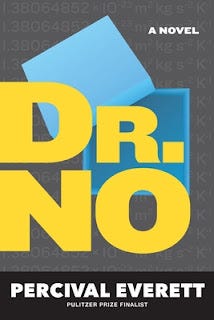
Dr. No by Percival Everett is an amusing work of fiction. The novel centers around a math professor named Wala Kitu from Brown who meets a billionaire James Bond villain wannabe, John Sill. Wala studies the concept of "nothing" and for the most part, the book is a series of jokes playing on the word "nothing" with the concept of "nothing." Sill's mother on the other hand had run a prostitution business ring in Missouri and used their open ears to get the inside scoop from politicians, which she used to buy and then flip real estate in hotspots where the government would claim them. Sill proceeded to become a worldwide villain with high up connections and mansions and jets across the world.
The book is witty and told from the point of view of Wala, who is honestly more robot than man. He is not emotionless, but he is rather dispassionate in his analysis of events, which creates a sort of dry humor. Wala also has a one-legged dog named Trigo, who is his best friend. Trigo appears in Wala's dreams as a non sequitur messenger of sorts, expressing Wala's inner and rather random thoughts. There is also an mathematician named Eigen, who is a gifted topologist who wants to experience something dangerous, and so takes a fancy for John Sill.
Overall, I wouldn't necessarily recommend but it was an amusing story.
What is happy? Define your terms. This happy you speak of, is it a state or a condition, if there is a distinction to be made there? Is it something I can take on, something I can occupy, or is it something that occupies me? Is it something I find or something that I passively catch.
You're not seeing happiness. You're seeing social awkwardness, a mild blindness to the normal range of social cues. You like me because I'm weird and you like that because you think you're weird. And you are, in a good way. You know what a homotopy equivalence is and you don't need to know that. No one needs to know that. Face it, that's weird." I drank my tea.
Darwin was right. A mathematician is a blind man in a dark room looking for black cat isn't there
A mathematician is asked if he'd rather have cold coffee or meet God. He says he'll have the cold coffee. He's been told that nothing is better than meeting God and cold coffee is better than nothing
I have no idea why boats are always female, but so be it. Even the USS Abraham Lincoln is a she
To designate feelings, to verbalize them, was to, necessarily, alter them, with no particular direction or mission. When I was very young, I didn't trust speech, believing that other, nonword languages would intrude, complicate, or obstruct meaning, body language, facial expression, timing, inflection, so I write notes, letters. Now I knew that any movement from initial, pure thought was a movement away from precise meaning or representation. Meaning is always constructed after the fact. Not only is there no private language, but there is no such thing as private meaning.
She and I were always awkward; it was our usual status or posture in the world, and so acceding to it, recognizing it of course served to neutralize it, if not negate it.
Hegel had it turned around. One doesn't start with a thesis. One starts with an antithesis. Everyone always underestimates negation.
Is it because they see it as a primitive, as not using our sophisticated processes of aesthetic sublimation to manage our fears, needs, and desires, because it works by implementing Manichaestic strategy? Must our default always be a surrender to our belief in individual psychological complexity?
[I didn't know how to even interpret this one...]
Philosophical conviction seldom leads to real-world modification. I could tell myself that pain was merely reportage from my body that some trauma had occurred and therefore I could talk myself out of the sensation, but that was all bullshit.
The yuk-yukking came from the other room. Never trust anything with a laugh you can spell.
To prove that a given set of presumptions implies a contemplated conclusion, prove that the premises are at variance with the negation of that conclusion. Logic was simple enough to employ and understand, but hard to make useful. The rules were always clear, exacting, but had little to do with reality. I sat there on the cold bench trying to reason to our next move.
Thank you for the book, Yesenia.