
Contact (1997): mysticism and faith

Staying in on Friday night to watch a Sci-Fi movie beats going out, almost all the time.
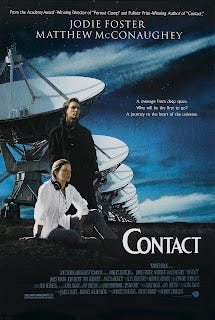
My roommate and I watched Contact (1997) directed by Robert Zemeckis and featuring actors like Jodie Foster as Eleanor and Matthew McConaughey as Palmer.
Normally, I would have written a full post about the movie right after watching (regretful that I fell asleep instead). Since a few days have passed, I'm settling for just a few sentences about the feeling that's lingered.
The movie was enormous in the sense that it made you truly feel like a spec in the universe. Like Arrival (2016), it was interesting to see how the directors envisioned the world and humans reacting to the discovery of an alien species. While Arrival focused more heavily on world governments and politics, Contact kept the attention on the religious overtone of aliens (though not as in-depth as The Three Body Problem by Cixin Liu).
Contact was much more than a movie about extraterrestrials and communication... it was a movie about the notion of faith. It ebbed and flowed between contextualizing "faith" in the religious sense and also in mystic sense.
Mysticism: belief characterized by self-delusion or dreamy confusion of thought, especially when based on the assumption of occult qualities or mysterious agencies (Oxford Languages).
One of the speech topics in my Rhetoric & Dialogue class was to talk about a time you experienced joy, love, sadness, or hatred. My professor gave a simple, yet beautiful example. He talked about a particular sunset he experienced in his early twenties while he was in Australia. He wasn't one to preach on religion, but in that moment, he felt an overwhelming feeling of transcendent joy -- a coming to grips with the universe and the world around you wherein you were one with the entity. A dreamy confusion of thought that may as well be delusion, accredited to the mysterious powers of the sun and the beauty in nature.
In Contact, Eleanor experienced the same mystic powers of the universe. And she brought her audience along with her. In her testament to the supreme court at the end of the movie, she's placed right next to Palmer, a symbol of faith, religion, and pursuit of truth in the movie.
Here's the transcript:
--
Panel member : Doctor Arroway, you come to us with no evidence, no record, no artifacts. Only a story that to put it mildly strains credibility. Over half a trillion dollars was spent, dozens of lives were lost. Are you really going to sit there and tell us we should just take this all... on faith?
[pause, Ellie looks at Palmer]
Michael Kitz : Please answer the question, doctor.
Ellie Arroway : Is it possible that it didn't happen? Yes. As a scientist, I must concede that, I must volunteer that.
Michael Kitz : Wait a minute, let me get this straight. You admit that you have absolutely no physical evidence to back up your story.
Ellie Arroway : Yes.
Michael Kitz : You admit that you very well may have hallucinated this whole thing.
Ellie Arroway : Yes.
Michael Kitz : You admit that if you were in our position, you would respond with exactly the same degree of incredulity and skepticism!
Ellie Arroway : Yes!
Michael Kitz : [standing, angrily] Then why don't you simply withdraw your testimony, and concede that this "journey to the center of the galaxy," in fact, never took place!
Ellie Arroway : Because I can't. I... had an experience... I can't prove it, I can't even explain it, but everything that I know as a human being, everything that I am tells me that it was real! I was given something wonderful, something that changed me forever... A vision... of the universe, that tells us, undeniably, how tiny, and insignificant and how... rare, and precious we all are! A vision that tells us that we belong to something that is greater then ourselves, that we are *not*, that none of us are alone! I wish... I... could share that... I wish, that everyone, if only for one... moment, could feel... that awe, and humility, and hope. But... That continues to be my wish.
--
So what is faith? Unless you're a suicidal nihilist, faith is something inherent in every human. It's a process of contextualizing your belief in something. Whether that something be God, aliens, the dao, the universe, or nirvana is up to the individual.
Notes/Favorite Lines:
Palmer Joss : What are you studying up there?
Ellie Arroway : Oh, the usual. Nebulae, quasars, pulsars, stuff like that. What are you writing?
Palmer Joss : The usual. Nouns, adverbs, adjective here and there.
David Drumlin : I know you must think this is all very unfair. Maybe that's an understatement. What you don't know is I agree. I wish the world was a place where fair was the bottom line, where the kind of idealism you showed at the hearing was rewarded, not taken advantage of. Unfortunately, we don't live in that world.
Ellie Arroway : Funny, I've always believed that the world is what we make of it.
Ellie Arroway : You know, there are four hundred billion stars out there, just in our galaxy alone. If only one out of a million of those had planets, and just of out of a million of those had life, and just one out of a million of those had intelligent life; there would be literally millions of civilizations out there.
Palmer Joss : [looking the night sky] Well, if there wasn't, it'll be an awful waste of space.
Ellie Arroway : [looking him] Amen.