
Chip War by Chris Miller
No product is more central to international trade than semiconductors.

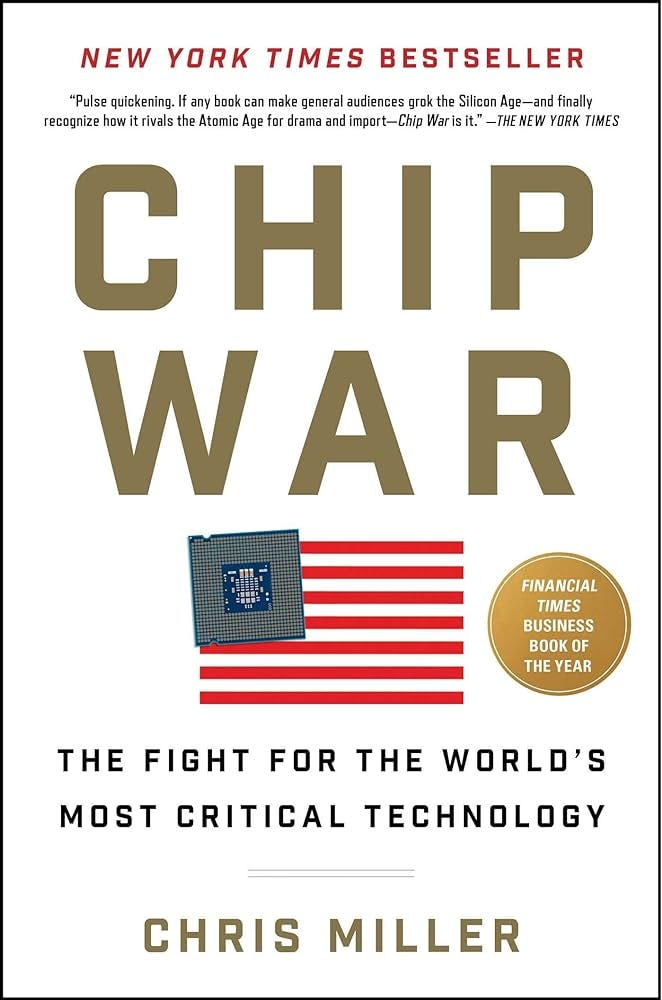
Rating: 9/10
Semiconductors and chips are all the hype in todays AI-driven economy. Chip War by Chris Miller was an excellent read for anyone who wants to know about the history of semiconductors and where the power lies between nations and corporations in this vital industry. As Alan Kay, “People who are really serious about software should make their own hardware”, thus as an incoming software investor, I thought it was vital to understand hardware for macro purposes.
Side-note: I love economic history.
Book notes:
Bell labs scientists like Shockley innovate vacuum tubes to create transistors.
Shockley creates Shockley Semiconductor. The “Traitorous eight”, who dislike his management and left to create Fairchild Semiconductor, create better managed companies with legacies for innovation (Intel, AMD, etc)
Traitorous Eight: Julius Blank, Victor Grinich, Jean Hoerni, Eugene Kleiner, Jay Last, Gordon Moore, Robert Noyce, and Sheldon Roberts
Japan, South Korea, Singapore, and Taiwan were notable as countries which gained a foothold to outsourced US semiconductor opportunities. During the Cold War, being anti-USSR, made the US state dept follow a doctrine of bolstering their economies
Japan: Akio Morita (Sony)
South korea:
Taiwan: Morris Chang (TSMC) works at Texas Instruments
Silicon Valley
Andy Grove saving Intel from DRAM, making a wartime CEO decision to leave their famed initial market in favor of microprocessors
Japanese firms couldn’t replicate the rise of PC chips
Software from Silicon Valley enables chips to be made with streamlined processes. It’s an art form, with process design changing from firm to firm, but software helped standardize it
Micron, funded and steered by an Idaho potato millionaire, innovates on chip design during a period where it was ultra commoditized
The best time to buy a commodities business is when it’s priced low
Made employees work in sweatshop conditions” relative to other Silicon Valley firms. In idaho, there were no firms down the road to switch to
Japan:
Low interest rates, massive government subsidizes, and operational excellence
Japan currently (2024) has the highest debt to GDP ratio in the world, sustainable bc their population has the highest amount of savers in the world
At the same time as low interest rates in Japan, the US had 21% interest rate. So many firms simply couldn’t compete
The Japan That Can Say No by Akio Morita and Shintaro Isihara
Ultimately overinvested in subsidizing their chip companies. Profitability became less important than growth, and the stock market eventually tanked
Market share went from 90% in late 1980s to 20% 1998
The Iraq Kuwait war was America’s opportunity to flex the power of silicon over steel in warfare/ Transition from quantity (USSR advantage) to quality and precision munitions.
US beat USSR in chips and ultimately warfare:
USSR was focused on (1) espionage, stealing massive amounts of chips under fake EUropean companies and infiltrating US science exchange programs… and (2) copy-paste tactics, but the US was innovating chips at the rate of Moore’s law, making stolen chips too old to be replicated
Zelenograd, Russia was their “chip city”
USSR had only defense budget for chips to fuel their growth… but US had a large and growing consumer market too
Taiwan and South Korea overtake Japan after the Japanese Financial Crisis
ASML bought Intel’s group in 2001, becoming a monopoly in photolithography machines, which are used to etch transistor structures onto silicon wafers
The EUV (extreme ultraviolet light) machines are the “most expensive mass-produced machine tool in history” and are the product of billions in R&D investment via Intel, Samsung, and TSMC
DARPA, elite US universities, and Sematech were organizations both public and private that were essential to connectivity between industry and cutting edge engineering
Intellectual property was something that “imperialists used to bully less-advanced countries.” (Chang Li, Taiwan’s minister of economy)
The three lithography wars
ASML was a bridge between the US and Japan during a tense period. They also had investment from Philips, which gave them a natural investment from TSMC.
Grove/Intel invested $200M
AMD divested their chip building arm, creating Global Foundries, which was struggling to compete with TSMC and Samsung
Qualcomm (founded 1985) - How to transmit more data via the radio spectrum? Cram calls into available spectrum space. Use excess capacity
People initially thought voice quality would be low and calls would be dropped
“People who are really serious about software should make their own hardware” -
When releasing the iPhone, Apple designed its own chips and didn't go for products from Qualcomm
Steve Job’s philosophizes on the connection between hardware and software
Designed in California. Assembled in China. Made in Taiwan.
Tesla designs its own chips for its cars
ASML
Highly specific supply chain management, producing only 15% of parts in house.
To suppliers: “If you don’t behave, we’ll buy you.”
Cost $370M per machine and has a 24/7/365 attention
2G: picture texts. 3G: open websites. 4G: stream videos
5G is looking like: ultra-high-speed data transfer
Modem chips allow us to send many more 1s and 0s. Beam forming allows precision with radio waves instead of sending them in every direction.
Tsinghua Unigroup - Zhao Weiguo
Micron’s IP was stolen by Fujian Jinhua. Weak chinese IP law meant the Chinese courts favored FJ, and the state-backers threatened to cut off Micron from the chinese market (#1 customer). Micron was preparing for a settlement agreement because they couldn’t count on US support from a weak stance by the Obama administration. Trump’s administration retaliated and successfully worked with Japan to cut Chinese chip producers off from essential components
The US banning Huawei and other strategic Chinese chip chinese companies crippled the frontier industry in China. European countries like Great Britain cut contracts with Huawei after realizing it could not supply the parts
Weaponized interdependence via monopolizing software for chip: keep your friends close, enemies closer
US control over key choke points in the supply chain of chips (Monthly Review)
Applied Materials is the world’s largest semiconductor tool-making company, building the equipment that deposits thin films of chemicals on top of silicon wafers during processing.
Lam Research has world-beating expertise in etching circuits into silicon wafers.
KLA Corporation has the world’s best tools for finding nanometer-sized errors on wafers and lithography masks.
Cadence, Synopsys, and Mentor are the three U.S. firms that provide the software capable of laying out billions of transistors on a wafer. Together, they control around three-quarters of the market.
China would like a non-US supply chain but will be unable, in the next 10 years at least, to do this. It will shift away from choke point technologies as best it can
Worry is that China’s sleuths of subsidies will help it win market share. Will play a bigger role in producing non-cutting edge logic chips, NAND memory market, and fabrication share from 15% to 24% by 2030 overtaking Taiwan and South Korea by volume. More leverage would mean better at imposing tech transfer. But this is all dependent on govt support.
Open vs closed architecture
X86 is based on Intel and AMD
Risk 5 is open-sourced architecture. Risk of security defects is lower because more engineers can see it. Geopolitically neutral, moved from the US to Switzerland.
The semiconductor shortage of post-2021 was a function of demand growth rather than shortage
AI enabled data centers, phones, computers, cars, etc.
Chip industries dealt well with Covid
$210B hit to car industry for canceling chips
Future of chips:
Microprocessors (general purpose) are getting replaced by customized chips. NVIDIA GPUs aren’t general purpose like a microprocessor, but they’ve made AI cheaper to implement.
Big tech firms like Amazon and Google design their own chips for their own servers.
Bifurcation of computing into slow and fast lane. Easier than ever before to combine many types of chips for various use cases — new packaging tech to connect chips easily.
The age of monopoly capital
Monopoly capital does not entail monopolization of the entire value chain by any single actor
“Designed by Apple in California. Assembled in China,” etched on a phone, he writes, “is highly misleading. The iPhone’s most irreplaceable components are indeed designed in California and assembled in China. But they can only be made in Taiwan.”
When writing books about a high tech industry, the author always faces a challenge between staying precise with the scientific advancements and between explaining to a layman's audience. As someone with just a foggy high school science background, I did think it could have used a few brief primer sections, which I did anyway via GPT.