
Call It Sleep by Henry Roth
“Bing! I’m an Innian. If you don’ have a bow ’n’ arrer, I c’n kill yuh. Bang!” Another shaft flew. “Right innee eye. Wyntcha wanna play?”

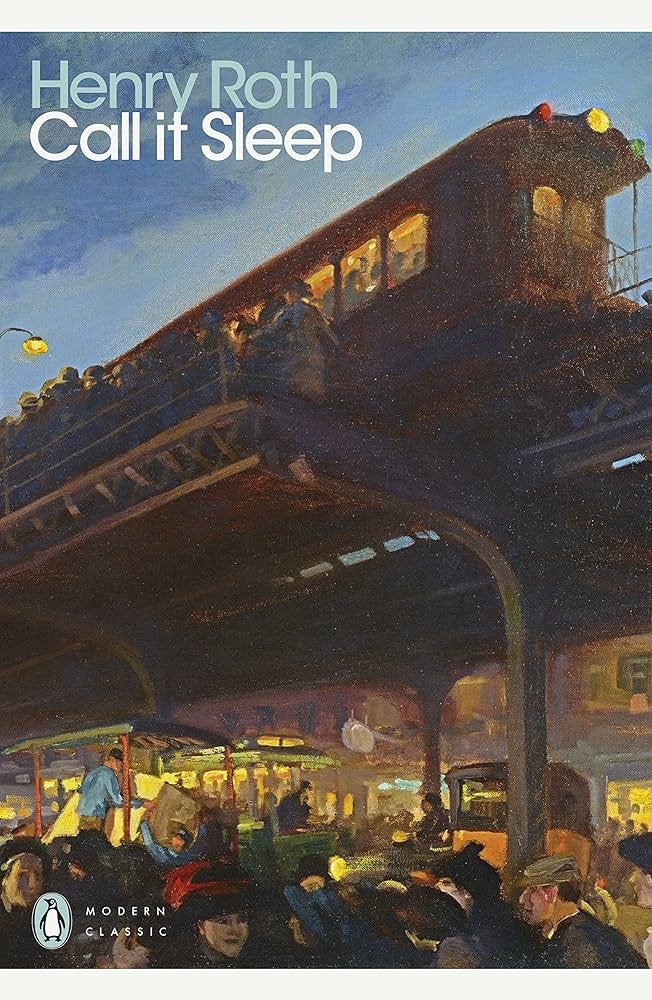
Rating: 5/10
Call It Sleep may be among the best written books I have ever read; however, for a reader like me, content is king. The book is slow and steady with its pace, with the narrative technique of life through a child’s eyes being the key focus. It is at once an impressive literary work and a very boring plot. I suppose it shows why I can appreciate the occasional English class, but be adverse to doing a minor. If in the future I’m ever writing a story of my own, I will surely reference back to the stylistic techniques.
Notes
Setting and Context
Set in the era of the author's childhood, conjuring pre-WWI immigrant America.
Reflects on the migration of 2.5m Jews from Russia, Austria, Hungary, etc., to the Lower East Side (LES), where 1m Jews constituted 25% of NYC's population.
Describes an age of transition with the coexistence of horse-drawn streetcars, electrified streetcars, and early automobiles.
Mentions notable locations: Cooper Union; Flat Iron Building.
There was no mention of parks. Children played in the streets.
Individual blocks were described ethnically, often by nationality & language, with Jews sharing Yiddish and mingling.
People referred to each other by their ethnic groups (ethnic stereotyping).
Egen researched tenement life.
Tenement Museum, NYC.
Characters and Perspectives
Focuses on a child/protagonist who is 5 years old at the start of Book 1 and 8 by the end of the novel.
Bertha is characterized by physical excess, unashamedness, green teeth...
Luter establishes his power, indicating that Albert isn't liked and that he protects him. Uses that to try to extract sexual favors from David’s mom
Albert perceives slights in the world around him and reacts vulnerably and gullibly.
Narrative Techniques and Themes
Uses stream of consciousness.
Writing from a child's POV, highlighting the challenge due to their reactive bodies and their role as think tanks of sensory perception.
The early pages of a book should teach us how to read the book.
Discovery vs. refrain in David's experiences.
David posits a secret reality behind what he can see, interpreting coded behavior and conversation among adults as a book about reading codes, the code of codes being language itself.
Vivid sensory detail and a collective POV focusing on the child, David.
Dialogues with himself, enhancing the stream of consciousness.
Structural Elements
(1) Consists of a Prologue and 4 books, using a mix of omniscient 3rd person and 1st person perspectives of David.
Book 4 revisits omniscience, becoming more experimental.
(2) Each book has its own symbolic centerpiece, acting as fixtures of his relationship to the world around him.
(3) Each book introduces new characters (e.g., Luter, Aunt Bertha) as a dramatic structure.
(4) Features a rhythmic structure reflecting David's challenges and his responses to them.
David’s father beating him + David running away
Albert tearing Bertha’s underwear + eavesdropping on convo about organist
Cultural and Social Observations
Novels and poetry are artifacts of the dream life of the culture.
Yiddish language use is notable for its wild metaphors and biblical references.
Selections (some for the prose, some for the humor):
Trinkets held in the mortar of desire, the fancy a trowel, the whim the builder. A wall, a tower, stout, secure, incredible, immuring the spirit from a flight of arrows, the mind, experience, shearing the flow of time as a rock shears water. The minutes skirted by, unknown.
She looked so frail in death, in her shroud—how shall I tell you, my son? Like early winter snow. And I thought to myself even then, let me look deeply into her face for surely she will melt before my eyes.
“Bing! I’m an Innian. If you don’ have a bow ’n’ arrer, I c’n kill yuh. Bang!” Another shaft flew. “Right innee eye. Wyntcha wanna play?”
Broken english is not easy stylistic choice
He spoke through his teeth—“The sooner you’re on the road to your fortune, the better I’ll like it. And don’t think,” he added with biting significance, “that if I don’t go to your wedding I won’t dance!
To want to marry that— that vile mouth! It would shame the water-carrier in a Russian bath!
That foible his father had of increasing his age to magnify his guilt had long ago become familiar to him
If you could read as easily as your eyes can piss, you were a fine scholar indeed!”
Shaggy clouds trooped after their van