
Breakneck by Dan Wang
A country can grow powerful when it trains a lot of engineers and puts them to work, even under less-than-great institutional arrangements

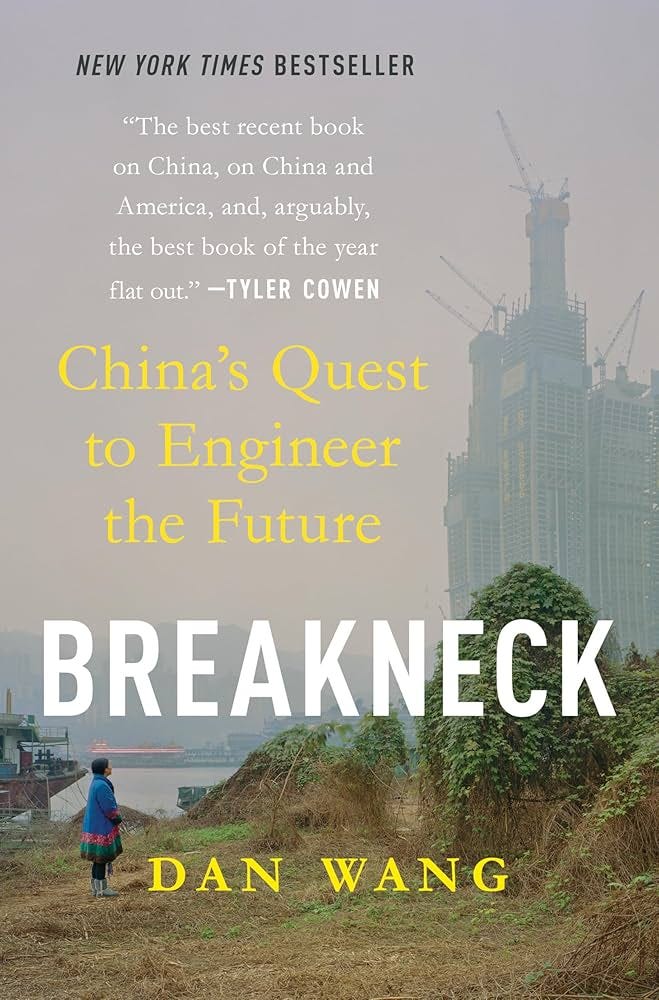
The core of Dan Wang’s Breakneck is a brilliant framing of the “Lawyerly vs. Engineering” society.
The Engineering Society has the advantage of physical dynamism, enabling a country to build infrastructure and scale manufacturing with *breakneck* speed by treating technology as a living practice of the factory floor. However, its disadvantage is a propensity for social overreach, where mechanistic leaders treat the population as an “aggregate” building material, leading to massive policy errors (Wang cites the one-child policy or Covid’s extreme lockdowns) because there is no system to check the state’s momentum.
The Lawyerly Society has the advantage of procedural protection, ensuring that individual rights are guarded and that the government is held to the “rule of law” rather than the whims of technocrats. Its primary disadvantage is institutional stasis, where an obsession with process and “democracy by lawsuit” creates a vetocracy that blocks new construction, drains industrial process knowledge (outsourcing / globalization to favor “capital light” businesses), and leaves the country physically stagnant.
Truly rare insights like this are treasures and they serve as a powerful lens for predicting geopolitical behavior and betting on long-term trajectories.
I picked up the book on the way to Breckenridge, just as I was weighing a trip to China before the new year. The timing was serendipitous. Reading this and Apple in China helped solidify our decision to get on the ground and explore the robotics scene firsthand.
If I have one critique, it’s that the book is perhaps too long for its central premise and that the thesis is hammered home a few times too many times. Conversely, the anecdotes are incredibly sticky. I found myself recalling them vividly while being in China and observing things myself.
Wang also does a good job deconstructing what “technology” actually is. He breaks it into three pillars:
Tools: The physical hardware.
Explicit Instructions: The blueprints and manuals.
Process Knowledge: The tacit knowledge gained only through practical, on-the-floor experience
Process knowledge is where China is accelerating and the US is atrophying. Wang’s plea is to bring (some/more) manufacturing back to the West. While he may lack a granular policy roadmap, his directional point is that losing the “muscle memory” of production is a strategic catastrophe. After seeing the supply chain of the robotics frontier and the hyper-compressed R&D cycles in China myself, it’s clear the US has a massive gap to close.
I’m still ruminating on what my own policy recommendations would be, but I intend to draft some soon.
Selections:
A rough rule of thumb is that China produces one-third to one-half of nearly any manufactured product, whether that is structural steel, container ships, solar photovoltaic panels, or anything else.
Only two American presidents worked as engineers
Many people still live under the strictures of the hukou, or household registration, an aim of which is to prevent rural folks from establishing themselves in cities by restricting education and health care benefits to their hometown
The fundamental tenet of the engineering state is to look at people as aggregates, not individuals.
To a first approximation, the twenty-four men who make up the Political Bureau (the highest echelon of the Communist Party, usually shortened to Politburo) are the only people permitted to do politics. Once they’ve settled questions of strategy, the only remaining task is for the bureaucracy to sort out the details.
Over the policy’s three-and-a-half-decade duration, China conducted nearly as many abortions, according to official figures, as the present population of the United States
The public soured on the idea of broad deference to US technocrats and engineers: urban planners (who were uprooting whole neighborhoods), defense officials (who were prosecuting the war in Vietnam) and industry regulators (who were cozying up to companies).
The lawyerly society grew out of a necessary corrective to the United States’ problems of the 1960s.
Though the political views of law students may twist in unexpected directions, we should keep in view that they are entwined most firmly around a pillar of personal ambition.
Since the middle of the twentieth century the American left pursued a “democracy by lawsuit” strategy that conservatives have revealed themselves to be no less capable at playing.
Designing new rules and committees have so often become the substitute for thinking hard about strategy and ends.
The lawyerly society is a systematic bias toward the well-off Lawyers are too often servants of the rich
A country can grow powerful when it trains a lot of engineers and puts them to work, even under less-than-great institutional arrangements
Chinese leaders are usually expected to administer a poor province before they can be promoted to the country’s political pinnacle.
Manufacturing hubs are everywhere, often making goods you don’t expect. Guizhou locals may be as surprised as anyone to host the world’s guitar capital.
“Socialism with Chinese characteristics.” China does little by way of redistribution from the wealthy to the poor; rather, it is enacting a Leninist agenda in which the state retains enormous discretion to command economic resources in order to maintain political control and to build toward a postscarcity world.
Shanghai alone moved more containers in 2022 than all of the US ports combined.
Americans are no longer able to appreciate that a physically dynamic landscape creates a sense of progress.
An educational system steeped in Marxism. For them, production was a noble deed to advance communism, while consumption was a despicable act of capitalism. This party believes that only the state has the wisdom to invest in strategic megaprojects, whereas consumers will waste money on themselves.
Since the state levies relatively light taxes, which it takes unobtrusively from citizens, it reduces the risk that people start asking questions about what the state is doing with their hard-earned funds and whether their taxes should entitle them to greater political participation. Low taxes make China stingy on welfare.
The lack of a safety net is one of the reasons that Chinese households save a great deal of their income for contingencies.
When Chinese officials talk about promoting consumption, it often involves building new malls or replacing old industrial equipment. In other words, it’s still more about investing to build stuff rather than shifting the propensity of households to spend a greater share of their income.
The defining feature of socialism was not economic redistribution but rather “concentrating resources to accomplish great tasks.”
Under Deng’s definition, the United States has also achieved plenty of socialism. The Manhattan Project, the Interstate Highway System, and the Apollo Program all concentrated resources to accomplish great tasks.
One of the Communist Party’s personnel practices (inherited from imperial times) is to rotate officials between various jurisdictions, forcing them to gain broad experience and preventing them from drawing their power base from their home province.
Tianjin has built not only China’s third-tallest skyscraper (ninety-seven floors, little occupied) but also one of its most photogenic libraries. The Dutch architects behind Tianjin’s Binhai Library put a bright white sphere in its center, around which undulating curves make up shelving space. Except few of these shelves held any books. Once I got up close, I could see that the beautiful shelves had only digital prints of book spines. All around me were people taking selfies rather than browsing or reading. I sometimes think of Tianjin’s library as a metaphor for China’s economy: great hardware that looks impressive from a distance, not filled with the softer stuff that actually matters. Tianjin could have focused on filling its amazing skyscrapers with better businesses. Instead, it could only build more hollow shells, while it gained considerable debt.
Agglomerations can achieve previously unseen levels of productivity, representing the difference between England and the rest of the world during the Industrial Revolution.
China produces so much in part because every province wants to be an automotive manufacturing hub. The country has over a hundred automotive brands, most of them small, all of them fighting for sales. The competition is so fierce in part because auto companies receive extensive support from local governments, who all try to promote their champion through cheap credit and consumer rebates to local companies. Shanghai, for example, is full of the locally produced SAIC-Volkswagen cars, w
“American manufacturers constantly asked themselves whether making masks and cotton swabs was part of their ‘core competence.’ Most of them decided not.” He put down his teacup and looked at me. “Chinese companies decided that making money is their core competence, therefore they go and make masks, or whatever else the market needs.” In 2020, I could have picked up face masks that were branded Foxconn (the world’s largest electronics contract manufacturer), BYD (the world’s largest electric vehicle manufacturer), or JD.com (China’s second-largest e-commerce platform). Companies retooled some of their production lines to get into the masks and money business. Chinese conglomerates rarely hesitate to go after the core business lines of others.
Many of these Chinese companies will inevitably go out of business, after they’ve dragged down their competitors all over the world in brutal price wars. This trend has produced a frustrating quirk in China’s equity markets. Financial investors have seen that there is no relationship between Chinese stock market performance and GDP growth.
“Thought work,” ranging from presenting resettlement as a voluntary and happy choice to holding intensive one-on-one meetings with recalcitrant folks who do not want to leave. Officials mix inducements with threats until they wear down the farmers. Thus, the state has been able to achieve “voluntary” resettlement rates of 100 percent.
Public works give government officials plenty of discretion about how to build a project, giving them a lot of opportunities to accept kickbacks. Even if officials are upstanding, the developer might contract out the construction to a lower-cost builder, who takes a margin and subcontracts out again, and on and on until it reaches someone willing to cut costs to the bone.
The engineering state is focused mostly on monumentalism. Though there are many public toilets, provision of toilet paper is only a sometimes thing. Nowhere in China is it advisable to drink tap water. Not even Shanghai.
Under banners like “abundance agenda,” “supply side progressivism,” and “progress studies,” various movements are trying to loosen American supply constraints.
The United States will have to regain all the muscle it has lost for building public works as well as manufacturing capacity, and China will have to empower consumers by getting over its fear of making people lazy.
China would be better off if it built less and built better.
There is no way to achieve large-scale decarbonization without largescale construction, of the sorts of solar, wind, and electrical transmission projects that China has been so good at.
As John Maynard Keynes said, “Anything we can actually do we can afford.”
China’s policymakers have declined to be bound by some of the fundamental tenets of Wall Street investors—reduce investment, shrink assets, produce profitability—all of which emphasize efficiency. Perhaps it will trigger financial distress in the future. So far, however, building big has improved the lives of regular people, not just a narrow set of elites.
Part of the reason that China dominates advanced manufacturing technologies is precisely because it tolerates lower profits while cultivating a large workforce.
At the peak times, three hundred thousand people work at Foxconn’s Shenzhen campus, about as many as live in Pittsburgh or St. Louis.
Another former Apple engineer told me that a grassy field had turned, four months later on his next visit from Cupertino, into an industrial building with six floors getting ready to install equipment. Local officials in Shenzhen, Sichuan, and Henan not only collaborated to find labor. They also offered cheap land, extended vast tax rebates, and built roads, dormitories, and factories. The central government pitched in to help too, creating “bonded zones,” which facilitated customs clearance.
Shenzhen the “Silicon Valley of hardware.”
Apple needed to hire nearly nine thousand industrial engineers in the earlier days of iPhone production. The company’s analysts expected recruitment to last nine months to hire that many engineers in the United States. In China, they were able to do it in two weeks. A large pool of good labor increases the speed of design and production cycles.
The dense network of factories also offered flexibility on manufacturing techniques.
“Almost always,” the engineer continued, “we found someone in Shenzhen by asking a guy who knows a guy whose cousin might be able to produce a few hundred thousand new screws.”
Proximity creates efficiency. When it’s time to do stuff, a company can collapse coordination that usually takes weeks into a business meeting lasting hours by convening all the relevant suppliers in one room the next morning.
“The peace dividends of the smartphone wars.” The hundreds of billions of dollars invested in the smartphone supply chain have caused the cost of electronic components—cameras, sensors, batteries, modems—to plummet.
Shenzhen is the headquarters of many of China’s most dynamic companies, including BYD, the world’s largest electric vehicle maker; DJI, the world’s largest consumer drone maker; and Huawei, the beleaguered company that is the world’s largest telecommunications equipment maker. Electric vehicles are full of the electronic components borrowed from smartphones; the consumer drone is roughly a reassembly of a smartphone camera and sensor with propellers for flight.
The magic of Shenzhen is the combination of the world’s most creative hardware engineers sitting in a sea of components that improve every year amid a labor force of millions who know how to put together electronics.
Xi Jinping kneecapped most of China’s digital platforms. Xi prefers his industry heavy and his output hard. He scorned the virtual economy, denouncing the “barbaric growth” of capital and focusing instead on industrial developments. That meant throwing everything into manufacturing.
Americans expect innovations from scientists working at NASA, in universities, or in research labs. They celebrate the moment of invention: the first solar cell, the first personal computer, first in flight. In China, on the other hand, tech innovation emerges from the factory floor, when a new product is scaled up into mass production.
The Hall of Uselessness by the Belgian sinologist Simon Leys
“Rebuilding Every 20 Years Renders Sanctuaries Eternal.” Shrine staff make plans measured in centuries: They have a two-hundred-year road map to plant enough cypress trees to make the nearby shrine forest self-sufficient, rather than having to ship timber in from other parts of Japan. Their planning and the ritual make me wonder how much process knowledge the West has given up.
Instead of viewing “technology” as a series of cool objects, we should look at it as a living practice
Can we moderns preserve manufacturing knowledge without enacting the rituals of craftspeople?
The value of these communities of engineering practice is greater than any single company or engineer.
Ecosystems of technology
Andy Grove, the legendary former CEO of Intel, said it best in 2010: that the United States needs to focus less on “the mythical moment of creation” and more on the “scaling up” of products. Grove saw Silicon Valley transition from doing both invention and production to specializing only in the former. And he understood quite well that technology ecosystems would rust if the research and development no longer had a learning loop from the production process.
Apple’s collaboration in Shenzhen helped transform the city into the world’s most innovative hub for electronics production. But this win for Apple’s shareholders has been a loss for American power.
Wall Street has been far keener to invest in capital-light businesses: digital platforms like social media and search engines or chip companies that focus on design rather than cumbersome fabrication facilities.
The problem lies with American policymakers and executives who fail to grasp the importance of process knowledge.
Every US factory closure represents a likely permanent loss of production skill and knowledge.
Low-wage ecosystems like Shenzhen became a giant magnet for US process knowledge.
Beijing did something unprecedented for Tesla in 2018: It allowed the company to fully own its plant in Shanghai.
“Catfishing”
When Tesla vehicles started rolling out of the Shanghai Gigafactory in 2019, BYD saw its sales decline by 11 percent, while profits fell by 42 percent. But Tesla would eventually do the whole market a favor. As in the United States, the company’s audacious branding stimulated consumers to think of electric vehicles as more than high-powered golf carts. And Tesla made investments in China’s tooling ecosystem that other automakers exploited to produce better cars. BYD benefited as well, reporting record profits in 2023 and becoming the world’s largest electric vehicle maker.
Not every technology improves through iterative adjustments to manufacturing processes, but a great deal can follow its logic.
Xi has declared that China targets completionism, which means that not even “low-end industries” should move out of China. Rather than follow economic logic, in which production gravitates toward countries with lower labor costs —which the United States and other high-income countries have more or less accepted —Xi does not want industry to keep shifting around.
Small countries have had to pick their battles, as Denmark did in the wind industry and South Korea did with memory chips. China wants to have it all.
The Industrial Party. Their views are simple to summarize: that nation-states ruthlessly compete with each other; that science and technology are the decisive forces in this Darwinian competition; and that therefore the state must be organized around the pursuit of science and technology. They patriotically view the Communist Party as the world’s most capable political organization for this pursuit.
The Morning Star of Lingao, which has been serialized by a group of authors since 2009. It is an alternate-history project that imagines that five hundred people from contemporary China traveled back in time to Lingao County in Hainan (the tropical island that is China’s southernmost province) in the year 1628. Their goal? To trigger an industrial revolution in the Ming dynasty.
Rare earth metals are not really rare. Processing them, however, demands enormous amounts of energy and water while spewing carcinogens into the atmosphere. Few parts of the Western world have the stomach for processing rare earth metals, which is why China controls this supply chain.
Tariffs under Trump and subsidies under Biden haven’t decisively moved the needle. Indeed, China’s goods exports to the United States hit a near record in 2022, the same level as in 2018, when the Trump administration initiated tariffs on China.
Smaller population, the higher wage and standard-of-living expectations, and the dollar’s status as a global reserve currency make that harder
it is difficult to imagine that Americans can tolerate the work habits of people in Shenzhen or Henan: working on assembly lines for eight hours a day, eating at cafeterias at designated times, crammed six to a dorm room at night
the solution has to involve reconstituting its communities of engineering practice that prioritize process knowledge. It means attempting to build up every segment of manufacturing: training workers and creating incentives for manufacturers in order to relearn mass production.
By 2100, China’s population is projected to halve to seven hundred million.
For his third term, Xi shrank the Politburo to twenty-four members, dropping the one space that had been given to a woman.
Natural scientists like Paul Ehrlich (coauthor of The Population Bomb, 1968) and organizations like the Club of Rome (which published The Limits to Growth in 1972) explained that as the global population exceeded the planet’s “carrying capacity,” humanity was on track to experience something between the gradual decline of living standards and the total extinction of human life.
Mechanistic thinking made Song a bad cybernetician because his model failed to be dynamic to feedback.
For the four-fifths of Chinese who lived in the countryside, having several children was the basis of economic security. Without multiple children, and ideally sons, a farmer couldn’t count on having enough work and old-age support.
A reporter based in China, wrote about a woman who was seven months pregnant when officials demanded that she give birth right away. These officials formed a shock brigade to round up all third-trimester women because they had some birth quotas left in the year, while they weren’t sure whether they would have many next year. Against the objections of the woman’s doctors, they induced an early birth. Kristof described how she nearly hemorrhaged to death during the birth. Her child died. And this mother-to-be was left physically disabled.
Zeng Zhaoqi, newly appointed party secretary of Guan County, was humiliated that it ranked last in the province for family planning. So he summoned the twenty-two most senior party officials one day in April, berating them for their failings and shouting that their measures must be more extraordinary. He demanded there be zero births in the county between May 1 to August 10. In reports now censored, residents said that every woman was forced to have an abortion, no matter how far she was into her pregnancy or whether it had been authorized. Zeng found toughs from other counties —since locals were reluctant to hurt their own—to halt births. This incident in Guan County is known by two names: the “childless hundred days” as well as the “slaughter of the lambs,” since 1991 was the year of the sheep in the Chinese zodiac. The slaughter ended well for Zeng. He was rewarded with successively more desirable promotions in Shandong. His superiors didn’t seem to have a sense of irony when they appointed him later to be the deputy head of the provincial committee on Caring for Future Generations.
It was a risky strategy to produce an out-of-plan child. Many jurisdictions did not allow them to have the schooling or medical benefits available to an authorized birth. It meant they might miss early inoculations, be barred from school enrollment, and experience forfeiture of their land rights. They were essentially second- or third-class citizens whose most likely fate was to become unskilled migrants.
Chinese leaders were just enough exposed to the West to absorb this neo-Malthusian doomerism, without being exposed enough to the Western pushback against it. And the one-child policy could only have been implemented in the engineering state. While the state possessed a bureaucracy to enforce controls of such extraordinary scale, there wasn’t a sufficiently developed civil society to fight for legal protection against it.
It’s unclear if Deng was aware of the irony that he was attempting to impose planning on the population while he was trying to dismantle planning for the economy.
Whereas one of the former propaganda slogans read, “Have one child, it will be enough; the state will care for you when you’re old and tough,” a new slogan now reads, “Have three children so you won’t have to seek state-supported elder care.”
We have to get quite worried if anyone in power starts saying that science alone is an object to be pursued rather than having to situate it in a social and ethical context. There is still truth, I think, to Winston Churchill’s quip that scientists should be “on tap, not on top.”
Women tend to be discarded (often in contempt) once they’ve reached unmarriageable age, which state media considers to be twenty-seven years old.
One former employee of the Women’s Federation told the Wall Street Journal that her office in Guangzhou spends more of its budget to give to social media companies to censor gender-related topics than on women’s advocacy.
The state is starting to see that this dial cannot be turned back. Although the state has had many tools to prevent births, it can’t seem to find the right tools to encourage copulation.
Marriage has become even less appealing since Chinese judges are increasingly reluctant to grant a divorce: 70 percent of divorce applications were granted in the mid-2000s, a rate that fell to 40 percent a decade later.
Weaknesses in China’s political system, in which local officials prevented health workers from reporting the disease. Rather, Wuhan officials directed police to punish medical whistleblowers.
Carrying blank pieces of paper became a way to symbolize China’s censorship. It was a perfect echo: Whiteness represented the enforcement of pandemic controls, through the protective medical suits of massed groups of dabai (big whites), until young people appropriated it for protest. Later, antiCovid demonstrations in China were collectively known as “the white paper protests.”
For three years, the government made it difficult for people to buy ibuprofen, Advil, and other fever reducers for fear that people might disguise their fevers to avoid detection. During an outbreak, pharmacies limited purchases of fever meds or removed fever meds from their shelves entirely. Therefore, much of the Chinese population met this Covid wave without medication on hand.
We can agree that “science is real.” But we have to keep in mind that there is a political determination involved with how to interpret the science. And that is something the lawyerly society is better at. It has lawyers interested in protecting rights, economists able to think through social science, humanists who consider ethics, and many other voices in the mix, attempting to open policy prescriptions up for debate. China doesn’t have a robust system for political contestation; engineers will simply follow the science until it leads to social immiseration.
The one-child policy brought the Communist Party to reach deep into women’s bodies; the digital surveillance developed as part of zero-Covid has allowed it to control even a person’s daily access to her shower. There’s now a direct institutional linkage between the two policies. The neighborhood committees that took a starring role in enforcing Covid lockdowns haven’t been disbanded; they are now being used to call up recently married women to ask about their menstrual cycles and whether they wouldn’t like to have a few children.
The engineering state tends to begin impressively and end disastrously.
Companies and investors therefore wondered whether Xi was genuinely unaware of how much his policies had destroyed major segments of the economy. Perhaps nobody had told Xi that he was the most feared unicorn hunter of all.
Over the course of 2021, hardly any major Chinese tech company emerged unscathed. Xi’s regulatory storm wiped out a trillion dollars of market value from Chinese companies. New Oriental, one of the education companies, lost 90 percent of its market cap and then laid off 60 percent of its employees. Alibaba toppled from being an $800 billion company to just a quarter of that size two years later.
In the United States, the political drama is around legislative processes and Supreme Court rulings; implementation of policy is quickly forgotten as political attention moves to the next big issue. In China, the policymaking process is conducted significantly in secret, then its outcome is dumped on the people.
The Chinese government often resembles a crew of skilled firefighters who douse blazes they themselves ignited.
China might close its doors in forty years, by the centenary of the founding of the People’s Republic. At that point, it will once again become the Celestial Empire, its people serenely untroubled by the turmoils of barbarians beyond its borders
So long as Beijing insists on capital controls, there’s a ceiling on how much the rest of the world will want its currency.
BRI projects have generated a positive return for Chinese lenders, though it is small. China has built useful infrastructure in countries that need it. So it’s not surprising that overall, developing countries hold China in more positive regard than do Americans and Europeans.
There’s one more thing that engineers are especially good at: building resilience into the economy. Rather than prizing efficiency and just-in-time deliveries, China has invested in redundancies and shock buffers.
one of the things that provincial governors are graded on is whether they are self-sufficient in rice and wheat, while mayors of major cities have to make sure that a variety of foods are grown locally. Mayors are graded on the amount of land they dedicate to vegetables and on ensuring that grocery markets are within walking distance for most residents, that there are no food safety scandals, and that prices are stable.
The Chinese government and Chinese companies tend, on average, to maintain greater stockpiles of different goods so they have better resilience. The American corporate dictum is that “inventory is evil.” Although having spare capacity hurts various profit measures of Chinese firms, especially its state-owned enterprises, they are better able to leap into action in any crisis. A lot of manufacturing and food capacity is a useful thing to have if there is another pandemic—or a war.
A country doesn’t need so many people to have a robust semiconductor industry: A few hundred thousand highly trained workers are enough. In 2025, China will graduate more than twice as many PhDs in STEM fields as the United States—and many in American universities are Chinese nationals likely to repatriate.
So far, export restrictions haven’t dealt a decisive blow to Chinese tech companies, which have found ways to limp along without full access to American chips. Even Huawei, which suffered the most intense US restrictions, is still selling 5G equipment globally and smartphones at home.
Free thought is essential for the humanities and the social sciences. But I’m not so sure that it’s a necessary condition for the natural sciences, for very little in chemistry, physics, mathematics, and engineering is innately political.
Beijing understands social media sites, like Facebook or TikTok, primarily as freewheeling platforms of expression. They bring little gain in economic productivity while creating huge potential for political unrest.
In the United States, physics and mathematics PhDs hardly have a chance to consider working in their field before a tech giant or hedge fund picks them up at the sidelines of a conference, flashes them with a humongous pay package, and folds these eager minds into their glamorous embrace.
It’s also possible that Western minds will be broken by AI. In the United States, every shift in mass media—from cable television in the 1990s, the internet in the 2000s, social media in the 2010s, and now AI—has increased discontent between the masses and the elites, as well as between the elites and each other. American society has become much messier than two decades ago, when people were bound by a consensual reality rather than spinning off into different worlds.
Industrial capacity should be understood, increasingly, as military capacity. All the drones, smartphones, and batteries that are overwhelmingly produced in China give it an advantage that the United States does not necessarily have.
China needs lawyers. Or, to be more precise, the ability for people to decline the state’s designs on their bodies, their speech, and their minds.
China’s two great sources of wealth creation: owning property (or participating in the great wave of construction) or owning a factory (and participating in the great wave of exports)
It is because I have benefited from their move that I feel somewhat embarrassed. Guilty, even. My parents are materially impoverished relative to most of their friends.
The Power Broker was also one of the books that played a part in the consolidation of the lawyerly society. On par with Rachel Carson’s Silent Spring and Ralph Nader’s Unsafe at Any Speed, it taught Americans to fear and loathe engineers.
The problem with the American right is not its desire to make the government more efficient. Their problem is that they diagnose the causes of inefficiency as a lazy workforce rather than the mountains of procedure that civil servants labor under. DOGE would be more effective if it targeted reductions in process rather than personnel.
If ambitious people are mostly working in consumer internet companies, then there’s little wonder at the disappointment embedded in Peter Thiel’s quip: “We wanted flying car, instead we got 140 characters.”
American progressives have a slogan that every billionaire is a policy failure. Since common folks are more on my mind, I propose an amendment: Every rise in housing prices is a policy failure. Prosperous places with substantial job creation—especially New York, San Francisco, and Boston—have perversely done the most to block new housing. Overall, half of American renters are considered cost-burdened (meaning that they spend more than 30 percent of their pretax income on rent), and many people who would like to buy a first home cannot afford one. The lack of building new homes has locked people out of cities with good jobs. It is increasing segregation by class and race.
The United States inherited a common law system typical for anglophone countries, in which judges have much more discretion (relative to legislatures) to shape the law. It is no coincidence that housing and infrastructure costs are astronomically high across the anglosphere, including in the United Kingdom, New Zealand, and Ireland.
“The worse the society, the more law there will be. In hell there will be nothing but law, and due process will be meticulously observed.”
Awesome post!! I actually saved this book a few weeks ago you beat me to it!
Some of my thoughts.
Firstly I love the housing snippet at the end. I think you should find time to read the Land Trap, I listened to it on Spotify. It had a long section on Chinas real estate policy. Surprisingly Chinese cities are even less affordable! Than even SF NYC etc. even mid tier cities (their classification not mine) have income multiples similar to our least affordable areas. Even though there is so much housing stock. Due to a confluence of factors, not the least that Chinese as you mention have a strong propensity to save, but also so few places to put their money. They can’t take it into international companies, and real estate traditional returned far more than Chinese equities. But the bubble has sort of popped, and the authors assertion was that the government is propping up a failed market and slowly letting the air out.
Industrial policy as defense rings true. I first made that connection reading AI 2027 and of course we have bigger problems at hand these days (demolition of our civil society and relationships with international community) but ideally we can get back to being competitive.
Interesting analysis of the pitfalls of engineer society. As I’ve been bemoaning lawyer society much recently. I wonder how to find a robust medium. My mind goes to Norway, specifically when they set up their Oil Fund which is a fascinating story. They explicitly hired in experts and let them create a win win model for oil effectively subsidized discovery and socialized the profits.
I just saw a quote about how more physicists become traders than physicists. I’ve long been worried about the college brain drain into finance etc but am now wondering if the top level PhD talent drain is even more hurtful to our productivity and bread and butter industries.
As someone increasingly abundance pilled the key question for the movement will be how to be like China without the bad stuff. Jersey city built a lot over the last decade or so, but haphazardly and their credit rating is in the dumpster, and clearly not much planning holistically. There’s some interesting mix of decentralization as WELL as centralization that is interesting with China. Like we need less government fingerprints to for example let building happen, but we don’t want to be Dallas. Zoning preemption laws at the state level are interesting.
Thanks for the long post.