
Blue Nights by Joan Didion
Can you evade the dying of the brightness? Or do you evade only its warning? Where are you left if you miss the message the blue nights bring?

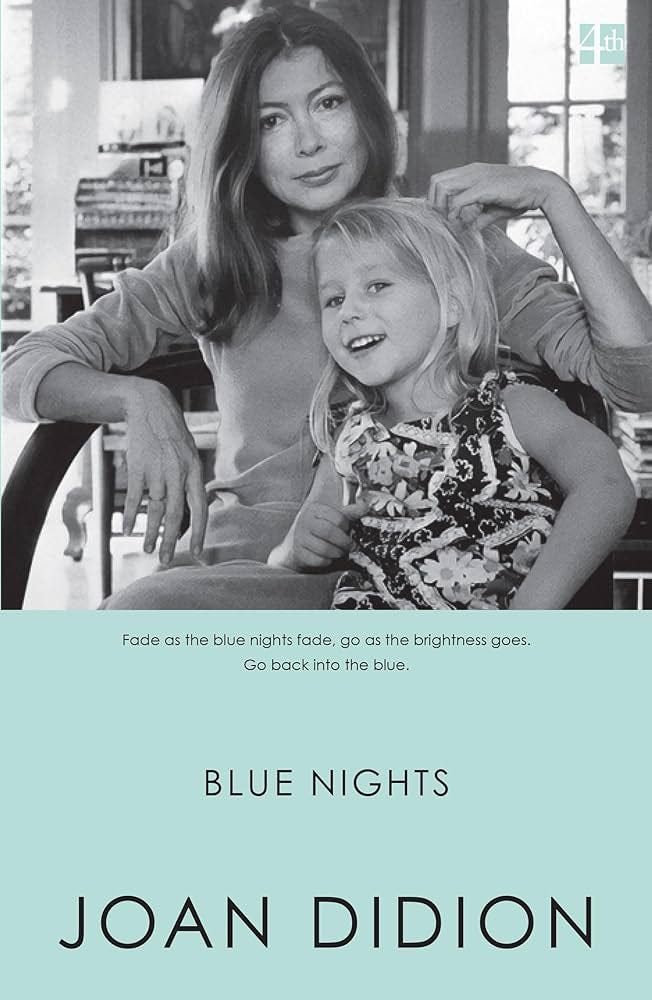
Blue Nights is the memoir Joan Didion wrote near the end of her life, after her daughter Quintana Roo died in her thirties, her husband John having died not long before. It is a book about loss and memory, as an old Joan Didion watching her own body and mind begin to fail.
The sentences are short and plain and in typical Didion style, they do not reach for comfort. They are unafraid to leave the reader afraid.
The memoir reads like a mind reflecting on itself, interrupted constantly by fragments that surface as unbidden memories, a tattoo, a dress, a stuffed rabbit, and then fold back into the thought she was having. It reminded me of the end of the film Arrival, the way Louise lives her whole life in a flash, already knowing how it ends, and walks into it anyway.
There is so much beautiful, vivid detail in the book. The clothes, the house on the water in Malibu, the famous friends, the small expensive things. Didion is not apologizing for the privilege and she is not arguing against it. The beauty is there to make the loss more visceral. Every gorgeous specific, the flowers woven into her daughter’s wedding braid, the peach-colored cake, the bright red soles of Quintana’s shoes as she kneels at the altar, feeds straight back into a memory and sharpens its edge. Those same red soles return near the end of the book, among the images Didion says she can still see when she closes her eyes. Beauty and grief turn out to be the same picture.
All of that beauty let her believe, for most of her life at least, that this could not happen to her. The title, Blue Nights, contains the main idea of this frailty. Perhaps the opening chapter of the book does the best job:
“In certain latitudes there comes a span of time approaching and
following the summer solstice, some weeks in all, when the twilights
turn long and blue. This period of the blue nights does not occur in
subtropical California, where I lived for much of the time I will be talking
about here and where the end of daylight is fast and lost in the blaze of
the dropping sun, but it does occur in New York, where I now live. You
notice it rst as April ends and May begins, a change in the season, not
exactly a warming—in fact not at all a warming—yet suddenly summer
seems near, a possibility, even a promise. You pass a window, you walk
to Central Park, you nd yourself swimming in the color blue: the actual
light is blue, and over the course of an hour or so this blue deepens,
becomes more intense even as it darkens and fades, approximates nally
the blue of the glass on a clear day at Chartres, or that of the Cerenkov
radiation thrown o by the fuel rods in the pools of nuclear reactors. The
French called this time of day “l’heure bleue.” To the English it was “the
gloaming.” The very word “gloaming” reverberates, echoes—the
gloaming, the glimmer, the glitter, the glisten, the glamour—carrying in
its consonants the images of houses shuttering, gardens darkening, grass-
lined rivers slipping through the shadows. During the blue nights you
think the end of day will never come. As the blue nights draw to a close
(and they will, and they do) you experience an actual chill, an
apprehension of illness, at the moment you first notice: the blue light is
going, the days are already shortening, the summer is gone.
Hers (and mine, and likely yours!) is a life that feels permanent and exempt, right up until the light begins to go.
The sense of being exempt is a motif (there are many motifs, more below). Didion keeps reaching for the hopeful words we all use to make a catastrophe survivable, and then she sets them down at arm’s length, often literally inside quotation marks, because each one made a promise her life did not keep.
“Recovery.” She remembers sitting near a bench where she had once pictured the moment Quintana’s recovery would be complete, the spot where her daughter would finally be well again, and her daughter was never well again. Recovery, she decides, is a word like “Adoption”, one that sounds far more plausible than it ever turns out to be.
“Diagnosis.” Quintana’s doctors handed down a list of catastrophic observations over the years: manic depression, OCD, borderline personality disorder, and Didion remembers that not one of those names ever led to a cure. The word sounds like the first step toward a solution, and it only ever named the suffering.
“Choice narrative.” The bedtime story in which the parents lovingly chose this one special baby out of all the others in the nursery. It was meant to make an adopted child feel wanted. But if you can be chosen, Didion comes to see, you can also be passed over, and the very story meant to reassure her daughter evidently planted a lifelong terror that she could be left behind.
Didion believed that ordinary catastrophe was a thing that happened to other people. Each of these words points down a road that seems to lead somewhere safe. None of them do. I may be reading too deeply for style to meet meaning, but her unconsoling sentences use only words that can actually carry the weight she puts on them.
-
The book also explores vulnerability. To commit to loving another person completely is also, whether you let yourself see it or not, to commit to becoming the person who may one day have to live without them. From the moment Didion saw her daughter arrived she wrote that she was never again not afraid, and that fear was not weakness or neurosis, but the true cost of the love, paid in advance. I can see it too… there is always a version of the future in which you do everything right and it still does not end well. To love someone deeply is to sign up for that version too.
Surely, many of us have seen some of that future version? Mom went through so much as a child, and I nor my sister, truly had the faculty to engage with her suffering. Between injury after injury leading to surgery after surgery, resulting in overly-strong medication and surely runaway healthcare bills, and the search for eventual re-employment... on some of those midsummer days, perhaps my parents felt the allure of those same blue nights? We somehow made it through. Dad and Ammama and our family friends stood strong. We persevered through it. Shravya and I were too young to know - surely the happy outcome we live in now was not an obvious conclusion.
-
Didion confesses, more than once, that she could never afford to see Quintana clearly, the actual separate person she was rather than the child she needed her to be. The little girl arrives in full color as the five-year-old who once telephoned a state psychiatric hospital on her own to ask what she should do if she was going crazy. The grown woman arrives mostly as a diagnosis, and as Didion’s late admission that the one warning sign she had failed to recognize in her daughter was the frantic fear of being abandoned. This is a flinch in Didion’s directness and truthfulness, perhaps one particular subject she cannot quite turn and face.
The book does not end in a neat resolution of peace. There is a day Didion spends trying to write down the name of a person to call in case of emergency, working through the possibilities until the list runs out, because the one person who would truly need to know is the one already gone. She is ages into a fear, which is not for what is already lost. What is lost is already gone. The fear is for what is still to be lost.
I know that I can no longer reach her. I know that, should I try to reach her—should I take her hand as if she were again sitting next to me in the upstairs cabin on the evening Pan Am from Honolulu to LAX, should I lull her to sleep against my shoulder, should I sing her the song about Daddy gone to get the rabbit skin to wrap his baby bunny in—she will fade from my touch.
Vanish.
Pass into nothingness: the Keats line that frightened her.
Fade as the blue nights fade, go as the brightness goes.
Go back into the blue.
I myself placed her ashes in the wall.
I myself saw the cathedral doors locked at six.
I know what it is I am now experiencing.
I know what the frailty is, I know what the fear is.
The fear is not for what is lost.
What is lost is already in the wall.
What is lost is already behind the locked doors.
The fear is for what is still to be lost.
You may see nothing still to be lost.
Yet there is no day in her life on which I do not see her.
—
No selections - this was read as paperback and marked with pen :)
During one particular session while reading the book, I decided to write down all the words and references I didn’t know. She had such a rich vocabulary and recall of things. I wonder what her process of writing this must have been. Each thing must have been so associated with the life experiences.
nasturtiums, batiste, parasol, watercress sandwiches, beatific, plumeria, stephanotis, mink stole, terra incognita, bougainvillea, bassinette, layette, “qua”, quicksilver, chiffon, challis, pinafore, angora cape, magnin, corvette, chatelaine, a champagne flute, christian louboutin, The Byrds, Olds 88
Motif’s:
Bunny Rabbit: Daddy’s gone to get a rabbit skin to wrap his baby bunny in
Sara Mankiewicz’s Minton plates
Quintana weeding the unused tennis court
The women smoking cigarattes in their chanel suits and their David Webb bracelets
Quinta’s phrase: Like when someone dies, don’t dwell on it
Corporeal ineptness from Ntzoakr Shange
The yellow roses on the stadium
Maintain momentum
Christian Louboutin, bright red soles
Plumeria tattoo
Frailty: invisible on the street; the target of any wheeled vehicle on the scene
Hello Quintana, I’m going to lock you here in the garage. After I become five I never dreamed about him.
Let me just be in the ground. Let me just be in the ground and go to sleep.
What if you hadn’t been home when Dr. Watson called– What if you you couldn’t meet him at the hospital– What if there’d been an accident on the freeway– What would happen to me then–
Que hermosa, que chula
When we talk about mortality we are talking about our children