
Barchester Towers by Anthony Trollope

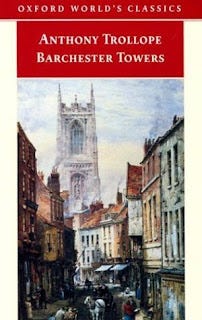
Sincere thanks to audiobook narrator and british-accent connoisseur David-Shaw Parker for making this book hilarious readable. Barchester Towers is a Victorian era fiction novel and I’m unsure if I could have had the motivation to read it cover to cover without the audio or the class requirement (ENGL 0090 with Jennifer Egan).
I’ll be attaching some of my notes from class in addition to my usual list of quotes.
Notes from Molly Young (TA for ENGL 0090, 5th year PhD focusing on Victrorian Era novels)
The three voices of the Trollope:
The Shakespearean Fool
Trollope’s socio political critique
Theatricality of social life and knowingness of clergymen
The Philosopher
How do I behave in an ethically sound way with only partial knowledge of others’ minds? (Everyone else is automated!)
Psychological war: inner monologues, inward desires for power and status
Introduces characters psychologically first, then physical
Free indirect discourse: narrator enters into the mind of the character without quoting them while staying in the third person
The Critic
Metacommentary of “contemporary literary zeitgeist” (I had to ask what that meant in class)
Metacommentary as an ethical move
Novels are always self-aware and self-reflexive
Trollope is a Polyvocal narrator
Victorian period is an age of secularization, waning authority of the church, the french revolution, technological innovation, increased liberalism and politics, and high skepticism
Who is really good in Trollope’s vision?
Only Mr. Harding because his inner life/desires and outer life/actions are aligned. It makes him less exciting and less worldly, but by Trollope’s standards, he is a more virtuous human being for it
Mr. Slope is the fulcrum of the novel
He conflated his own self-interest with the “greater good”
What goes wrong for Mr. Slope?
His physical body betrays his schemes
Sadomasochistic quality (the derivation of pleasure from acts of giving or receiving pain) of Madame Neroni in the A Love Scene interaction between herself and Mr. Slope
Thesis I have: Trollope believes pursuing power isn't a noble objective, even if it is a natural one
Prof Egan’s perspective – For those who want to write fiction, focus on reading 19th century literature
Barchester Towers is book 2 of a 3 volume series. It was released as a full book, unlike most writing back then, which was serialized.
List of highlights (via Zotero):
“But how was he to act while his father-in-law stood there holding his hand? how, without appearing unfeeling, was he to forget his father in the bishop—to overlook what he had lost, and think only of what he might possibly gain ?”
“Sydney Smith truly said that in these recreant days we cannot expect to find the majesty of St. Paul beneath the cassock of a curate. If we look to our clergymen to be more than men, we shall probably teach ourselves to think that they are less”
“"Let me ever remember my living friends, but forget them as soon as dead," was the prayer of a wise man who understood the mercy of God.”
“He understood well the value of forms, and knew that the due ob- servance of rank could not be maintained unless the exterior trappings belonging to it were held in proper esteem.”
“He knew well his patron's strong points, but he knew the weak ones as well. He understood correctly enough to what attempts the new bishop's high spirit would soar, and he rightly guessed that public life would better suit the great man's taste, than the small details of diocesan duty.
He, therefore, he, Mr. Slope, would in effect be bishop of Barchester.”“He knew that he should have a hard battle to fight, for the power and patronage of the see would be equally coveted by another great mind—Mrs. Proudie would also choose to be bishop of Barchester. Mr. Slope, however, flattered himself that he could out-manoeuvre the lady”
“She would necessarily remain ignorant of much, while he would know everything belonging to the diocese. At first, doubtless, he must flatter and cajole, perhaps yield, in some things; but he did not doubt of ultimate triumph. If all other means failed, he could join the bishop against his wife, inspire courage into the unhappy man, lay an axe to the root of the woman's power, and emancipate the husband.”
“To him the mercies of our Saviour speak in vain, to him in vain has been preached that sermon which fell from divine lips on the mountain—"Blessed are the meek, for they shall inherit the earth"—"Blessed are the merciful, for they shall obtain mercy." To him the New Testament is comparatively of little moment, for from it can he draw no fresh authority for that dominion which he loves to exercise over at least a seventh part of man's allotted time here below.”
“Both men are eager, much too eager, to support and in- crease the power of their order. Both are anxious that the world should be priest-governed, though they have probably never confessed so much, even to themselves. Both begrudge any other kind of dominion held by man over man.” --Slope vs Grantly
“Let him be supreme who can”
“be believed, he can be all powerful over those who listen. If he be careful to meddle with none who are too strong in intellect, or too weak in flesh, he may indeed be supreme. And such was the ambition of Mr.
Slope.” --Love description of Slope. Alive the comparison to Grantly and showing how they differ in acquiring and wanting power. Slope seems like a plotting cunning slithering type figure“the female heart, if it glow with a spark of low church susceptibility, cannot withstand him.”
“the husbands, for their wives' sake, are fain to admit him; and when once admitted it is not easy to shake him ofif. He has, however, a pawing, greasy way with him, which does not endear him to those who do not value him for their souls' sake” --Very LBJ like personality. Not loved except by those susceptible to his specific charm, and hard to get off once he latches on
“There were four persons there, each of whom considered himself the most important personage in the diocese; himself, indeed, or herself, as Mrs. Proudie was one of them ; and with such a difference of opinion it was not probable that they would get on pleasantly together. The bishop himself actually wore the visible apron, and trusted mainly to that to that and his title, both being facts which could not be overlooked. The archdeacon knew his subject, and really understood the business of bishoping, which the others did not ; and this was his strong ground. Mrs. Proudie had her sex to back her, and her habit of command, and was nothing daunted by the high tone of Dr. Grantly's face and figure.
Mr. Slope had only himself and his own courage and tact to depend on, but he nevertheless was perfectly self-assured, and did not doubt but that he should soon get the better of weak men who trusted so much to externals, as both bishop and archdeacon appeared to do.”“She shook her finger at him as she quoted the favourite law, as though menacing him with punishment” --Such a nimbi holier than thou Karen
“I will not follow his example, nor shock my readers by transcribing the term in which he expressed his feeling as to the lady who had been named.” --Interruptions by the narrator referring to himself (“I”). Adds a sense of comedy that he decides to omit a part of the events, thinking them too extreme for even his readers
“Yes—what are we to do with him ? How are we to treat him ? There he is, and there he'll stay. He has put his foot in that palace, and he will never take it out again till he's driven. How are we to get rid of him ?"”
“It is not the dissenters or the papists that we should fear, but the set of canting, low-bred hypocrites who are wriggling their way in among us ; men who have no fixed principle, no standard ideas of religion or doctrine, but who take up some popular cry, as this fellow has done about 'Sabbath travelling.' "”
“Dr. Grantly was going to fight because he found that he hated the man. Mr. Slope had predetermined to hate the man, because he foresaw the necessity of fighting him.
When he had first reviewed the carte dii pays, previous to his entry into Barchester, the idea had occurred to him of conciliating the archdeacon, of cajoling and flattering him into submission, and of obtaining the upper hand by cunning in- stead of courage. A little inquiry, however, sufficed to convince him that all his cunning would fail to win over such a man as Dr. Grantly to such a mode of action as that to be adopted by Mr. Slope ; and then he determined to fall back upon his courage. He at once saw that open battle against Dr. Grantly and all Dr. Grantly's adherents was a necessity of his position, and he deliberately planned the most expedient methods of giving offence.” The game theory from each character depends the plot. knowing that Slope can do both cunning or open battle makes it even more interesting“His object was to express his abomination of all ceremonious modes of utterance, to cry down any religious feeling which might be excited, not by the sense, but by the sound of words, and in fact to insult cathedral practices.” --Just as Grantly predicted
“but how much of the meaning of the words was lost when they were produced with all the meretricious charms of melody ! &c. &c.”
“No one but a preaching clergyman can revel in platitudes, truisms, and untruisms, and yet receive, as his undisputed privilege, the same respectful de- meanour as though words of impassioned eloquence, of persuasive logic, fell from his lips. Let a professor of law or physic find his place in a lecture-room, and there pour forth jejune words, and useless empty phrases, and he will pour them forth to empty benches. Let a barrister attempt to talk without talking well, and he will talk but seldom. A judge's charge need be listened to per force by none but the jury, prisoner, and gaoler. A member of Parliament can be coughed down or counted out. Town-councillors can be tabooed. But no one can rid himself of the preaching clergy- man. He is the bore of the age, the old man whom we Sindbads cannot shake off, the nightmare that disturbs”
“We are all loo fond of our own voices, and a preacher is encour- aged in the vanity of making his heard by the privilege of a compelled audience. His sermon is the pleasant morsel of his life, his delicious moment of self-exaltation.”
“She prided herself on her freedom from English prejudice, and she might have added, from feminine delicacy.”
“He had none of the mauvaise honte of an Englishman. He required no introduction to make himself agreeable to any person. He habitually addressed strangers, ladies as well as men, without any such formality, and in doing so never seemed to meet with rebuke.”
“Bertie Stanhope, as he was generally called, was, however, popular with both sexes ; and with Italians as well as English.
His circle of acquaintance was very large, and embraced people of all sorts. He had no respect for rank, and no aversion to those below him. He had lived on familiar terms with English peers, German shopkeepers, and Roman priests.”“She had sent a servant beforehand to learn whether it was a right or a left hand sofa, for it required that she should dress accordingly, particularly as regarded her bracelets.”
“So, when a granite battery is raised, excellent to the eyes of warfaring men, is its strength and symmetry admired.
It is the work of years. Its neat embrasures, its finished parapets, its casemated stories, show all the skill of modern science. But, anon, a small spark is applied to the treacher- ous fusee—a cloud of dust arises to the heavens—and then nothing is to be seen but dirt and dust and ugly fragments.” What is this“As soon as the constellation had swept by, Ethelbert rose from his knees, and turning with mock anger to the fat rector, said : "After all it was your doing, sir—not mine. But perhaps you are waiting for preferment, and so I bore it." Whereupon there was a laugh against the fat rector, in which both the bishop and the chaplain joined; and thus things got themselves again into order.”
“"The blood of Tiberius," said the signora, in all but a whisper; "the blood of Tiberius flows in her veins. She is the last of the Neros !"”
“catechism”
“"It isn't Vicinironi, papa," said Netta; "but Vesey Neroni, and she's Dr. Stanhope's daughter.”
“prebendaries”
“In Germany the professors do teach ; at Oxford, I believe, they only profess to do so, and sometimes not even that.”
“coxcomb”
“The fact is, you are half afraid of this Slope, and would rather subject yourself to comparative poverty and discomfort, than to come to blows with a man who will trample on you, if you let him."”
“If honest men did not squabble for money, in this wicked world of ours, the dishonest men would get it all ; and I do not see that the cause of virtue would be much improved.
No,—we must use the means which we have.”“Mrs. Bold was worth the wooing”
“He did not wish to give way to Mr. Harding, and then be rejected by the daughter. He did not wish to lose one influential friend before he had gained another.”
“And here the author must beg it to be remembered that Mr. Slope was not in all things a bad man. His motives, like those of most men, were mixed ; and though his conduct was generally very different from that which we would wish to praise, it was actuated perhaps as often as that of the majority of the world by a desire to do his duty. He believed in the religion which he taught, harsh, unpalatable, uncharitable as that religion was. He believed those whom he wished to get under his hoof, the Grantlys and Gwynnes of the church, to be the enemies of that religion. He believed himself to be a pillar of strength, destined to do great things ; and with that subtle, selfish, ambiguous sophistry to which the minds of all men are so subject, he had taught himself to think that in doing much for the promotion of his own interests he was doing much also for the promotion of religion.
But Mr. Slope had never been an immoral man.” --Trollope humanizes Mr Slope“If it should turn out to be really the fact that Mrs. Bold had twelve hundred a year at her own disposal, Mr. Slope would rather look upon it as a duty which he owed his religion to make himself the master of the wife and the money ; as a duty, too, in which some amount of self-sacrifice would be necessary. He would have to give up his friendship with the signora, his resist- ance to Mr. Harding, his antipathy—no, he found on mature self-examination, that he could not bring himself to give up his antipathy to Dr. Grantly” --He does things for some greater purpose, though that purpose is questionable as being the real real motive
“Some men have a great gift of making money, but they can't spend it. Others can't put two shillings to- gether, but they have a great talent for all sorts of outlay.
I begin to think that my genius is wholly in the latter line."”“Well, Madeline; so I'm going to be married," Bertie began, as soon as the servants had withdrawn.
"There's no other foolish thing left, that you haven't done," said Madeline, "and therefore you are quite right to try that." "”“vapid”
“Bertie Stanhope had been so much knocked about the world from his earliest years, that he had not retained much respect for the gravity of English customs ; but even to his mind an idea presented itself, that, perhaps in a wife, true British prejudice would not in the long run be less agreeable than Anglo-Italian freedom from restraint”
“You don't mean to say that no man can love a woman unless he be a fool?" "I mean very much the same thing,—that any man who is willing to sacrifice his interest to get possession of a pretty face is a fool. Pretty faces are to be had cheaper than that”
“Marriage means tyranny on one side and deceit on the other”
“It is not destined that Eleanor shall marry Mr. Slope or Bertie Stanhope. And here, perhaps, it may be allowed to the "ovelist to explain his views on a very important point in the art of telling tales” Trollope spoils his own plot on purpose
“my Eleanor”
“"He's a great big naughty boy," said she to the child ; "and we must send him away to a great big rough romping school, where they have great big rods, and do terrible things to naughty boys who don't do what their own mammas tell them ;" and she then commenced another course of kissing, being actuated thereto by the terrible idea of sending her child away which her own imagination had depicted.”
“de trop”
“Your father wouldn't see Quiverful, would he? Quiverful is an honourable man, and would not, for a moment, stand in your father's way."”
“I could do nothing, Mr, Slope, without consulting my father." "Ah !" said he, "that would be useless you would then only be your father's messenger. Does anything occur to yourself? Something must be done”
“After all, in such cases the matter between husband and wife stands much the same as it does between two boys at the same school, two cocks in the same yard, or two armies on the same continent. The conqueror once is generally the”
“conqueror for ever after. The prestige of victory is everything.”
“Now, bishop, look well to thyself, and call up all the manhood that is in thee. Think how much is at stake. If now thou art not true to thy guns, no Slope can hereafter aid thee.
How can he who deserts his own colours at the first smell of gunpowder expect faith in any ally. Thou thyself hast sought the battle-field ; fight out the battle manfully now thou art there. Courage, bishop, courage! Frowns cannot kill, nor can sharp words break any bones. After all the apron is thine own. She can appoint no wardens, give away no benefices, nominate no chaplains, an' thou art but true to thyself. Up, man, and at her with a constant heart”“she is a woman, and such a woman too as thou well knowest : a battle of words with such a woman is the very mischief.
Were it not better for thee to carry on this war, if it must be waged, from behind thine own table in thine own study? Does not every cock fight best on his own dunghill? Thy daughters also are here, the pledges of thy love, the fruits of thy loins ; is it well that they should see thee in the hour of thy victory over their mother ? nay, is it well that they should see thee in the possible hour of thy defeat? Besides, hast thou not chosen thy opportunity with wonderful little skill, indeed with no touch of that sagacity for which thou art fa- mous? Will it not turn out that thou art wrong in this matter, and thine enemy right ; that thou hast actually pledged thyself in this matter of the hospital, and that now thou wouldest turn upon thy wife because she requires from thee but the fulfilment of thy promise? Art thou not a Christian bishop, and is not thy word to be held sacred whatever be the result? Return, bishop, to thy sanctum on the lower floor, and postpone thy combative propensities for some occasion in which at least thou mayest fight the battle against odds less tremendously against thee.”“that Mr. Slope seems to think” --Mr proudie gives up all his self respect once he mentions Mr slope, bc his wife can now attack his independence as a decision maker. For the same reason why leaders are responsible for the acts of their subjects (good or bad), so to are they for the decisions they ultimately make. That is responsibility, and Mr Proudie’s weakness shows how he gives it up to two more dominant characters in his council
“"Mr. Slope, I did not at all approve your conduct the other night with that Italian woman. Any one would have thought that you were her lover.” --Manipulation tactic: attack them for something unrelated but which could be perceived as being part of the same core problem. In this case, of “character”
“If you will take my advice, however, you will be careful not to obtrude advice upon the bishop in any matter touching patronage. If his lordship wants advice, he knows where to look for it.”
“there certainly was not room in the diocese for the energies of both himself and Mrs. Proudie, and that it behoved him quickly to ascertain whether his energies or hers were to prevail”
“THERE was much cause for grief and occasional perturbation of spirits in the Stanhope family, but yet they rarely seemed to be grieved or to be disturbed. It was the peculiar gift of each of them that each was able to bear his or her own burden without complaint, and perhaps without sympathy. They habitually looked on the sunny side of the wall, if there was a gleam on either side for them to look at ; and, if there was none, they endured the shade with an indifference which, if not stoical, answered the end at which the Stoics aimed.”
“daguerreo”
“There is no way of writing well and also of writing easily.”
“Labor omnia vincit improbtts.”
“He had failed, failed in his own opinion as well as that of others when others came to know him, if he could not re- duce the arguments of his opponents to an absurdity, and conquer both by wit and reason. To say that his object was ever to raise a laugh, would be most untrue. He hated such common and unnecessary evidence of satisfaction on the part of his hearers. A joke that required to be laughed at was, with him, not worth uttering. He could appreciate by a keener sense than that of his ears the success of his wit, and would see in the eyes of his auditory whether or no he was understood and appreciated.”
“the safety which he was .about to seek within the gates of Rome was no other than the selfish freedom from personal danger which the bad soldier attempts to gain who counterfeits illness on the eve of battle.”
“the subject of so many friendly or unfriendly criticisms. Considering how much we are all given to discuss the characters of others, and discuss them often not in the strictest spirit of charity, it is singular how little we are inclined to think that others can speak ill-naturedly of us, and how angry and hurt we are when proof reaches us that they have done so. It is hardly too much to say that we all of us occasionally speak of our dearest friends in a manner in which those dearest friends would very little like to hear themselves mentioned ; and that we nevertheless expect that our dearest friends shall invariably speak of us as though they were blind to all our faults, but keenly alive to every shade of our virtues.”
“A pagan, too, with his multiplicity of gods, would”
“think it equally odd that the Christian and the Mohammedan should disagree."”
“"Wars about trifles," said he, "are always bitter, especially among neighbours. When the differences are great, and the parties comparative strangers, men quarrel with courtesy.
What combatants are ever so eager as two brothers?"”“The outer world, though it constantly reviles us for our human infirmities, and throws in our teeth the fact that being clergymen we are still no more than men, demands of us that we should do our work with godlike perfection. There is nothing godlike about us : we differ from each other with the acerbity common to man—we triumph over each other with human frailty—we allow differences on subjects of divine origin to produce among us antipathies and enmities which are anything but divine. This is all true. But what would you have in place of it? There is no infallible head for a church on earth. This dream of believing man has been tried, and we see in Italy and in Spain what has come of it.”
“I know no life that must be so delicious as that of a writer for newspapers, or a leading member of the opposition—to thunder forth accusations against men in power ; show up the worst side of everything that is produced ; to pick holes in every coat ; to be indignant, sarcastic, jocose, moral, or supercilious ; to damn with faint praise, or crush with open calumny ! What can be so easy as this when the critic has to be responsible for nothing? You con- demn what I do; but put yourself in my position and do the reverse, and then see if I cannot condemn you”
“milliners, and the poor, giving much the largest share to the latter. It may be imagined, therefore, that with all her little follies she was not unpopular. All her follies have, we believe, been told. Her virtues were too numerous to describe, and not sufficiently interesting to deserve description.”
“he took a little merit to himself for having studiously provided the best man he could without reference to patronage or favour; but he did not say that the best man according to his view was he who was best able to subdue Mr. Slope, and make that gentleman's situation in Barchester too hot to be comfortable”
“iniquity”
“Rectory”
“flounces”
“meretricious”
“But Eleanor was not in love with him. How many shades there are between love and indifference, and how little the graduated scale is understood !”
“jointure”
“It was almost as though he were playing with a child. She knew well enough that he was in truth a sober thoughtful man, who in some matters and on some occasions could endure an agony of earnestness. And yet to her he was always gently playful. Could she have seen his brow once clouded she might have learnt to love him.”
“overtures”
“factotum”
“He was not careful, as another might be who sat on an easier worldly seat, to stand well with those around him, to shun a breath which might sully his name, or a rumour which might affect his honour. He could not afford such niceties of conduct, such moral luxuries. It must suffice for him to be ordinarily honest according to the ordinary honesty of the world's ways, and to let men's tongues wag as they would.”
“Quixotic”
“Thus, while the outer world was accusing Mr. Quiverful of rapacity for promotion and of disregard to his honour, the inner world of his own household was falling foul of him, with equal vehemence, for his willingness to sacrifice their interest to a false feeling of sentimental pride. It is astonishing how much difference the point of view makes in the aspect of all that we look at”
“He maintained his self-possession, however, smiled with a slight unmeaning smile, and merely said that he was obliged to Mr. Slope for the trouble he was taking.”
“But if you will allow me to inform the bishop that you decline to stand in Mr. Harding's way, I think 1 may promise you—though, by the bye, it must not be taken as a formal promise—that the bishop will not allow you to be a poorer man than you would have been had you become warden.”
“A low voice "is an excellent thing in woman."”
“She determined that she would at once go to the palace; that she would do so, if possible, before Mrs. Proudie could have had an interview with Mr. Slope ; and that she would be either submissive piteous and pathetic, or else indignant violent and exacting, according to the manner in which she was received.”
“brougham”
“Those who have thanks to return for favours received find easy admittance to the halls of the great. Such is not always the case with men, or even with women, who have favours to beg. Still less easy is access for those who demand the fulfilment of promises already made.”
“"Look here, my man," said Mrs. Quiverful ; "I must see her ;" and she put her card and half-a-crown—think of it, my reader, think of it; her last half-crown—into the man's hand, and sat herself down on a chair in the waiting-room.”
“portmanteau”
“"My lord," said the lady, "is Mr. Slope to leave this room, or am I ?" Here Mrs. Proudie made a false step. She should not have alluded to the possibility of retreat on her part. She should not have expressed the idea that her order for Mr. Slope's expulsion could be treated otherwise than by immediate obedience. In answer to such a question the bishop naturally said in his own mind that as it was necessary that one should leave the room, perhaps it might be as well that Mrs. Proudie did so”
“sy is success to those who will only be true to themselves ! Mr. Slope saw at once the full amount of his gain, and turned on the vanquished lady a look of triumph which she never forgot and never forgave. Here he was wrong. He should have looked humbly at her, and with meek entreating eye have deprecated her anger. He should have said by his glance that he asked pardon for his success, and that he hoped forgiveness for the stand which he had been forced to make in the cause of duty. So might he perchance have somewhat mollified that imperious bosom, and prepared the way for future terms. But Mr. Slope meant to rule without terms. Ah, forgetful, inexperienced man !”
“Mrs. Quiverful immediately rose upon her feet, thinking it disrespectful to remain sitting while the wife of the bishop stood. But she was desired to sit down again, and made to do so, so that Mrs. Proudie might stand and preach over her. It is generally considered an offensive thing for a gentleman to keep his seat while another is kept standing before him, and we presume the same law holds with regard to ladies. It often is so felt ; but we are inclined to say that it never produces half the discomfort or half the feeling of implied inferiority that is shown by a great man who desires his visitor to be seated while he himself speaks from his legs. Such a solecism in good breeding, when construed into English, means this : "The accepted rules of courtesy in the world require that I should oiifer you a seat ; if I did not do so, you would bring a charge against me in the world of being arrogant and ill-mannered ; I will obey the world ; but, nevertheless, I will not put myself on an equality with you. You may sit down, but I won't sit with you. Sit, therefore, at my bidding, and I'll stand and talk at you !"”
“There is an old song which gives us some very good advice about courting: "It's gude to be off with the auld luve Before ye be on wi' the new."”
“But two strings to Cupid's bow are always dangerous to him on whose behalf they are to be used. A man should remember that between two stools he may fall to the ground.”
“But in sooth Mr. Slope was pursuing Mrs. Bold in obedience to his better instincts, and the signora in obedience to his worser. Had he won the widow and worn her, no one could have blamed him. You, O reader, and I, and Eleanor's other friends would have received the story of such a winning with much disgust and disappointment ; but we should have been angry with Eleanor, not with Mr. Slope.”
“He was the finest fly that Barchester had hitherto afforded to her web ; and the signora was a powerful spider that made wondrous webs, and could in no way live without catching flies. Her taste in this respect was abominable, for she had no use for the victims when caught. She could not eat them matrimonially, as young lady-flies do whose webs are most frequently of their mothers' weaving. Nor could she devour them by any escapade of a less legitimate description. Her unfortunate affliction precluded her from all hope of levanting with a lover. It would be impossible to run away with a lady who required three servants to move her from a sofa.”
“In age the lady was younger than the gentleman ; but in feelings, in knowledge of the affairs of love, in intrigue, he was immeasurably her junior. It was necessary to her to have some man at her feet. It was the one customary excitement of her life. She delighted in the exercise of power which this gave her ; it was now nearly the only food for her ambition ; she would boast to her sister that she could make a fool of any man,”
“d : "Whatever you do, my friend, do not mingle love and business. Either stick to your treasure and your city of wealth, or else follow your love like a true man. But never attempt both. If you do, you'll have to die with a broken heart as did poor Dido.”
“Never mind love. After all, what is it? The dream of a few weeks. That is all its joy. The disappointment of a life is its Nemesis. Who was ever successful in true love? Success in love argues that the love is false. True love is always despondent or tragical. Juliet loved, Haidee loved, Dido loved, and what came of it? Troilus loved and ceased to be a man.”
“dissimulation”
“My heart again ! how you talk. And you consider then, that if a husband be not master of his wife's heart, he has no right to her fealty; if a wife ceases to love, she may cease to be true.”
“d man? What possible chance between man and woman? Mr. Slope loved furiously, insanely, and truly; but he had never played the game of love. The signora did not love at all, but she was up to every move of the board.”
“premiere jeitnesse”
“catechism”
“THERE are people who delight in serious interviews, especially when to them appertains the part of offering advice or administering rebuke, and perhaps the archdeacon was one of these. Yet on this occasion he did not prepare liimself for the coming conversation with much anticipation of pleasure.” --This whole chapter is a lesson on miscommunication. If any of the characters had been honest and straightforward with both what they were feeling and why they were concerned, none of it should have happened. I'm sure we can see this play out in history many times
“How easily would she have forgiven and forgotten the archdeacon's suspicions had she but heard the whole truth from Mr. Arabin. But then where would have been my novel? She did not cry, and Mr. Arabin did not melt”
“Few men do understand the nature of a woman's heart, till years have robbed such understanding of its value. And it is well that it should be so, or men would triumph too easily”
“It is impossible to say how the knowledge had been acquired, but the signora had a sort of instinctive knowledge that Mr. Arabin was an admirer of Mrs. Bold. Men hunt foxes by the aid of dogs, and are aware that they do so by the strong organ of smell with which the dog is endowed. They do not, however, in the least comprehend how such a sense can work with such acuteness. The organ by which women instinctively, as it were, know and feel how other women are regarded by men, and how also men are regarded by other women, is equally strong, and equally incomprehensible. A glance, a word, a motion, suffices : by some such acute exercise of her feminine senses the signora was aware that Mr. Arabin loved Eleanor Bold; and therefore, by a further exercise of her peculiar feminine propensities, it was quite natural for her to entrap Mr. Arabin into her net.”
“She had had almost enough of Mr. Slope, though she could not quite resist the fun of driving a very sanctimonious clergyman to madness by a desperate and ruinous passion. Mr. Thorne had fallen too easily to give much pleasure in the chase. His position as a man of wealth might make his alliance of value, but as a lover he was very second-rate. We may say that she regarded him somewhat as a sportsman does a pheasant. The bird is so easily shot, that he would not be worth the shooting were it not for the very respectable appearance that he makes in a larder. The signora would not waste much time in shooting Mr. Thorne, but still he was worth bagging for family uses. But Mr. Arabin was game of another sort. The signora was herself possessed of quite sufficient intelligence to know that Mr. Arabin was a man more than usually intellectual. She knew also, that as a clergyman he was of a much higher stamp than Mr. Slope, and that as a gentleman he was better educated than Mr. Thorne. She would never have attempted to drive Mr. Arabin into ridiculous misery as she did Mr. Slope, nor would she think it possible to dispose of him in ten minutes, as she had done with Mr. Thorne.”
“"Is not such the doom of all speculative men of talent?" said she. "Do they not all sit rapt as you now are, cutting imaginary silken cords with their fine edges, while those not so highly tempered sever the every-day Gordian knots of the world's struggle and win wealth and renown? Steel too highly polished, edges too sharp, do not do for this world's work, Mr. Arabin."” --Gordian Knot metaphor is very well done
“The greatest mistake any man ever made is to suppose that the good things of the world are not worth the winning. And it is a mistake so opposed to the religion which you preach ! Why does God permit his bishops one after another to have their five thousands and ten thousands a year if such wealth be bad and not worth having? Why are beautiful things given to us, and luxuries and pleasant enjoyments, if they be not intended to be used? They must be meant for some one, and what is good for a layman cannot surely be”
“bad for a clerk. You try to despise these good things, but you only try ; you don't succeed.”
“ce, just so much so as to give her an air of special interest. She expected a compliment from her admirer, but she was rather grateful than otherwise by finding that he did not pay it to her. Messrs. Slope and Thorne, Messrs. Brown, Jones and Robinson, they all paid her compliments. She was rather in hopes that she would ultimately succeed in inducing Mr. Arabin to abuse her.”
“He is not the first man who has thought it expedient to call in the assistance of Bacchvts on such an occasion.”
“He was right in repeating the boast of Lady Macbeth : he was not drunk ; but he was bold enough for anything.”
“She was rejecting him before he had offered himself, and informed him at the same time that he was taking a great deal too much on himself to be so familiar. She did not even make an attempt "From such a sharp and waspish word as 'no' To pluck the sting.."”
“But, nevertheless, she should not have raised her hand against the man. Ladies' hands, so soft, so sweet, so delicious to the touch, so graceful to the eye, so gracious in their gentle doings, were not made to belabour men's faces.” --Trollope takes a stance on right and wrong here
“We will not attempt to tell with what mighty surgings of the inner heart Mr. Slope swore to revenge himself on the woman who had disgraced him, nor will we vainly strive to depict his deep agony of soul.” --narrator doesn't depict everything. like mrs. proudie v mr proudie in the bedroom
“He longed in his heart to be preaching at her. 'Twas thus that he was ordinarily avenged of sinning mortal men and women. Could he at once have ascended his Sunday rostrum and fulminated at her such denunciations as his spirit delighted in, his bosom would have been greatly eased. But how preach to Mr. Thome's laurels, or how preach indeed at all in such a vanity fair as this now going on at Ullathorne? And then he began to feel a righteous disgust at the wickedness of the doings around him. He had been justly chastised for lending, by his presence, a sanction to such worldly lures. The gaiety of society, the mirth of banquets, the laughter of the young, and the eating and drinking of the elders were, for awhile, without excuse in his sight. What had he now brought down upon himself by sojourning thus in the tents of the heathen ? He had consorted with idolaters round the altars of Baal ; and therefore a sore punishment had come upon him. He then thought of the Signora Neroni, and his soul within him was full of sorrow. He had an inkling—a true inkling—that he was a wicked, sinful man ; but it led him in no right direction ; he could admit no charity in his heart. He felt debasement coming on him, and he longed to shake it off, to rise up in his stirrup, to mount to high places and great power, that he might get up into a mighty pulpit and preach to the world a loud sermon against Mrs. Bold.” --very old testament
“A very great example had declared and practised the wisdom of being everything to everybody, and Mr. Slope was desirous of following it. His maxim was never to lose a chance.”
“She had whispered to him words that really meant nothing, but which coming from such beautiful lips, and accompanied by such lustrous glances, seemed to have a mysterious significance, which he felt though he could not understand.”
“Morning parties, as a rule, are failures. People never know how to get away from them gracefully. A picnic on an island or a mountain or in a wood may perhaps be permitted. There is no master of the mountain bound by courtesy to bid you stay while in his heart he is longing for your departure. But in a private house or in private grounds a morning party is a bore. One is called on to eat and drink”
“at unnatural hours. One is obliged to give up the day which is useful, and is then left without resource for the evening which is useless. One gets home fagged and desoeuvre, and yet at an hour too early for bed. There is no comfortable resource left.”
“It has been said that Bertie Stanhope was a man without principle. He certainly was so. He had no power of using active mental exertion to keep himself from doing evil. Evil had no ugliness in his eyes ; virtue no beauty. He was void of any of these feelings which actuate men to do good. But he was perhaps equally void of those which actuate men to do evil. He got into debt with utter recklessness, thinking nothing as to whether the tradesmen would ever be paid or not. But he did not invent active schemes of deceit for the sake of extracting the goods of others. If a man gave him credit, that was the man's look-out ; Bertie Stanhope troubled himself nothing further. In borrowing money he did the same ; he gave people references to "his governor ;" told them that the "old chap" had a good income; and agreed to pay sixty per cent, for the accommodation. All this he did without a scruple of conscience ; but then he never contrived active villainy.”
“Buildings should be fitted to grace the sculpture, not the sculpture to grace the building”
“People when they get their income doubled usually think that those through whose instrumentality this little ceremony is performed are right at bottom”
“Till we can become divine we must be content to be human, lest in our hurry for a change we sink to something lower”
“"My dear Sir,—I wish you every success. I don't know that I can help you, but if I can, I will.”
“He was sufficiently conversant with the tactics of”
“the Jupiter to know that the pith of the article would lie in the last paragraph.”
“Belzebub colt;” --What is this?
“And now it remained to them each to enjoy the assurance of the other's love. And how great that luxury is ! How far it surpasses any other pleasure which God has allowed to his creatures !”
“here is a feeling still half existing, but now half conquered by the force of human nature, that a woman should be ashamed of her love till the husband's right to her compels her to acknowledge it. We would fain preach a different doctrine. A woman should glory in her love; but on that account let her take the more care that it be such as to justify her glory.”
“She had found the strong shield that should guard her from all wrongs, the trusty pilot that should henceforward guide her through the shoals and rocks. She would give up the heavy burden of her independence, and once more assume the position of a woman, and the duties of a trusting and loving wife.” --Shows the mentality of the times
“Very many men now-a-days, besides the archdeacon, adopt or affect to adopt the nil admirari doctrine ; but nevertheless, to judge from their appearance, they are just as subject to sudden emotions as their grandfathers and grandmothers were before them.”
“At last he rose, and twitched his mantle blue (black), To-morrow to fresh woods and pastures new."”
“Fiddlestick !”
“In spite of what he has so often said himself, he is not even yet an old man. He does such duties as fall to his lot well and conscientiously, and is thankful that he has never been tempted to assume others for which he might be less fitted. The Author now leaves him in the hands of his readers ; not as a hero, not as a man to be admired and talked of, not as a man who should be toasted at public dinners and spoken of with conventional absurdity as a perfect divine, but as a good man without guile, believing humbly in the religion which he has striven to teach, and guided by the precepts which he has striven to learn.”