
A Rage In Harlem by Chester Himes
If Christ knew what kind of Christians He got here in Harlem He’d climb back up on the cross and start over.

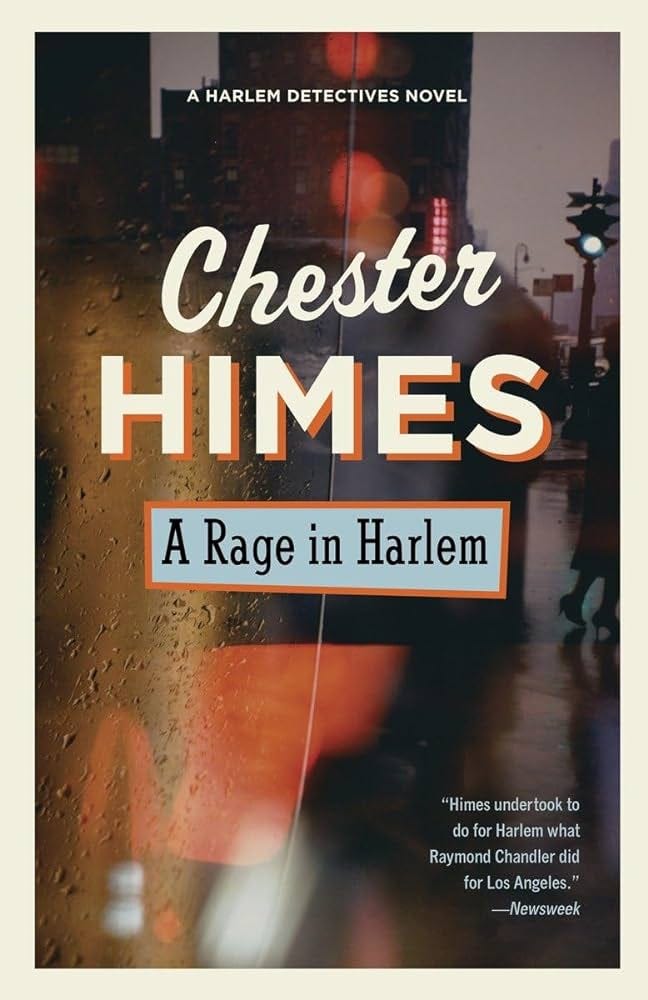
In the wake of a violent shootout with the police, Imabelle flees from Natchez, Mississippi, with a cache of stolen gold. Her escape leads her to New York, where she soon finds herself pursued by her gangster boyfriend's relentless gang. In Harlem, she finds refuge with Jackson, an unassuming undertaker, who unwittingly falls in love with her. As the Mississippi mobsters close in, Jackson must rely on his street-savvy brother, Goldy, to protect both Imabelle and their newfound love. As tensions escalate, the streets of Harlem become the stage for a confrontation that intertwines love, betrayal, and survival.
The narrative begins in a seemingly benign world, but as the story unfolds, the portrayal of this world gradually shifts. Chester Himes, writing the novel in France, drew upon his intermittent stays in Harlem and memories from Cleveland to shape the setting. The narrative's backdrop, set in 1957—the era depicted in Goodbye, Columbus—presents a starkly different milieu from the suburban comforts of the Patimkin household in Short Hills. Carlota, the Patimkin maid, could represent the kind of black women portrayed in Himes' novel, those relegated to domestic service in a predominantly white society.
Professor Egan emphasized that grasping the book's mastery involves delving into the cost-benefit analysis of 'genre.' Typically, genre confines authors; readers of crime or gothic novels come seeking familiar conventions. However, Himes masterfully bends genre to his will, immersing readers in a humor-laden Harlem filled with absurd yet harmless scenarios. Midway through, the tone shifts dramatically as Himes uses setting, action, and narrative perspective to inject significant social commentary. The narrative closes as it opened, with genre taking the reins once again, reintroducing slapstick humor but now shaded with a deeper awareness of Harlem's grim realities.
Goldy's unexpected death, given his astute and resourceful nature, is a pivotal moment crafted by Himes to dismantle the comedic overlay and reveal the more menacing, sinister layers of the world he has constructed. Genre initially acts as a veil, seducing the reader into complacency before Himes strips it away to expose a reality filled with greed, drugs, and despair. Following this revelation, Himes unflinchingly details the harsh conditions that pervade his characters' lives.
Looking eastward from the towers of Riverside Church, perched among the university buildings on the high banks of the Hudson River, in a valley far below, waves of gray rooftops distort the perspective like the surface of a sea. Below the surface, in the murky waters of fetid tenements, a city of black people who are convulsed in desperate living, like the voracious churning of millions of hungry cannibal sh. Blind mouths eating their own guts. Stick in a hand and draw back a nub.
That is Harlem.
The farther east it goes, the blacker it gets. East of Seventh Avenue to the Harlem River is called The Valley. Tenements thick with teeming life spread in dismal squalor. Rats and cockroaches compete with the mangy dogs and cats for the man-gnawed bones… It is a truck-rutted street of violence and danger, known in the underworld as the Bucket-of-Blood. See a man lying in the gutter, leave him lay, he might be dead.
The story concludes on a somber note, prompting readers to ponder the future trajectory. Employing genre both as a gateway into and an exit from the narrative, Himes leaves us to contemplate the enduring implications of the social commentary he has laid bare, ensuring the themes resonate long after the book is closed.
Notes from class:
Tropes: Wild chase. Irresistible, untrustworthy female. Policemen bond with each other. Showdown between good and bad.
The omniscient 3rd person narration allows for a gritty realism in the comedy that easily moves along the POVs of many characters (Jackson, Goldy, Imabelle, Grave Digger, etc.).
Some characters
Jackson
A square, as gullible as a sucker can be accompanied by a true belief in Christian values.
Jackson’s perspective is comically limited while the omniscient narrators id displaying all competing POVs
Goldy
Brother of Jackson. Identical twin but comical opposite
He disguises as Sister Gabriel, a sister of mercy. Gives “Admit One” tickets in exchange for donations.
The people of Harlem take their religion seriously. If Goldy had taken off in a flaming chariot and galloped straight to heaven, they would have believed it – the godly and the sinners alike.
He knew that most folks in Harlem believed that holy people could look straight up into heaven and nd the number coming out that day any time they wished.
Reverend Gaines
Clerical worldliness.
Imabelle
Imabelle was Jackson’s woman. She was a cushioned-lipped, hotbodied, banana-skin chick with the speckled-brown eyes of a teaser and the high-arched, ball-bearing hips of a natural-born amante. Jackson was as crazy about her as moose for doe.
The Physical Self
Jackson is sweaty, huffing and puffing, fat, clumsy
Imballe uses her body as a tool. In fact, she is defined by it
Goldy and his roommates make a living by concealing their gender. It’s not querness – it’s posing for profit.
Billie is trans. Himes has an empathic portrayal of it for the time
Lots of prostitution and underage women ‘for sale’ that is relatively unexplored and assumed as the backdrop for the era
Identity & Exclusion
Gradually shifts comic narrative into social commentary
“Keep it cool. Don’t make graves.”
The detectives take tributes from the underworld. Justice in this world isn’t the same as in the white world
Genre
Above all, it is a creative tradition
Ou become a citizen of a collective imaginary realm. A shared sensibility and understanding of readers and writers of that genre.
Advantages to the creator
Mood / atmosphere /setting
Inherent drama
Makes stakes feel high from the beginning and create a sense of purpose
Who cares? Why does this matter?
You know when a story opens with “a murder has been committed”
Familiar elements or tropes
High-low realm. Democratic. Need to succeed on the terms of the genre — anyone can do it but you better knew what you're doing
Multimedia
You get a ready-made audience. The audience may never hear of the author, but pick up a book just because of the genre
Directs render focus
Ex: who-done-it. Murder is central, but the book isn't about processing grief
Disadvantages to the creator
There are boxes that must be checked, which is constraining
Very rarely do you want re-read a Who-Done-It
Hard to be original
‘Eventhing has been done’
Hard to transcend the genre
Very hard to bring readers with you in and out of the genre
In crime, the artist has to balance inevitability vs surprise
Features of a genre
(1) Inherent drama / stakes
(2) Tropes and Familiar Events
(3) Atmosphere / Landscape
Selections:
Him and that woman. Living in sin. And him calls himself a Christian. If Christ knew what kind of Christians He got here in Harlem He’d climb back up on the cross and start over.
“Calls herself a Christian,” he muttered to himself. “Couldn’t be more of a devil if she had two horns.”” There is a conflict here between what Christian charity is. Is it automatic forgiveness without facing consequences or is it face the consequences and then forgive. What is forgiveness to a Christian?
The nun slipped a black hand into the folds of her gown, drew out two white cards, and gave them to the little girl. Printed on the cards were the words: ADMIT ONE Sister Gabriel”
“They just say ‘Admit One.’ They don’t say to where.
All three impersonated females and lived by their wits. All were fat and black, which made it easy.
There were pictures of three colored men wanted in Mississippi for murder. That meant they had killed a white man because killing a colored man wasn’t considered murder in Mississippi.
“Man, Saint Peter himself doesn't know where every hole is at in Harlem. I’ve seen grandpappy rats get so lost in these holes they and themselves are shacked up with a sewer full of eels.”
“When Goldy got to the Savoy they were just leaving with two studs who’d got into a knife fight about a girl. The stud who’d brought the girl had gotten jealous because she’d danced too much with another stud. What made Con Ed and Grave Digger mad was the girl had put these two studs to fighting so she could slip away with a third stud, and these two studs were too simpleminded to see it.
“You shouldn’t talk that way to women,” Jackson protested. The man looked at Jackson queerly. “What can you call a two bit whore but a whore, friend?” “They were good enough for Jesus to save,” Jackson said.
“This is the kind of place I like,” he said. “I like culture. Good food. Fine wine. Prosperous men. Beautiful women. Cosmopolitan atmosphere. Only trouble is, it takes money, Jackson, money.”
Don’t count your chickens before they hatch
He knew the best way to confuse a white cop in Harlem was to quote foolishly from the Bible.
It was the code of Harlem for one brother to help another lie to white cops.
“Yes, sir, in the service of the Lord,” Goldy said slowly in his most prayerful-sounding voice. “To take that which is left of him who hath been taken in the first death, praise the Lord, to wait in the endless river until he shall be taken in the second death.” Both cops looked at Goldy uncomprehendingly. “You mean to pick up a dead body.” “Yes, sir, to gather in the remains of him who hath been taken in the first death.” The cops exchanged glances.”
“I’m going to leave the motor running,” he said. “What for? You want to get it stolen?” “Nobody’d steal a hearse.” “What you talking about? These folks over here’ll steal a blind man’s eyes.”
“Can’t come as boys to do a man’s job,” Goldy said
Muggers with scarred faces cased the lone pedestrians like hyenas watching lions feast.”
This scene is written so violently. It shows a bleak perspective of a dog eat dog world. It's pits colors; cops, criminals, and detectives all against each other in this system of violence.
Nothing even left to pray for. His girl was gone. Her gold ore was gone. His brother was dead, and gone too. He just wanted to throw himself on the mercy of the Lord. It was all he could do to keep from weeping.
“I just wanted to kneel here beside you, Reverend Gaines, and give myself up to the Lord.” “What!” Reverend Gaines started as though Jackson had uttered blasphemy. “Give yourself up to the Lord? Jesus Christ, man, what do you take the Lord for? You have to go and give yourself up to the police. The Lord won’t get you out of that kind of mess.”